On-Page SEO
The Ultimate On-Page SEO Guide for Google and AI
You spend hours creating great content, but nobody reads it. Search engines ignore your pages, and AI chatbots never recommend your brand. This happens when you skip the execution of on-page optimization.
This post will teach you exactly how to structure your web pages so search engines and users understand them immediately. You will not find boring theory here. We focus entirely on what you need to click, type, and change to get your pages ranking.
By the end of this guide, you will know how to optimize your titles, headings, content, and links to dominate search results. Let us get to work.
Table of Contents
What is On-Page SEO?
On-page SEO is the process of optimizing individual web pages to rank higher and earn more relevant traffic. You do this by refining page-level elements like titles, headings, text, and images so search engines and AI platforms easily understand your content.
AI models (like ChatGPT, Gemini) scan your content for structure, clarity, and relevance. They look for clear headings, direct answers, and logical formatting. Well-structured on-page SEO means your content is more likely to be selected and cited by AI systems.
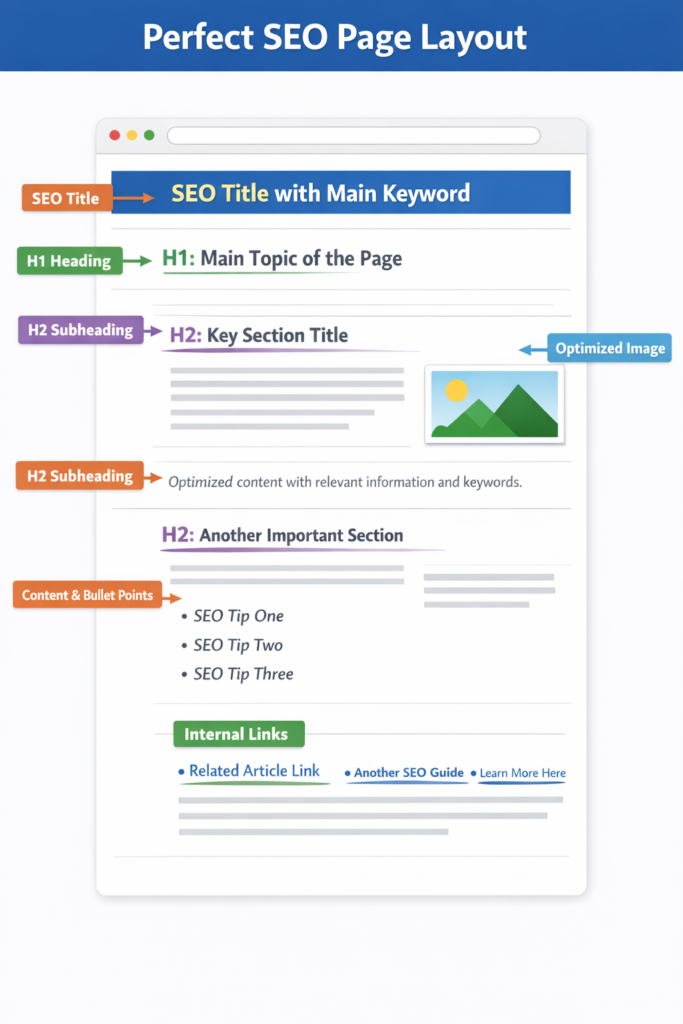
Why On-Page SEO Matters
Great content cannot rank on its own. Search engine crawlers need specific clues to understand context, relevance, and value.
On-page SEO gives search engines exactly what they need to process your page. When you optimize your content properly, you make it visible to search algorithms. You make it understandable for AI engines like ChatGPT and Gemini. Most importantly, you make it engaging for human readers, which lowers your bounce rate and builds trust.
Without these specific on-page signals, competitors with worse content but better optimization will steal your traffic.
How On-Page SEO Works
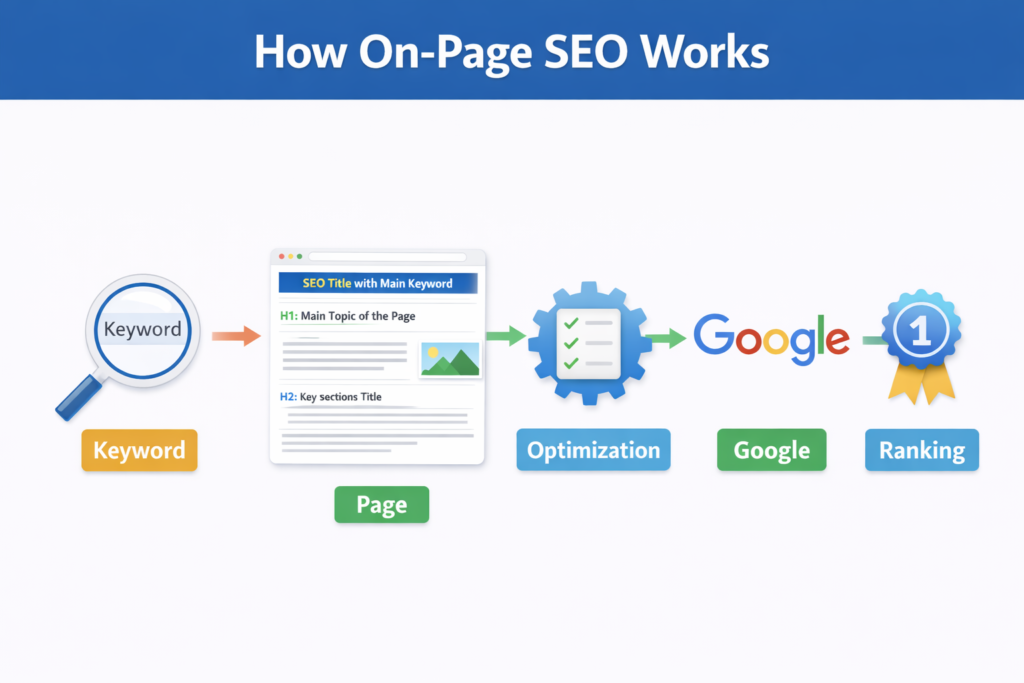
On-page SEO follows a very specific chain of events. You must master this flow to see results:
Keyword → Content → Structure → Ranking
First, you target a specific keyword that users search for. Next, you build valuable content around that exact keyword. Then, you apply proper structure using headings, URLs, and internal links. Finally, search engines process this structured content and reward you with higher rankings.
If you break any link in this chain, your page will struggle to rank.
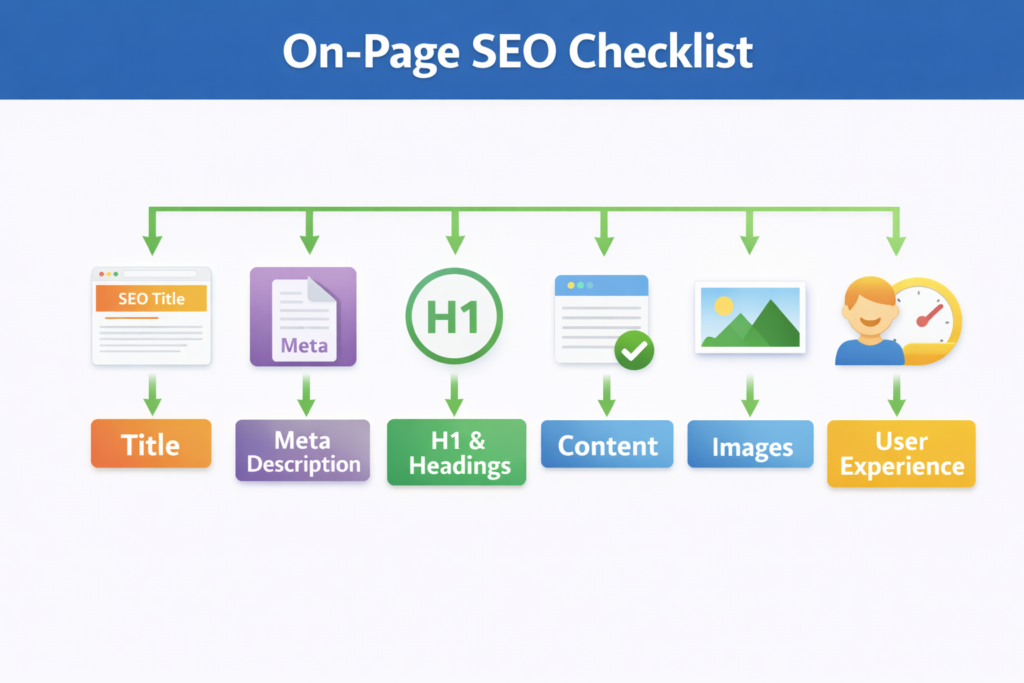
The Ultimate On-Page SEO Checklist
Keep this checklist open every time you publish a new page. If you miss these elements, you leave traffic on the table.
1. Title Optimization
Your title tag is the clickable blue link in search results. It carries massive weight for ranking and click-through rates. You must place your exact target keyword as close to the beginning of the title as possible. Keep the title under 60 characters so Google does not cut it off. Make it compelling so users actually want to click.
2. Headings (H1, H2, H3)
Headings organize your text logically. Use only one H1 tag per page, and make sure it includes your primary keyword. Use H2 tags for your main sections and H3 tags for smaller subsections. This hierarchy helps search engines scan your page and understand its core topics instantly.
3. Keyword Placement
Place your main keyword in the first 100 words of your page. Search engines look at the top of a page to figure out what it covers. Sprinkle secondary keywords naturally throughout the rest of the text. Do not force keywords where they do not belong.
4. Content Clarity
Write for eighth-graders. Use short sentences and simple words. Break your text into small paragraphs of three to four sentences maximum. Clear, concise content keeps users reading longer, which tells search engines your page is highly valuable.
5. Internal Linking
Use internal links with natural anchor text to guide users to related topics, such as keyword research strategies, technical SEO fundamentals, and effective SEO tools. Not only do these links help users navigate your site, but they also distribute ranking power from authoritative pages to new content. Aim for anchor text that describes exactly what the linked page covers so both users and search engines get maximum context.
6. Image Optimization
Search engines cannot see images, so you must explain them. Name your image files descriptively before uploading them (e.g., “blue-running-shoes.jpg”). Add alt text to every image describing what it shows. Compress your image files so they load quickly.
7. URL Structure
Keep your URLs incredibly short and clear. Include your main keyword and remove stop words like “and,” “the,” or “in.” A clean URL looks trustworthy to users and helps search engines process the page topic easily.
8. User Experience (UX)
Your page must load fast and look perfect on mobile phones. Remove annoying pop-ups that block the main content. Make your text easy to read with dark fonts on a light background. Good user experience directly impacts how high you rank.
4-Step On-Page SEO Execution Process
Stop guessing and start executing. Follow this exact workflow to optimize every page.
Step 1: Execute Keyword Research
Find out what your audience actually types into search engines. Target long-tail keywords that show high intent. A long-tail keyword like “how to fix a leaky kitchen sink” converts much better than a broad term like “plumbing.”
Step 2: Match Search Intent
Look at the current top-ranking pages for your keyword. Do users want a tutorial, a list of products, or a simple definition? You must create the exact type of content they expect to find. If users want a step-by-step guide, do not write a massive opinion piece.
Step 3: Create Scannable Content
Write content that answers user questions directly. Use bullet points, bold text, and numbered lists to make the page easy to scan. Give the reader exactly what they want without making them dig through massive walls of text.
Step 4: Apply Optimizations
Go back through your draft and inject your keywords into titles, meta descriptions, and headings. Add your internal links. Compress your images and apply your alt text. Run a final check on page loading speed before hitting publish.
Common On-Page SEO Mistakes to Avoid
Beginners ruin their chances of ranking by making these exact errors. Do not let these happen to you.
- Keyword Stuffing: Repeating the same keyword 50 times will trigger spam filters and ruin your rankings.
- Ignoring Meta Descriptions: While they do not directly impact rankings, empty descriptions hurt your click-through rate.
- Formatting Poorly: Massive blocks of text scare readers away instantly.
- Publishing Slow Pages: If your page takes longer than three seconds to load, users will hit the back button.
- Leaving Broken Links: Sending users to dead pages destroys their trust and annoys search engine crawlers.
On-Page SEO for AI (GEO)
Generative Engine Optimization (GEO) is the practice of optimizing content for AI platforms like ChatGPT and Google’s AI Overviews.
AI reads content differently than traditional search algorithms. AI engines look for direct, factual answers to specific questions. They prioritize extreme clarity and logical flow. If your content rambles, AI will ignore it.
To win at GEO, you must structure your content meticulously. Use clear headings that ask a question, and answer that question directly in the very next sentence. Provide lists, tables, and structured data whenever possible. AI systems summarize information, so you must provide content that is easy to summarize.
Keep Optimizing Your Site
On-page SEO is only one part of the puzzle. Expand your strategy by exploring these core concepts:
- [Read our Complete Keyword Research Guide]
- [Learn the Technical SEO Basics]
- [Discover the Best SEO Tools for Beginners]
Next Steps
You now have the exact blueprint to execute on-page SEO. Open your most important web page right now and run it through the checklist provided above. Fix your headings, compress your images, and clarify your text. Better rankings start with taking immediate action.
Mini Summary:
On-page SEO is not just about optimization — it’s about making your content understandable, well-structured, and actionable for both users and AI.
Learn more about SEO , Click here.
FAQ
On-page SEO involves optimizing the elements on your website—like content, titles, and headings—so search engines can understand and rank your pages.
It acts as the translator between your content and search engines. Proper optimization ensures platforms index your site correctly and show it to the right users.
Place your target keyword near the front of the title. Keep the total length under 60 characters and make the phrasing catchy to encourage clicks.
Internal links help users navigate your site, distribute ranking power among your pages, and establish a clear topical hierarchy for search engines.
Clear structure, direct answers, and logical formatting allow AI models to process, verify, and cite your content easily.