
Keyword Research
Keyword Research: The Complete Guide to Finding Profitable Keywords for SEO
Imagine trying to find a specific book in a library with no catalogue system. You could wander for hours, guessing which aisle or shelf might hold what you need. This is what navigating the internet without Search Engine Optimization (SEO) feels like for your customers. And at the heart of every effective SEO strategy is a powerful, often misunderstood, discipline: keyword research.
Getting your keyword research right is the difference between shouting into the void and having a meaningful conversation with your ideal audience. It’s the foundational step that informs your entire digital marketing plan, from content creation and on-page SEO to your paid advertising campaigns. Without a solid keyword research process, you are simply guessing what people want.
This comprehensive guide will demystify the art and science of keyword research. We will take you from the fundamental principles to advanced techniques used by industry professionals. You will learn not just how to do keyword research, but how to think strategically about the words and phrases that connect your business to the people who need you most. Whether you’re a complete beginner or looking to refine your skills, this is your complete roadmap to finding profitable keywords that drive traffic, generate leads, and grow your business.
Table of Contents
What is Keyword Research?
Keyword research is the process of finding and analysing the words and phrases people use when they search for information, products, or services in search engines like Google. It’s about understanding the language of your target audience to create content and marketing strategies that align directly with their needs and queries. At its core, SEO keyword research is a form of market research for the digital age.
Think of it as the bridge between your website and your potential customers. By understanding the specific terms (keywords) they type into the search bar, you can optimise your website’s pages to appear in the search results for those queries. This is the cornerstone of attracting relevant, high-quality traffic to your site.
The goal isn’t just to find any keywords; it’s to uncover opportunities. This involves looking at several factors:
- Relevance: How closely does the keyword match the content, product, or service you offer?
- Search Volume: How many people are searching for this keyword each month?
- Competition: How difficult will it be to rank on the first page of search results for this keyword?
- Search Intent: What is the user’s underlying goal when they search for this keyword? Are they looking to learn, compare, or buy?
A successful keyword research strategy balances these elements to identify terms that can bring valuable traffic to your website. It’s a critical component of any robust SEO plan, influencing everything from the topics you write about to the structure of your website. Without it, your SEO efforts lack direction and focus.
Why Keyword Research is Important for SEO
Keyword research is far more than just a box to tick on your SEO checklist; it is the strategic foundation upon which successful digital marketing campaigns are built. Neglecting this crucial step is like setting sail without a map or a compass. You might move, but you will not reach your desired destination.
A solid keyword research strategy provides direction and purpose for all your SEO efforts. It ensures that every piece of content you create and every optimisation you perform is targeted, data-driven, and aligned with your business objectives. Let’s explore the fundamental reasons why keyword research for SEO is non-negotiable.
It Uncovers Your Audience’s Language and Needs
At its heart, keyword research is a deep dive into the mind of your target customer. It reveals the exact words and phrases they use when they are looking for solutions that your business provides. This insight is marketing gold.
When you understand their language, you can:
- Speak Directly to Them: You can create content and copy that resonates on a personal level, using the same terminology they do. This builds trust and shows that you understand their problems.
- Identify Pain Points: The questions people ask and the problems they describe in search queries tell you exactly what challenges they face. Your content can then be tailored to solve these specific issues.
- Discover New Opportunities: A thorough keyword analysis can reveal adjacent topics or services your audience is interested in, opening up new content avenues or even business ventures you hadn’t considered.
For example, a company selling accounting software might assume customers search for “accounting software.” But keyword research could reveal they are also searching for “how to automate invoicing,” “small business tax tips,” and “making tax digital compliance.” This information allows the company to create helpful content that captures a much wider, yet still highly relevant, audience.
It Drives High-Quality, Targeted Traffic
The goal of SEO is not just to get more traffic; it is to get the right traffic. Keyword research is the mechanism that filters out irrelevant visitors and attracts users who are genuinely interested in what you offer.
By targeting specific keywords, you are effectively raising your hand and saying, “I have the answer to your specific query.” When a user lands on your site from a relevant search, they are far more likely to engage with your content, convert into a lead, or make a purchase. This is because there is a strong alignment between their intent and the information you provide.
Consider the difference between ranking for “shoes” versus “men’s waterproof hiking boots size 10.” The first term is broad and attracts a wide range of searchers with different needs. The second, a classic long-tail keyword, attracts a user who knows exactly what they want. While the search volume is lower, the traffic from that specific search is significantly more valuable and has a much higher probability of converting.
It Provides a Roadmap for Your Content Strategy
Content creation without keyword research is pure guesswork. You might write what you think your audience wants to read, but the data will tell you what they are actually searching for.
A comprehensive keyword research process forms the backbone of your content calendar. It helps you:
- Prioritise Topics: By analysing search volume and competition, you can decide which topics to tackle first to get the best return on your content creation efforts.
- Build Topic Clusters: You can identify a central “pillar” topic and several related “cluster” topics, creating a web of interlinked content that establishes your website as an authority on a subject. This structure is highly favoured by search engines.
- Optimise Existing Content: Keyword analysis isn’t just for new content. It can identify gaps in your existing pages, revealing opportunities to update and optimise them for better performance.
- Answer Specific Questions: Tools and techniques in keyword research can uncover the exact questions people are asking. By creating content that directly answers these questions (e.g., in a blog post or FAQ section), you position yourself as a helpful expert and can even capture featured snippets in search results.
Ultimately, keyword research ensures that every hour spent on content creation is an investment with a clear, strategic purpose aimed at meeting a proven demand.
It Boosts Your Search Engine Rankings
Search engines like Google have one primary goal: to provide their users with the most relevant and high-quality results for their queries. When you conduct thorough keyword research and create content that aligns perfectly with specific keywords, you are making Google’s job easier.
By using the right keywords in your titles, headings, body text, and meta descriptions, you send clear signals to search engine crawlers about what your page is about. This process, part of on-page SEO, helps search engines correctly index and rank your content for the appropriate queries.
Without this focus, your content can be ambiguous. Google may struggle to understand its primary topic, causing it to rank for irrelevant terms or fail to rank for the terms that matter. A focused keyword research strategy is the most direct way to communicate your relevance to search engines, which is the key to improving visibility and climbing the search engine results pages (SERPs).
Types of Keywords: Understanding the Building Blocks of SEO
To master keyword research, you need to understand that not all keywords are created equal. Different types of keywords serve different purposes in your SEO strategy, attract different kinds of traffic, and require unique approaches to content creation.
Understanding the nuances between these types is critical. A strategy that relies solely on one type—like high-volume short terms—will likely result in frustration and wasted resources. Conversely, a balanced approach that leverages various keyword types will help you capture traffic at every stage of the customer journey.
Let’s break down the primary categories of keywords you will encounter during your keyword analysis.
Keyword Length: Short-Tail vs. Long-Tail
One of the most fundamental ways to categorise keywords is by their length and specificity.
1. Short-Tail Keywords (Head Terms)
Short-tail keywords, often called “head terms,” typically consist of one to two words. They are broad, general, and usually have very high search volumes.
- Examples: “Shoes,” “SEO,” “Marketing,” “Pizza.”
- Characteristics: High traffic potential, extreme competition, low conversion rate, vague intent.
While the search volume for these terms is attractive, ranking for them is often incredibly difficult, especially for new websites. Furthermore, the intent is often unclear. If someone searches for “shoes,” are they looking to buy running shoes, repair old heels, or learn about the history of footwear? Because the intent is scattered, conversion rates for short-tail keywords tend to be lower.
2. Middle-Tail Keywords (Body Keywords)
These usually consist of two to three words and sit in the sweet spot between broad head terms and hyper-specific long-tail phrases.
- Examples: “Running shoes,” “SEO tools,” “Email marketing software.”
- Characteristics: Moderate search volume, moderate competition, clearer intent than head terms.
These keywords offer a balance. They are more specific than head terms, meaning the traffic is more qualified, but they still carry enough search volume to be worth the effort of targeting.
3. Long-Tail Keywords
Long-tail keywords generally contain three or more words. They are highly specific phrases that often mimic how people actually speak or ask questions.
- Examples: “Best waterproof running shoes for men,” “free keyword research tools for beginners,” “how to do keyword research for ecommerce.”
- Characteristics: Low search volume individually, lower competition, high conversion rate, very specific intent.
Don’t let the lower search volume fool you. Collectively, long-tail searches make up the vast majority of all Google searches. Because they are so specific, the user knows exactly what they want. If you can provide the answer or product they are searching for, they are highly likely to convert. Integrating long tail keywords is one of the most effective keyword research techniques for new sites looking to gain traction quickly.
Search Intent Keywords: Categorising by User Goal
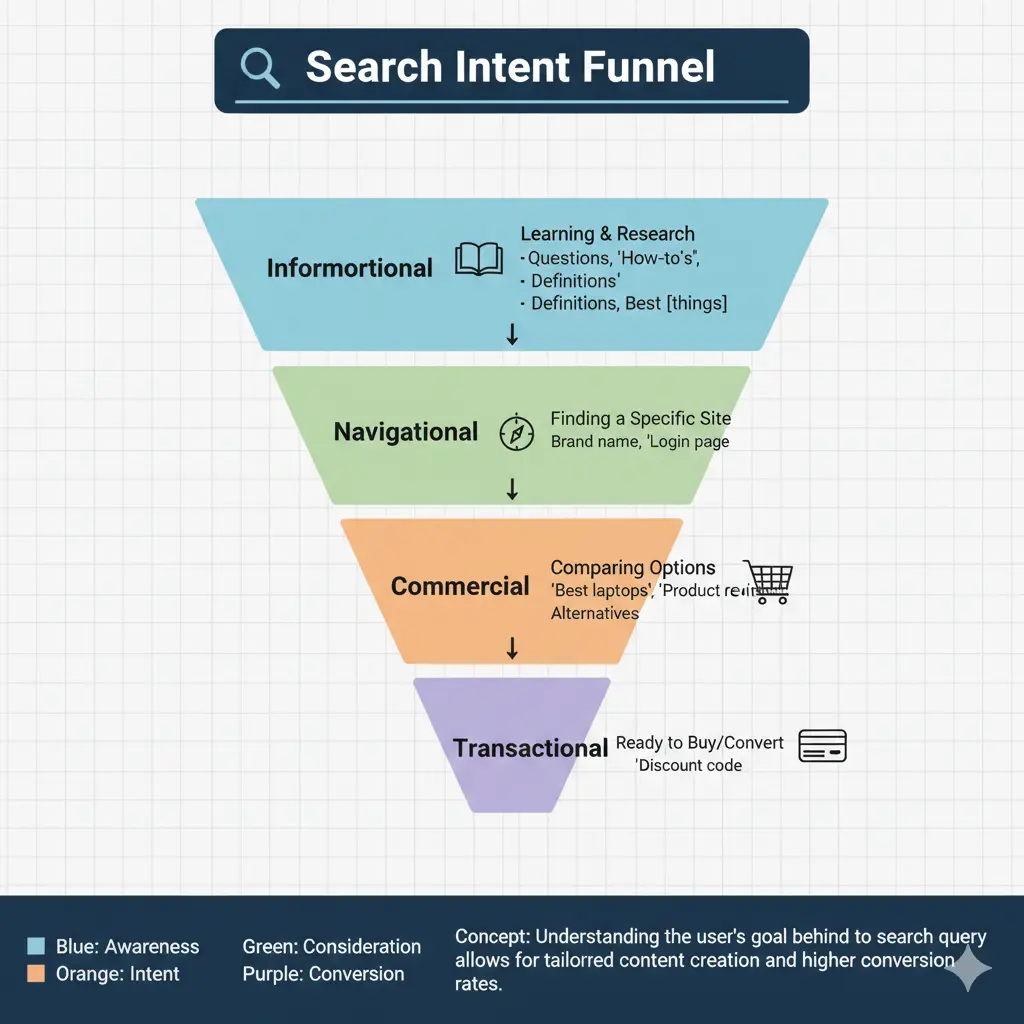
Modern SEO is less about matching strings of text and more about matching intent. Google’s algorithms are now sophisticated enough to understand why a user is searching. Categorising keywords by intent is crucial for creating content that satisfies the user’s needs.
1. Informational Keywords
These are searches performed by users looking for an answer to a specific question or general information. They are at the top of the buying funnel (Awareness stage).
- Intent: “I want to know…” or “I want to learn…”
- Signal Words: How, what, why, when, guide, tutorial, tips, examples.
- Examples: “What is keyword research,” “how to bake a cake,” “history of Rome.”
Strategy: Target these with educational blog posts, comprehensive guides (like this one), and “how-to” videos. The goal is to build authority and trust, not necessarily to sell immediately.
2. Navigational Keywords
These searches occur when a user is trying to find a specific website or page. They already know the brand name but need a quick way to get there.
- Intent: “I want to go to…”
- Examples: “SEOJerry blog,” “Facebook login,” “Apple support.”
Strategy: You generally only rank for navigational keywords related to your own brand. Ensure your technical SEO is sound so users can easily find your home page, login page, or contact page when they search for your brand specifically.
3. Commercial Keywords (Commercial Investigation)
These users are in the consideration phase. They know they have a problem and are investigating potential solutions. They are comparing products or services but aren’t quite ready to pull out their credit card yet.
- Intent: “I want to compare…” or “I want to find the best…”
- Signal Words: Best, top, review, comparison, vs, attributes (e.g., “cheap,” “fastest”).
- Examples: “Best keyword research tools,” “Mailchimp vs ConvertKit,” “top rated running shoes.”
Strategy: Create comparison pages, “best of” listicles, and detailed reviews. This content helps the user evaluate their options and positions your solution as a strong contender.
4. Transactional Keywords
These are the “money keywords.” The user is ready to buy or take a specific action. They have done their research and are at the bottom of the funnel (Conversion stage).
- Intent: “I want to buy…” or “I want to sign up…”
- Signal Words: Buy, price, coupon, discount, deal, for sale, order, download.
- Examples: “Buy Nike Air Max,” “SEO audit pricing,” “download keyword tool.”
Strategy: Target these with highly optimised product pages, landing pages, and service pages. The path to conversion should be frictionless.
Why You Need a Mix
An effective keyword research strategy doesn’t focus on just one type.
- If you only target informational keywords, you will get lots of traffic but few sales.
- If you only target transactional keywords, you will struggle to build brand awareness and will fight fierce competition for every click.
The best approach is to build a content funnel. Use informational keywords and long tail keywords to attract a broad audience and build trust. Use commercial keywords to nurture that interest. Finally, use transactional keywords to capture the value you’ve created. By mapping these search intent keywords to specific stages of your buyer’s journey, you ensure that you are meeting your audience with the right message at exactly the right time.
Search Intent: The 'Why' Behind Every Keyword
If keyword research tells you what people are searching for, search intent tells you why. In modern SEO, understanding search intent is arguably more important than focusing on the exact keyword itself. It is the practice of deciphering the underlying goal a user has when they type a query into a search engine.
Google’s primary objective is to satisfy its users by providing the most relevant answer to their query in the shortest amount of time. Its algorithms have become incredibly sophisticated at interpreting the intent behind a search. To succeed in SEO, you must align your content with this intent. Creating a page about the history of running shoes will never rank for the query “buy running shoes,” no matter how well-optimised it is, because it fails to match the user’s transactional intent.
A successful keyword research strategy is therefore incomplete without a deep analysis of search intent. It is the crucial layer of insight that transforms a simple list of keywords into a powerful content plan that meets user needs and is rewarded by search engines.
Why is Search Intent Critical for Keyword Research?
Ignoring search intent is a common reason why many SEO campaigns fail. You can spend months trying to rank for a keyword, only to find that your content format is completely wrong for what users and Google expect to see.
- It Determines Content Type: Intent dictates whether you should create a blog post, a product page, a category page, a comparison review, or a video tutorial. Getting this wrong leads to high bounce rates and poor rankings.
- It Improves User Experience: When your content directly addresses the user’s underlying need, they are more likely to stay on your page, engage with your content, and view your brand as a helpful authority. This sends positive user engagement signals to Google.
- It Increases Conversion Rates: By creating content for each stage of the buyer’s journey (informational, commercial, transactional), you can guide users from initial awareness to final purchase. Matching intent means you deliver the right message at the right time.
It Is Essential for Ranking: Google analyses the top-ranking pages for a given query to understand what type of content best satisfies user intent. If the top 10 results are all e-commerce category pages, your blog post is unlikely to break through. You must match the dominant intent of the search engine results page (SERP).
How to Identify Search Intent
Identifying the intent behind a keyword is a core part of the keyword research process. While it gets easier with experience, there are two primary methods you can use.
1. Analyse Keyword Modifiers
The words people add to their core search term are strong indicators of their intent. As we discussed in the “Types of Keywords” section, these modifiers act as signposts.
- Informational: how, what, why, guide, tips, learn, tutorial, example
- Commercial: best, top, review, comparison, vs, alternative
- Transactional: buy, price, coupon, sale, discount, order, near me
- Navigational: [brand name], login, contact, [brand name] blog
When you see these words in your keyword list, you can immediately categorise them and begin to understand the user’s goal.
2. Analyse the SERPs
This is the most reliable method and a non-negotiable step in any professional keyword research workflow. Google has already done the hard work for you. By showing you the top-ranking pages, it is telling you exactly what kind of content it believes satisfies the intent for that query.
To do this, simply perform a search for your target keyword in an incognito window and ask yourself:
- What types of pages are ranking? Are they blog posts, product pages, listicles, news articles, or forum discussions?
- What is the dominant content format? Are they “how-to” guides, “best of” roundups, or direct e-commerce pages?
- What titles and meta descriptions are used? Do they promise an answer, a comparison, or a product?
- Are there special SERP features? Do you see a Featured Snippet (often informational), a “People Also Ask” box (informational), or a shopping carousel (transactional)?
For example, if you search for “best running shoes,” you will likely see a list of articles from running magazines and review sites titled “The 10 Best Running Shoes of 2026.” This tells you the intent is commercial investigation. To rank, you would need to create a similar, but better, listicle-style review page.
Putting Search Intent into Practice
Integrating search intent analysis into your keyword research strategy is a game-changer. It shifts your focus from simply collecting keywords to understanding the people behind them.
Before finalising a keyword for a piece of content, always take a moment to perform a SERP analysis. Identify the dominant intent and the prevailing content format. If you can create a piece of content that aligns with that intent and provides more value than what is currently ranking, you have found a true SEO opportunity. This is how you move beyond basic keyword research and start creating content that consistently performs.
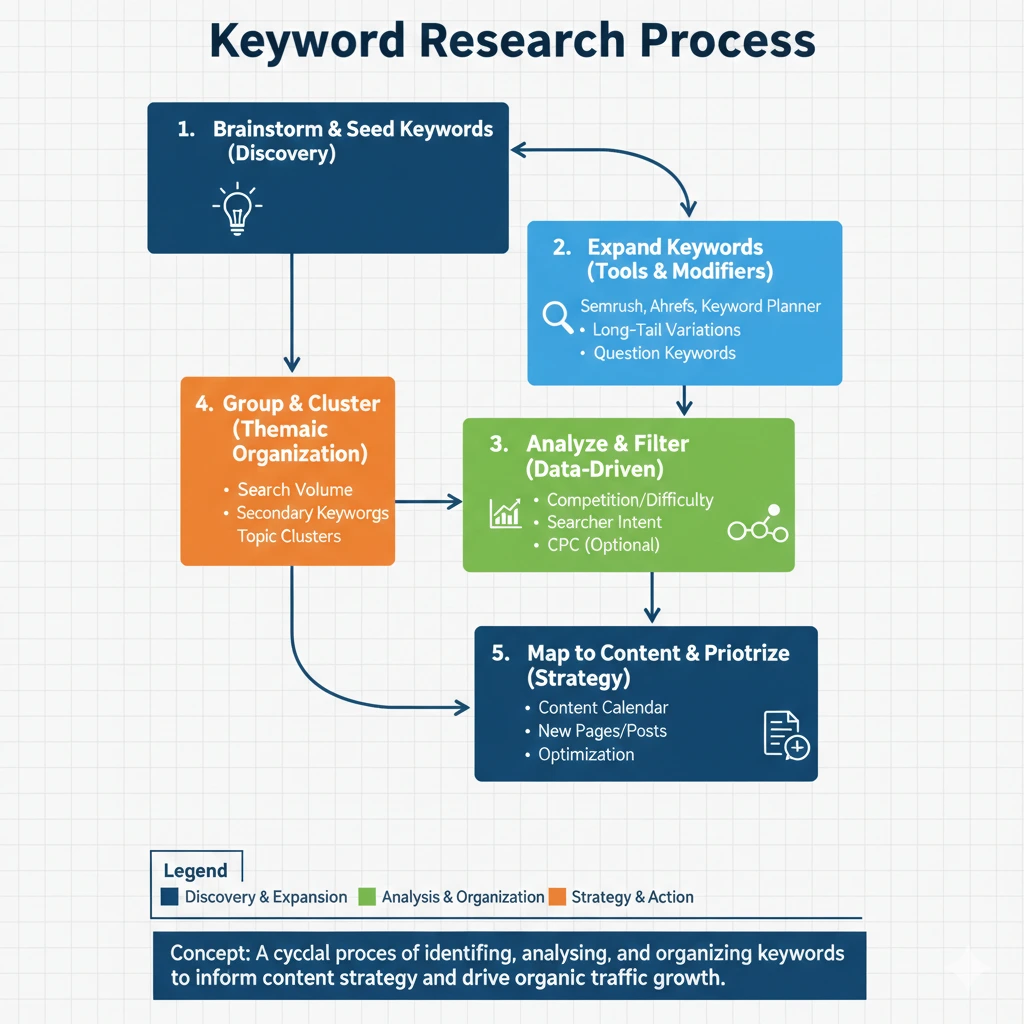
Keyword Research Process Step-by-Step
Now that you understand the fundamental concepts of search intent and keyword types, it is time to put that knowledge into action. Knowing the theory is essential, but knowing how to do keyword research effectively is what separates successful SEO campaigns from those that struggle to gain traction.
This section outlines a practical, repeatable workflow. Whether you are launching a new blog or optimising a large e-commerce site, this keyword research process will help you uncover opportunities that drive real business results.
Step 1: Define Your Goals and Core Topics
Before opening any tools, you need to understand what you are trying to achieve. Are you looking to drive sales for a specific product, or are you trying to build brand awareness through educational content? Your goals dictate your keyword choices.
Start by identifying the broad topics relevant to your business. These are the “buckets” that your keywords will fall into.
- For a bakery: Topics might include “wedding cakes,” “gluten-free baking,” “pastry classes,” and “birthday cupcakes.”
- For a digital agency: Topics might include “SEO services,” “web design,” “content marketing,” and “social media management.”
By defining these buckets first, you ensure your research remains focused and organised.
Step 2: Brainstorm Your 'Seed' Keywords
Seed keywords are the foundation of your research. They are the initial terms that you will feed into keyword research tools to generate hundreds of other ideas.
Think like your customer. If you were looking for your product or service, what would you type into Google?
- Product names: “running shoes,” “crm software”
- Problems: “how to lose weight,” “fix leaky tap”
- Competitor names: “Adidas alternatives,” “Salesforce vs HubSpot”
Don’t worry about search volume or difficulty yet. Just write down as many relevant terms as you can think of. These seeds will grow into your final keyword list.
Step 3: Expand Your List Using Keyword Research Tools
You cannot rely on brainstorming alone; you need data. This is where keyword research tools come into play. These platforms analyse vast databases of search queries to show you what people are actually searching for, rather than what you think they are searching for.
You can use paid tools like Ahrefs, Semrush, or Moz, or start with free options like Google Keyword Planner.
Action:
Enter your seed keywords into your chosen tool. The tool will generate a list of related keywords, questions, and phrase matches. For example, if you enter “vegan recipes,” the tool might suggest:
- “easy vegan dinner recipes”
- “vegan recipes for beginners”
- “high protein vegan meals”
- “vegan dessert ideas”
This step is about expansion. Cast a wide net to capture as many potential keyword research techniques and variations as possible. You might also want to explore how AI SEO tools can automate this discovery phase, finding patterns that traditional tools might miss.
Step 4: Analyse Search Volume and Competition
Now you have a massive list of potential keywords. The next step is to filter them based on two critical metrics: Search Volume and Keyword Difficulty (KD).
- Search Volume: This tells you the average number of monthly searches for a keyword. High volume means more potential traffic, but usually more competition.
- Keyword Difficulty (KD): Most tools provide a score (usually 0-100) estimating how hard it is to rank for a term. A higher score means you will need more authority and backlinks to compete.
The Sweet Spot:
If you are a new website, targeting keywords with massive volume and high KD (like “credit cards”) is often a wasted effort. Instead, look for the “low hanging fruit”: keywords with decent search volume but lower competition. These are often long-tail keywords that are easier to dominate.
Step 5: Verify Search Intent
As discussed in the previous section, intent is king. Before you commit to a keyword, you must verify that the content you plan to create matches what Google wants to show.
Go through your filtered list and check the intent for each keyword.
- Keyword: “buy coffee machine” -> Intent: Transactional (Needs a product page).
- Keyword: “how to clean coffee machine” -> Intent: Informational (Needs a blog post).
If you try to rank a blog post for “buy coffee machine,” you will likely fail because the user (and Google) wants a shop, not an article. Discard any keywords where the intent does not align with your business goals or content capabilities.
Step 6: Identify 'Zero-Search' Volume Opportunities
Don’t automatically delete keywords just because a tool says they have zero search volume. Tools are estimates, not gospel.
Many highly specific long-tail queries register as “zero volume” simply because the data sample is small. However, these keywords often have incredibly high conversion rates because the user intent is so specific. If a keyword is highly relevant to your service and you know your customers ask about it, keep it. It might only bring in 10 visitors a month, but if 5 of them become clients, it is highly valuable.
Step 7: Finalise and Map Your Keywords
The final step in this keyword research strategy is to organise your selected keywords into a plan. You should not just have a spreadsheet of random words; you need a content map.
Group related keywords together. For example, “best running shoes,” “top rated running trainers,” and “running shoe reviews” likely all have the same intent and can be targeted on a single page.
Create a Keyword Map:
- Page Topic: The main subject (e.g., Best Running Shoes).
- Primary Keyword: The main term you want to rank for (highest volume).
- Secondary Keywords: Related terms to include in subheadings and body text.
- URL Slug: The proposed web address.
This map becomes your to-do list for content creation or on-page optimisation. By following this structured process, you ensure that every piece of content you produce has a clear purpose and a fighting chance of ranking in the search results.
Competitor Keyword Research: How to Ethically Steal What Works
You do not need to reinvent the wheel with your keyword research. Your competitors have already spent significant time, money, and effort figuring out which keywords drive traffic and conversions in your niche. By analysing their strategies, you can gain a massive shortcut, uncover proven opportunities, and avoid the painful process of trial and error. This is the power of competitor keyword research.
It is a crucial discipline that involves systematically identifying the keywords your competitors are ranking for, but that you are not. This process provides invaluable insights into market demand, content strategies that work, and gaps you can exploit to gain a competitive advantage. It is one of the most effective ways to refine and expand your own keyword research strategy.
Why is Competitor Keyword Research a Must-Do?
Conducting a thorough competitor analysis is not just about copying what others are doing; it is about learning from their successes and failures to make smarter decisions.
- It Uncovers Proven Keywords: Your competitors are ranking for certain terms for a reason—they attract valuable traffic. This helps you validate keyword ideas and prioritise terms that are already proven to work in your industry.
- It Reveals Content Gaps: You might find keywords your competitors rank for that you have not even considered. These “keyword gaps” represent opportunities to create new content and capture a share of their audience.
- It Helps You Benchmark Performance: By understanding which keywords your top competitors target and how well they rank, you can set realistic goals and track your progress against a clear benchmark.
- It Informs Your Content Strategy: Analysing the top-ranking pages for your competitors’ keywords shows you exactly what kind of content (e.g., blog posts, guides, tools) resonates with your target audience and with Google.
It Highlights ‘Low-Hanging Fruit’: You can often find keywords where your competitors are ranking but their content is weak, outdated, or not fully optimised. These are prime opportunities for you to create something better and steal the ranking.
A Step-by-Step Guide to Competitor Keyword Research
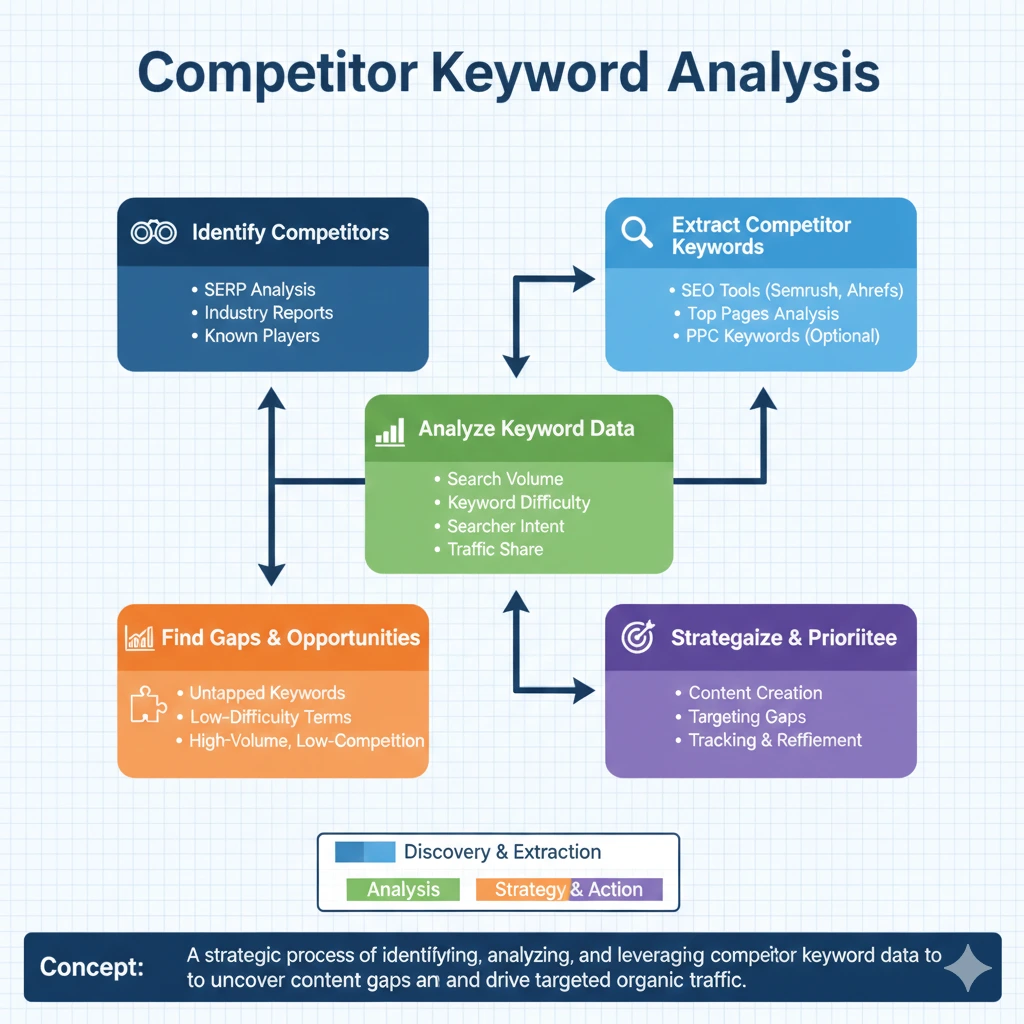
This process can be broken down into a few manageable steps. By following this workflow, you can turn your competitors’ hard work into your strategic advantage.
Step 1: Identify Your True SEO Competitors
First, you need to know who you are up against. Your business competitors are not always the same as your “SEO competitors”. A local bakery’s business competitor might be the shop across the street, but their SEO competitor could be a national food blog that ranks for all the recipe keywords.
You are looking for the domains that consistently appear in the search results for the keywords you want to rank for.
How to find them:
- Brainstorm: List the direct business competitors you already know.
- Google Search: Search for your most important seed keywords and see which domains repeatedly show up on the first page.
- Use Keyword Research Tools: Most professional SEO tools (like Ahrefs or Semrush) have a feature where you can enter your domain, and it will identify your top organic search competitors based on keyword overlap.
Aim for a list of 3-5 of your most relevant and formidable SEO competitors.
Step 2: Analyse Their Top Keywords with SEO Tools
This is where you leverage keyword research tools to do the heavy lifting. The goal is to extract the keywords that are driving the most organic traffic to your competitors’ websites.
The most common method is to use a “Content Gap” or “Keyword Gap” analysis feature.
The Process:
- Enter your domain into the tool.
- Enter the domains of your 3-5 competitors.
- Run the analysis.
The tool will generate a report showing you several key insights, but the most valuable one is a list of keywords that one or more of your competitors rank for, but you do not.
This report is a goldmine. You now have a data-driven list of topics that your target audience is searching for and that your competitors are successfully using to attract them.
Step 3: Dig into Their Top-Performing Pages
Keywords are only half the story. You also need to understand the content that is successfully ranking for those keywords. Most SEO tools allow you to see the “Top Pages” for any domain, showing you which URLs receive the most organic traffic.
Action:
- Enter a competitor’s domain into the tool’s site analysis feature.
- Navigate to the “Top Pages” or “Top Content” report.
- Analyse the pages that are driving the most traffic.
Look for patterns. Are their top pages long-form blog posts? Are they product category pages? Are they free tools or calculators? This analysis tells you what type of content you need to create to compete effectively. For example, if your competitor’s top page is a 4,000-word guide on “how to choose a coffee machine,” a simple 500-word blog post from you will not be enough to outrank them.
Step 4: Find and Prioritise Your Opportunities
You will now have a large list of potential keywords from your gap analysis. It is time to filter and prioritise. Look for the sweet spot:
- High Relevance: The keyword is directly related to a product or service you offer.
- Decent Search Volume: The keyword has enough search traffic to be worth the effort.
- Manageable Keyword Difficulty: The term is not so competitive that you have no chance of ranking.
Focus on keywords where the intent aligns with your business goals. A high-volume informational keyword is great for a blog post to build authority, while a transactional keyword is perfect for a new service or product page.
Step 5: Create Superior Content
The final step is to take what you have learned and execute. For the prioritised keywords you have identified, the goal is not to simply copy what your competitor did. The goal is to create something significantly better.
Analyse their ranking page and ask yourself:
- Can I make my content more comprehensive or in-depth?
- Can I provide more up-to-date information or data?
- Can I create a better user experience with better design, images, or videos?
- Can I explain the topic more clearly for a beginner?
By leveraging competitor keyword research, you are not starting from scratch. You are starting with a proven roadmap. Your job is to take that map and draw a better, faster, and more valuable route for the user to follow. Do that, and you will not only catch up to your competitors—you will surpass them.
How Professionals Do Keyword Research
While the basic steps of brainstorming and checking search volume are a good start, professional SEOs go much deeper. To rank in competitive niches, you cannot simply rely on surface-level data. You need a keyword research strategy that is nuanced, predictive, and deeply aligned with user psychology.
Here is how the experts elevate their keyword research from a basic administrative task to a high-level strategic advantage.
1. Moving Beyond Volume: The 'Topic Cluster' Approach
Beginners often look for single keywords to target with single blog posts. Professionals, however, think in terms of ecosystems. They use the “Topic Cluster” model (or Hub and Spoke model).
Instead of finding one keyword like “best protein powder,” a professional will identify a core “Pillar” topic (e.g., “Protein Powder Guide”) and then map out dozens of supporting “Cluster” keywords (e.g., “whey vs casein,” “protein powder for weight loss,” “is plant protein better”).
Why this works: This approach signals to search engines that you are a comprehensive authority on the entire subject, not just a lucky guesser for one keyword. It also creates a powerful internal linking structure that passes authority between pages.
2. Leveraging SERP Feature Opportunities
A professional keyword analysis involves looking at the Search Engine Results Page (SERP) not just as a list of links, but as a battlefield of features. Google now includes “People Also Ask” (PAA) boxes, Featured Snippets, Local Packs, and Video Carousels.
Experts specifically hunt for keywords that trigger these features because they offer a shortcut to visibility.
- Featured Snippet Hunting: If a keyword triggers a featured snippet (position zero), professionals will structure their content specifically to win it. They might add a concise definition (40-60 words) at the top of their page or use a clear table format, increasing the chances of Google extracting that content.
PAA Mining: The “People Also Ask” box is a goldmine for long-tail questions. Professionals scrape these questions to build comprehensive FAQ sections that directly answer what users are asking, often capturing traffic that competitors miss.
3. Integrating AI for Keyword Discovery
The rise of artificial intelligence has revolutionised how we approach SEO. AI keyword research allows professionals to process vast amounts of data and uncover semantic relationships that traditional tools might miss.
Tools powered by Large Language Models (LLMs) can help you:
- Cluster Keywords Automatically: Instead of manually sorting thousands of rows in a spreadsheet, AI can group keywords by intent and topic in seconds.
- Predict Emerging Trends: AI can analyse patterns to suggest topics that are gaining momentum before they show high search volume in traditional keyword research tools.
- Understand Semantic Relevance: AI helps identify “LSI” (Latent Semantic Indexing) keywords—related terms that help search engines understand the context of your content. For example, if you are writing about “Apple,” using words like “pie,” “fruit,” and “orchard” tells the AI you mean the fruit, not the tech company.
By integrating AI SEO tactics, professionals can build content briefs that are mathematically more likely to satisfy the search algorithm.
4. Mapping Keywords to the Buyer’s Journey
Amateurs target keywords; professionals target stages of intent. A sophisticated keyword research strategy maps every single term to a specific phase of the customer funnel.
- Awareness: “What is CRM?” (Educational blog post)
- Consideration: “Salesforce vs HubSpot features” (Comparison guide)
- Decision: “HubSpot discount code” (Landing page)
Professionals ensure they have coverage across all stages. They don’t just chase the high-volume traffic at the top; they ensure they have the “money pages” ready to catch the users at the bottom. This prevents the common problem of having high traffic but low conversions.
5. Analysing 'Time to Rank' and ROI
Finally, professionals are realistic about resources. They don’t just ask “Can we rank for this?” they ask “How long will it take, and is it worth it?”
They use metrics like Keyword Difficulty (KD) alongside their own domain authority to estimate “Time to Rank.” If a keyword requires 50 high-quality backlinks and six months of effort to crack the top 10, but only brings in 200 visitors, they might deprioritise it in favour of a keyword with lower volume but higher conversion potential and easier difficulty. This ROI-focused mindset ensures that SEO efforts directly contribute to business growth, rather than just vanity metrics.
Keyword Research Tools: Your Arsenal for SEO Success
While strategy and human intuition are vital, modern keyword research is impossible to perform effectively without the right tools. These platforms provide the essential data—search volume, competition, keyword ideas, and competitor insights—that transforms your research from guesswork into a data-driven science.
The market is filled with dozens of keyword research tools, ranging from free, simple solutions to comprehensive, enterprise-level suites. Each has its strengths and is suited for different stages of the keyword research process.
This section serves as a brief introduction to the most popular and reliable tools in the industry. For a detailed breakdown, comparisons, and tutorials on each, please see our complete guide to the best keyword research tools.
Free Keyword Research Tools
For those just starting out or working with a limited budget, free tools offer a fantastic entry point into data-backed keyword discovery.
Google Keyword Planner
The original and still one of the most important tools is Google’s own Keyword Planner. It is part of the Google Ads platform, but you can access it for free with a Google account.
- Best for: Finding commercial keywords, getting search volume data directly from Google, and performing Google keyword research. It provides volume ranges, but its data is invaluable as it comes from the source.
- How it fits: Excellent for initial brainstorming and validating keyword ideas with Google’s own data, especially for pay-per-click (PPC) campaigns and finding transactional terms.
AnswerThePublic
This unique tool visualizes search questions and related phrases in a compelling way. You enter a seed keyword, and it generates mind maps of questions people are asking around that topic, categorized by prepositions (like “for,” “with,” “to”) and comparisons (“vs,” “and,” “or”).
- Best for: Understanding user intent, finding long-tail question keywords, and generating content ideas for blog posts and FAQs.
- How it fits: Perfect for the early stages of research when you are trying to understand the full scope of a topic and uncover the specific language your audience uses.
Premium (All-in-One) SEO Toolkits
For professionals and businesses serious about their SEO, all-in-one paid suites are a necessary investment. They go far beyond basic keyword suggestions, offering competitor analysis, rank tracking, and site audit features.
Ahrefs
Ahrefs is widely regarded as an industry leader, boasting one of the largest backlink indexes and a massive keyword database. Its “Keywords Explorer” tool is exceptionally powerful.
- Best for: In-depth competitor analysis, accurate keyword difficulty scores, and discovering vast lists of related keywords and questions. Its “Content Gap” feature is superb for competitor keyword research.
- How it fits: An essential tool for the entire workflow, from initial discovery and filtering to advanced competitor analysis.
Semrush
Semrush is another top-tier SEO toolkit that offers a comprehensive suite of features. Its keyword research capabilities are robust, with a particular strength in analysing competitor strategies and paid search data.
- Best for: Detailed SERP analysis, identifying keyword gaps, and understanding the complete keyword profile of any domain. It provides excellent insights into both organic and paid keywords.
- How it fits: Like Ahrefs, Semrush is a cornerstone tool for any serious keyword research strategy, providing data for every step from brainstorming to content creation.
Moz Pro
Moz has been a respected name in the SEO industry for years. Its “Keyword Explorer” tool is known for its user-friendly interface and unique metrics like “Organic CTR” and “Priority” scores, which help users decide which keywords to target.
- Best for: Prioritising keywords based on a mix of volume, difficulty, and opportunity. Its suggestions are often highly relevant and creative.
- How it fits: A strong choice for those who want a clean interface and helpful prioritisation metrics to streamline their keyword selection process.
Choosing the right tool depends on your budget, goals, and the complexity of your needs. Many beginners start with free tools to learn the fundamentals before graduating to a premium suite to execute a more advanced SEO strategy.
AI & LLM Keyword Research: The Future is Here
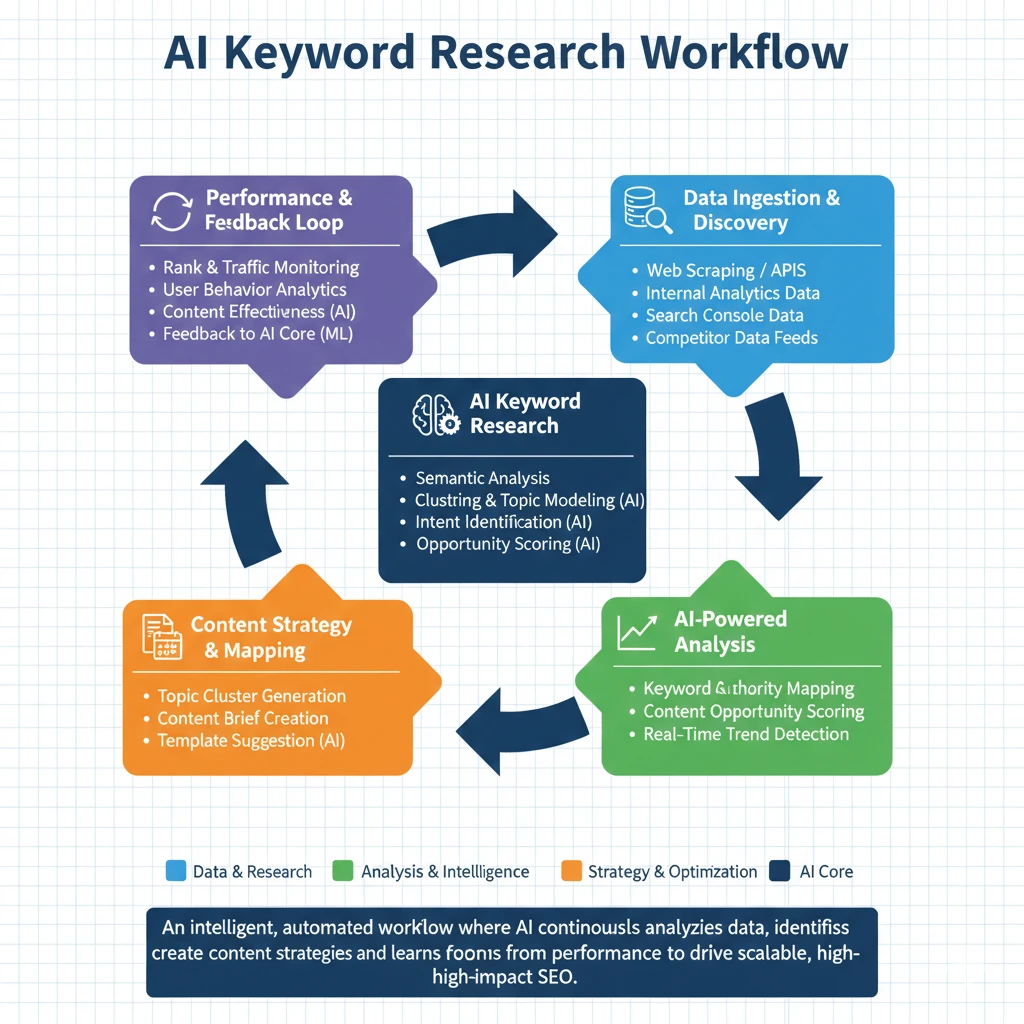
The landscape of search engine optimisation is undergoing a seismic shift, and at the epicentre is Artificial Intelligence (AI). Traditional keyword research often involved hours of staring at spreadsheets, manually grouping terms, and guessing at user intent. Today, Large Language Models (LLMs) and AI keyword research tools have transformed this process from a manual slog into a strategic, high-velocity operation.
AI does not replace the need for an SEO professional, but it drastically amplifies their capabilities. By leveraging these advanced technologies, you can uncover patterns, semantic relationships, and long-tail opportunities that standard tools might miss.
Moving Beyond Simple String Matching
Old-school keyword research techniques relied heavily on “string matching”—finding keywords that contained a specific word sequence (e.g., “best running shoes,” “cheap running shoes”).
AI and LLMs operate differently. They understand semantics—the meaning behind the words. An LLM understands that a user searching for “footwear for marathon training” has the same intent as someone searching for “long distance running shoes,” even though the words are completely different.
This semantic understanding allows you to:
- Identify LSI Keywords: AI can instantly generate a list of conceptually related terms (Latent Semantic Indexing) to help search engines understand your content’s context.
- Uncover Topical Authority: Instead of just giving you a list of keywords, AI can suggest entire topic clusters that you need to cover to be seen as an authority in your niche.
Automating the Heavy Lifting: Clustering and Analysis
One of the most powerful applications of AI keyword research is the ability to process vast amounts of data at speed.
Keyword Clustering
In the past, grouping thousands of keywords into relevant topics was a painful manual task. Now, you can feed a raw list of 5,000 keywords into an AI tool, and it will automatically categorise them into “parent” and “child” groups based on semantic relevance. This allows you to build perfectly structured content plans in minutes rather than days.
Intent Classification at Scale
Deciphering search intent is crucial, but doing it row-by-row in Excel is inefficient. LLMs can analyse a list of keywords and tag them by intent (Informational, Commercial, Transactional) with a high degree of accuracy. This ensures you never waste resources writing a blog post for a keyword that actually demands a product page.
Using LLMs as Creative Engines
Tools like ChatGPT, Claude, and Jasper act as tireless brainstorming partners. They are particularly effective at the “seed” stage of keyword research.
You can use prompts such as:
- “Act as a first-time home buyer. What specific questions, fears, and anxieties would you type into Google when looking for a mortgage?”
- “List 20 long-tail keywords related to ‘vegan baking’ that focus on common problems beginners face.”
These prompts often yield creative, problem-focused keywords that traditional tools—which rely on historical data—might not yet surface. This allows you to target emerging trends and specific user pain points before your competitors do.
The Limitations of AI
While AI keyword research is powerful, it is not infallible. LLMs are language predictors, not fact databases. They generally do not have access to real-time search volume or keyword difficulty metrics unless they are connected to live SEO data tools.
Therefore, the best approach is a hybrid one:
- Use AI for discovery, clustering, and intent analysis.
- Use traditional tools (like Ahrefs or Semrush) to validate search volume and difficulty.
By combining the creative and semantic power of AI with the hard data of traditional software, you create a keyword research strategy that is both innovative and grounded in reality.
Keyword Mapping & Content Planning: Turning Data into Action
You have finished your research. You have a spreadsheet containing hundreds, perhaps thousands, of terms. What happens next? This is where many SEO campaigns stumble. Data without direction is just noise. To transform your keyword research into traffic, you need a blueprint. This blueprint is called a Keyword Map.
Keyword mapping is the strategic process of assigning your discovered keywords to specific pages on your website. It bridges the gap between raw data and your actual site structure, ensuring that every keyword has a home and every page has a purpose.
Why You Cannot Skip Keyword Mapping
Without a map, you risk “keyword cannibalizations”. This occurs when you accidentally target the same keyword on multiple pages. When this happens, you force Google to choose which page is more relevant. Often, it will choose neither, or it will split the authority between them, hurting the rankings of both.
A solid mapping strategy ensures:
- One Page, One Core Intent: You group related terms (e.g., “cheap holidays” and “budget vacations”) onto a single page rather than creating two competing pages.
- Content Gap Identification: You can easily see which keywords do not yet have a matching page on your site, highlighting immediate content opportunities.
- Better Site Structure: It helps you visualize your internal linking and hierarchy, which is crucial for passing authority throughout your domain.
How to Build Your Keyword Map
Creating a map does not require fancy software; a simple spreadsheet is often the best tool for the job. Here is a practical workflow to organise your keyword research for content.
1. Group Keywords by Intent (Clustering)
Go through your master list of keywords. You will notice that many of them are asking for the same thing in slightly different ways.
- Cluster A: “how to bake bread”, “bread baking guide”, “baking bread for beginners”.
- Cluster B: “bread flour”, “best flour for bread”, “buy strong white flour”.
Cluster A is clearly informational; these users want to learn. Cluster B is commercial; these users want a product. These two clusters require two separate pages. Do not try to target them both on one URL.
2. Assign Clusters to URLs
Now, look at your website. Do you already have a page that covers Cluster A?
- If yes: Assign those keywords to that existing URL. This will be your “optimisation” list for refreshing that content.
- If no: Create a placeholder for a new URL (e.g., yourdomain.com/blog/bread-baking-guide). This becomes a new task in your content plan.
3. Define the Primary and Secondary Keywords
For each URL in your map, select one Primary Keyword. This is usually the term with the highest search volume or the clearest intent. This keyword will dictate your URL slug, H1 tag, and meta title.
The remaining keywords in the cluster become Secondary Keywords. You should weave these naturally into your subheadings (H2s, H3s) and body text. This is a core part of effective on-page SEO, ensuring you rank for the main topic and all its long-tail variations.
From Map to Content Plan
Once your map is complete, you have a list of actions. You know exactly which pages need to be created and which need to be updated. Now you must prioritise.
A smart keyword research strategy prioritises content based on business value, not just search volume.
- Priority 1 (Bottom of Funnel): Product and service pages. These drive revenue immediately. Ensure your transactional keywords are mapped and optimised first.
- Priority 2 (Middle of Funnel): Comparison guides and “best of” lists. These nurture leads who are close to buying.
- Priority 3 (Top of Funnel): Educational blog posts. These build traffic and links but have a longer path to conversion.
By following this hierarchy, you ensure that your content production delivers the fastest possible Return on Investment (ROI).
Building Topic Clusters
Keyword mapping is also the foundation of “Topic Clusters”. This is an advanced SEO technique where you create a central “Pillar Page” (targeting a broad, high-volume keyword) and link it to several supporting “Cluster Pages” (targeting specific, long-tail keywords).
For example:
- Pillar Page: “Complete Guide to Digital Marketing”
- Cluster Pages: “Email marketing tips”, “Social media strategy”, “PPC basics”.
Your keyword map will clearly show you which keywords are broad enough to be pillars and which are specific enough to be clusters. By interlinking these pages, you signal to Google that you are an authority on the entire topic, boosting the rankings for every page in the cluster.
Effective planning turns a chaotic list of keywords into a structured, executable strategy. It prevents wasted effort and ensures that every piece of content you write is an asset that contributes to your wider SEO goals.
Common Mistakes to Avoid in Keyword Research
The path to a successful SEO campaign is paved with good data, but it is also littered with common pitfalls that can derail your efforts. Even with the best intentions, a flawed keyword research process can lead to wasted time, squandered budgets, and content that never finds its audience.
Understanding these frequent errors is the first step to avoiding them. By being aware of these traps, you can refine your keyword research strategy and ensure your efforts are focused, efficient, and effective.
1. Targeting Only High-Volume, High-Competition Keywords
It is the classic beginner’s mistake: exporting a keyword list, sorting by search volume, and targeting the terms at the top. The allure of keywords with tens of thousands of monthly searches is strong, but it is often a fool’s errand.
- The Mistake: Believing that high volume equals high traffic for your site. These “head terms” (e.g., “insurance,” “laptops,” “SEO”) are incredibly competitive. You will be up against global brands with massive authority and budgets. For a new or small website, cracking the first page is next to impossible.
- How to Avoid It: Focus on the “low-hanging fruit.” Prioritise long-tail keywords and terms with a lower Keyword Difficulty (KD) score. It is far better to rank #1 for a keyword with 150 monthly searches than to rank #97 for a keyword with 150,000 searches. Your traffic will be more targeted and more likely to convert.
2. Ignoring or Misinterpreting Search Intent
This is perhaps the most critical error in modern SEO. You find a keyword with decent volume and low competition, write what you believe is a brilliant article, and it goes nowhere. The likely culprit? A mismatch between your content and the user’s search intent.
- The Mistake: Creating a blog post when the user wants to buy, or a product page when the user wants to learn. If you write an informational guide for the keyword “buy running trainers,” you are ignoring the clear transactional intent. Google knows this and will rank e-commerce pages above your article.
- How to Avoid It: Always analyse the SERPs before you commit to a keyword. Look at the top 10 results. Are they blog posts, product pages, listicles, or videos? The dominant content type on the first page is Google telling you exactly what kind of content satisfies the user’s intent for that query. Match it, then improve upon it.
3. Neglecting Long-Tail Keywords
A close cousin of targeting only high-volume terms is the failure to appreciate the power of the long tail. Many people dismiss keywords with 10 or 20 monthly searches as worthless.
- The Mistake: Believing that low search volume equals no value. Individually, long-tail keywords do not bring much traffic. Collectively, however, they make up the majority of all search queries. A single, well-written article can rank for hundreds of different long-tail variations.
- How to Avoid It: Embrace specificity. Use tools like AnswerThePublic and look at the “People Also Ask” boxes on Google to find the specific questions your audience is asking. Targeting “best waterproof running shoes for flat feet” will bring you less traffic than “running shoes,” but the visitors you do get will be highly qualified and extremely close to making a purchase.
4. The 'Set It and Forget It' Mentality
Keyword research is not a one-time task you complete when launching your website. Search trends evolve, new competitors emerge, and your audience’s language changes.
- The Mistake: Conducting keyword research once and then basing your content strategy on that outdated data for years to come. A keyword that was a golden opportunity two years ago might be hyper-competitive today, or its search volume may have vanished.
- How to Avoid It: Schedule regular keyword audits. At least once or twice a year, re-evaluate your target keywords. Use tools like Google Search Console to see what terms you are already ranking for and identify new “striking distance” keywords (those ranking on page 2 or 3) that a little optimisation could push to page 1. Keep your strategy dynamic.
5. Relying Solely on Tools without Human Insight
SEO tools are indispensable, but they are not infallible. They provide data, not wisdom. Relying 100% on tool metrics without applying your own industry knowledge and common sense is a recipe for a generic, ineffective strategy.
- The Mistake: Automatically discarding a keyword because a tool shows “zero search volume,” even when you know from talking to customers that it is a term they use. Or, blindly targeting a keyword just because a tool gives it a low difficulty score, without considering if it is even relevant to your business.
- How to Avoid It: Use tools as a guide, not a gospel. Combine the quantitative data from your tools with qualitative insights. Talk to your sales and customer service teams. Read forums and social media groups in your niche. What language do real people use? What problems do they talk about? This human intelligence, layered on top of tool data, is what separates good keyword research from great keyword research.
FAQ
Keyword research is the fundamental process of identifying and analysing the words and phrases people use when searching for information on search engines like Google. It involves discovering popular search terms, understanding the intent behind them, and using that data to inform a content and marketing strategy. The goal is to find opportunities to rank for terms that will drive relevant, high-quality traffic to your website.
Keyword research is the foundation of any successful SEO campaign. It is important because it helps you:
- Understand your audience: It reveals the exact language your customers use.
- Drive targeted traffic: It helps you attract visitors who are genuinely interested in what you offer.
- Inform your content strategy: It provides a data-driven roadmap for what content to create.
- Improve search rankings: It allows you to optimise your pages to be found for specific, relevant queries.
- Gain a competitive advantage: It uncovers what is working for your competitors so you can improve upon it.
Without proper keyword research, you are essentially creating content blindly, hoping it will resonate with an audience you have not taken the time to understand.
Choosing the right keywords is a balancing act between three key factors:
- Relevance: The keyword must be highly relevant to the product, service, or information you provide.
- Search Volume: The term should have enough monthly search volume to be worth the effort of targeting.
- Competition (Keyword Difficulty): You should be able to realistically compete for a top spot. New or smaller sites should target lower-difficulty keywords first.
The best keyword research strategy involves finding a sweet spot where a keyword is relevant, has decent search volume, and features manageable competition. Always analyse the search intent to ensure the content you create will match user expectations.
Long-tail keywords are longer, more specific search phrases that usually contain three or more words. For example, instead of "shoes" (a short-tail keyword), a long-tail version would be "men's waterproof hiking boots size 10".
While they have lower individual search volumes, long-tail keywords are incredibly valuable because they are less competitive and have a much more specific search intent. Someone searching a long-tail query knows exactly what they want, making them more likely to convert if you provide the right answer or product.
There is a wide range of excellent keyword research tools available, catering to different budgets and needs. Some of the most popular include:
- Free Tools: Google Keyword Planner is essential for getting data directly from Google. AnswerThePublic is fantastic for discovering question-based keywords.
- Premium Suites: All-in-one platforms like Ahrefs, Semrush, and Moz Pro offer comprehensive features for deep analysis, competitor research, and rank tracking. They are considered the industry standard for professionals.
The best approach is often to use a combination of tools to get a well-rounded view of keyword opportunities.
Keyword research is not a one-off task. A good rule of thumb is to conduct a thorough review and update of your keyword research strategy at least once or twice a year.
However, you should be monitoring performance more frequently. Keep an eye on:
- New trends: Are there new products, services, or topics emerging in your industry?
- Performance drops: Has a previously high-ranking page started to fall? It might need a content refresh with updated keywords.
- Search Console data: Regularly check Google Search Console for "striking distance" keywords (those ranking on page 2 or 3) that could be pushed to page 1 with a little optimisation.
Your strategy should be a living document that evolves with search trends, competitor actions, and your own business goals.