programmatic seo
Programmatic SEO: Rank Thousands of Pages with Automation & Data
Imagine trying to manually create a unique, optimised webpage for every product variation, service location, or data point your business has. For a company with thousands of potential search queries to target, this task is not just daunting; it’s impossible. This is the scaling problem that keeps SEO professionals and marketers awake at night. As competition intensifies and user search queries become more specific, the need for a scalable, efficient content strategy has never been more critical. This is where the power of programmatic SEO comes into play.
By leveraging data and smart automation, you can move beyond the limitations of manual content creation. This approach allows you to generate thousands of highly relevant, optimised pages that answer specific user needs at an unprecedented scale. It’s a fundamental shift from creating pages one by one to building a system that creates them for you. This guide will explore how you can use SEO automation and a data-first mindset to dominate search results and build a powerful engine for organic growth.
Table of Contents
What is Programmatic SEO?
Programmatic SEO is an advanced method of creating a large number of optimised landing pages by using a database and automated scripts. At its core, it is a form of data-driven SEO that combines a structured dataset with a predefined page template to generate hundreds or even thousands of unique pages, each targeting a specific, long-tail keyword.
Think of it like a mail merge, but for webpages. Instead of manually writing an article for “best plumbers in London,” “best plumbers in Manchester,” and “best plumbers in Birmingham,” you create one master template. This template has variables for elements like {city}, {average_cost}, and {local_reviews}. Then, you connect a database containing all your target cities and their corresponding data. A script runs, automatically merging the data with the template to instantly create a unique page for every single city in your database.
[Image: Diagram showing how a database and a template combine to create thousands of unique SEO pages]
This technique is the engine behind the success of many large digital brands like Zapier, Canva, and TripAdvisor. They don’t have an army of writers creating individual pages for every possible integration, design template, or hotel location. Instead, they use programmatic SEO to turn their internal data into a massive footprint of valuable, search-optimised content. This is the essence of large scale SEO: building a systematic and automated framework to capture a vast array of search intent without requiring proportional manual effort.
How Programmatic SEO Works
Understanding programmatic SEO requires a shift in mindset from “writing content” to “engineering content.” It is not about crafting individual sentences for every page but rather designing a system that produces them. While the scale can seem intimidating, the actual workflow follows a logical, repeatable process that turns raw data into indexed, ranking pages.
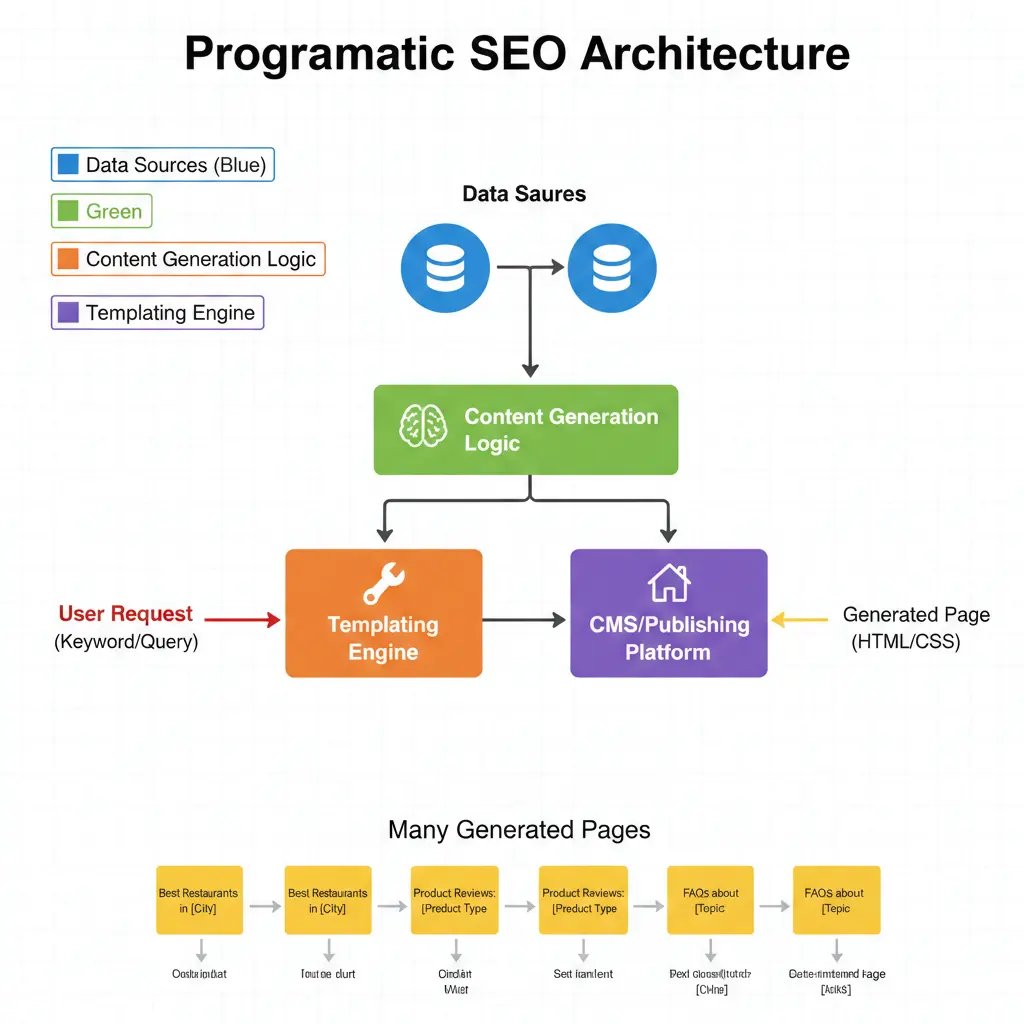
At a high level, the mechanism relies on three core components: a dataset, a template, and an automation script. When these three elements interact perfectly, they generate dynamic SEO pages that serve specific user intent at a massive scale. Here is how the process unfolds step-by-step.
1. Identifying the Head Term and Modifiers
The first step in any large scale SEO campaign is finding a keyword pattern that has enough volume and variation to justify automation. You are looking for a “head term” (the main topic) and “modifiers” (the variables that change).
For example, a travel site might identify the head term “Things to do in” and the modifier {City Name}. A software review site might use “Best alternatives to” as the head term and {Software Name} as the modifier. The goal is to find a query structure where users are searching for the same thing across hundreds or thousands of different variations.
2. Data Collection and Structuring
Once the pattern is identified, you need the fuel for your engine: data. This is often the most critical phase. Your data must be accurate, comprehensive, and structured in a way that a machine can read.
Data can come from internal proprietary sources (like your own user data or product inventory) or external sources (APIs, public datasets, or scraping). For programmatic SEO to be effective, this data needs to be cleaned and organized into a database—often a simple Google Sheet or Airtable for smaller projects, or a SQL database for enterprise needs. Each row represents a page you want to build, and each column represents a specific data point (e.g., population, price, rating, weather) that will be inserted into the content.
3. Designing the Master Template
With your data ready, you move to template based SEO. You create a single page layout that acts as the skeleton for all your generated pages.
This template includes static content (text that stays the same on every page) and dynamic placeholders (variables that change based on the data). A sentence in your template might look like this:
“Looking for the best hotels in {City}? We have analyzed {Number} properties with an average rating of {Rating} stars to help you decide.”
When the system runs, it swaps {City} for “London,” {Number} for “500,” and {Rating} for “4.5,” creating a sentence that feels unique and specific to that page.
4. Automated Page Generation
The final step is SEO automation. Using tools or custom scripts (often Python or Node.js), you connect your database to your CMS (like WordPress, Webflow, or a custom build). The script iterates through every row in your database, injecting the data into the template and publishing a new URL for each entry.
This process transforms a spreadsheet of 5,000 rows into 5,000 live, indexable URLs in a matter of minutes.
The Scalability Advantage
The beauty of this workflow lies in its efficiency. If you need to update your content—perhaps to change the year or update pricing—you don’t edit 5,000 pages manually. You simply update the master template or the database, and the changes propagate across the entire site instantly. This is programmatic SEO at its finest: maximizing output while minimizing manual input.
Programmatic SEO vs Traditional SEO
To truly grasp the power of programmatic SEO, it is essential to distinguish it from the traditional methodologies that have defined search engine optimisation for decades. While both approaches aim to increase organic visibility and drive traffic, the mechanics, philosophy, and scale at which they operate are fundamentally different.
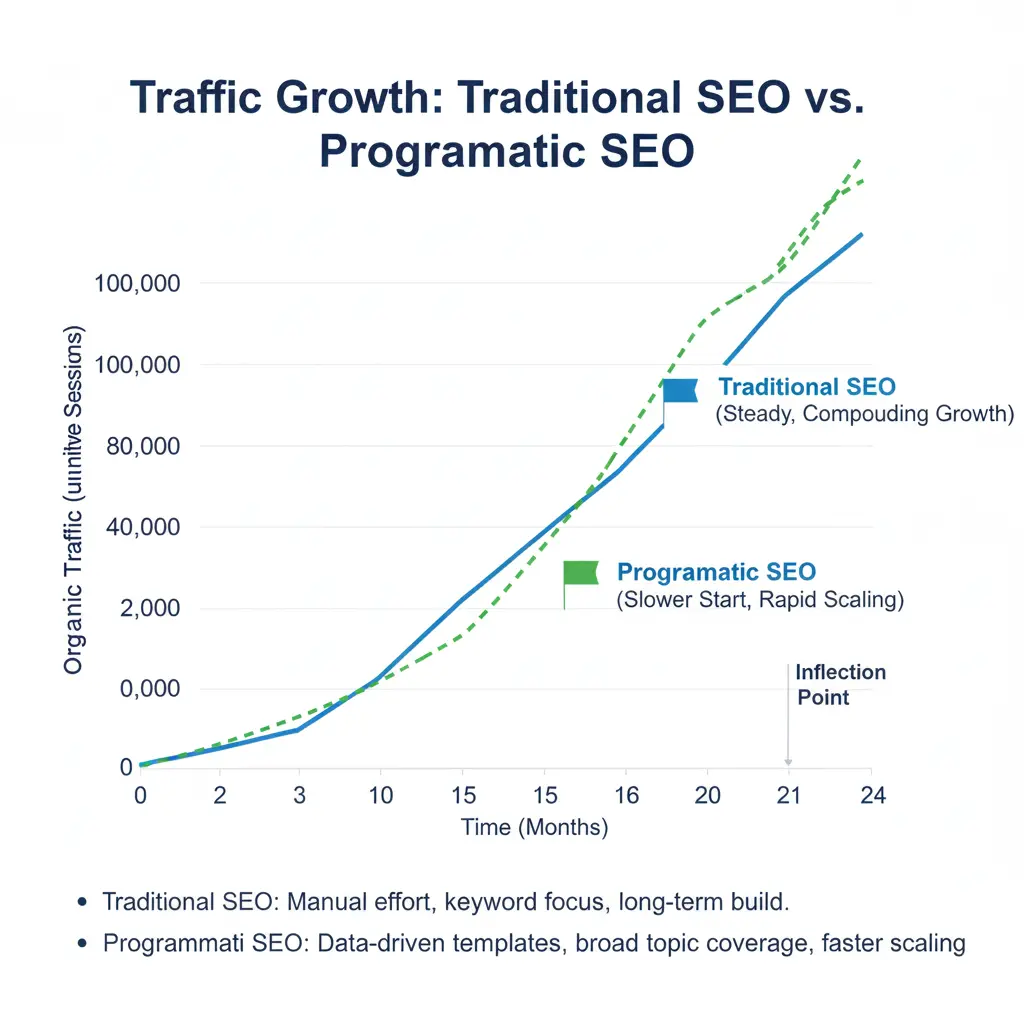
In traditional SEO, the unit of work is the individual page. In programmatic SEO, the unit of work is the system. This distinction changes everything from resource allocation to the speed of execution.
The Traditional SEO Approach: Craftsmanship Over Scale
Traditional SEO is akin to artisanal craftsmanship. It involves a high degree of manual effort and attention to detail for each specific URL. A typical workflow for a traditional campaign involves:
- Keyword Research: Identifying a single high-volume keyword (e.g., “CRM software”).
- Content Creation: A writer drafts a bespoke 2,000-word article, interviewing experts and crafting a unique narrative.
- On-Page Optimisation: An SEO specialist manually tweaks meta tags, headers, and image alt text.
- Publication: The page is published, and the team moves on to the next one.
This “hand-crafted” approach is excellent for targeting broad, highly competitive head terms where unique brand voice and deep thought leadership are required. However, it is inherently unsalable. If you identify 5,000 relevant long-tail keywords, you would need an army of writers and years of work to cover them all using traditional methods.
The Programmatic SEO Approach: Engineering at Scale
Programmatic SEO flips this model on its head. Instead of treating every page as a unique project, it treats pages as products of a data pipeline. It is less about writing and more about architecture.
When you implement a large scale SEO strategy, you aren’t writing 5,000 pages; you are building one robust template and connecting it to a dataset that contains 5,000 variations. The focus shifts from “How do I optimize this post?” to “How do I structure my data so it serves thousands of user intents simultaneously?”
Here is a comparative breakdown of how the two methodologies differ across key metrics:
1. Speed of Deployment
- Traditional: Linear growth. Publishing 100 pages might take a team of three writers three months.
- Programmatic: Exponential growth. Publishing 100 pages takes the same amount of time as publishing 10,000 pages—once the template and script are ready, the generation is instant.
2. Content Creation
- Traditional: Relies on creative writing and subjective editorial decisions. It is prone to writer’s block and inconsistency.
- Programmatic: Relies on data driven seo. Content is generated based on objective data points. If the data is accurate, the content is accurate. Consistency is guaranteed across every single page.
3. Keyword Targeting
- Traditional: Targets “Head” and “Body” terms with high search volume (e.g., “marketing software”). These are fiercely competitive.
- Programmatic: Dominates the “Long Tail.” It targets low-volume, high-intent queries at scale (e.g., “marketing software for dentists in London”). While individual search volumes are low, the aggregate traffic from thousands of these pages often eclipses that of a few high-volume pages.
4. Maintenance and Updates
- Traditional: Updating content is a manual nightmare. If a regulation changes or a product price updates, you must manually edit every affected article.
Programmatic: Updates are effortless. You change the data in your source (the “source of truth”), and the change automatically reflects across thousands of pages immediately. This efficiency is why enterprise SEO teams rely heavily on programmatic methods to manage massive sites.
When to Use Which?
It is rarely an “either/or” choice; the most successful brands use a hybrid approach.
Traditional SEO is indispensable for your core pages—your homepage, your main service pages, and your high-level blog content where brand storytelling is paramount. You simply cannot automate a thought-leadership opinion piece or a complex case study.
However, programmatic SEO is the only viable solution when you need to address a matrix of variables. If you are a travel aggregator, a job board, a real estate platform, or an e-commerce giant, manual SEO will never allow you to capture the full breadth of user searches. By leveraging automation and templates, you can unlock a level of visibility that manual effort simply cannot achieve.
Data Sources for Programmatic SEO
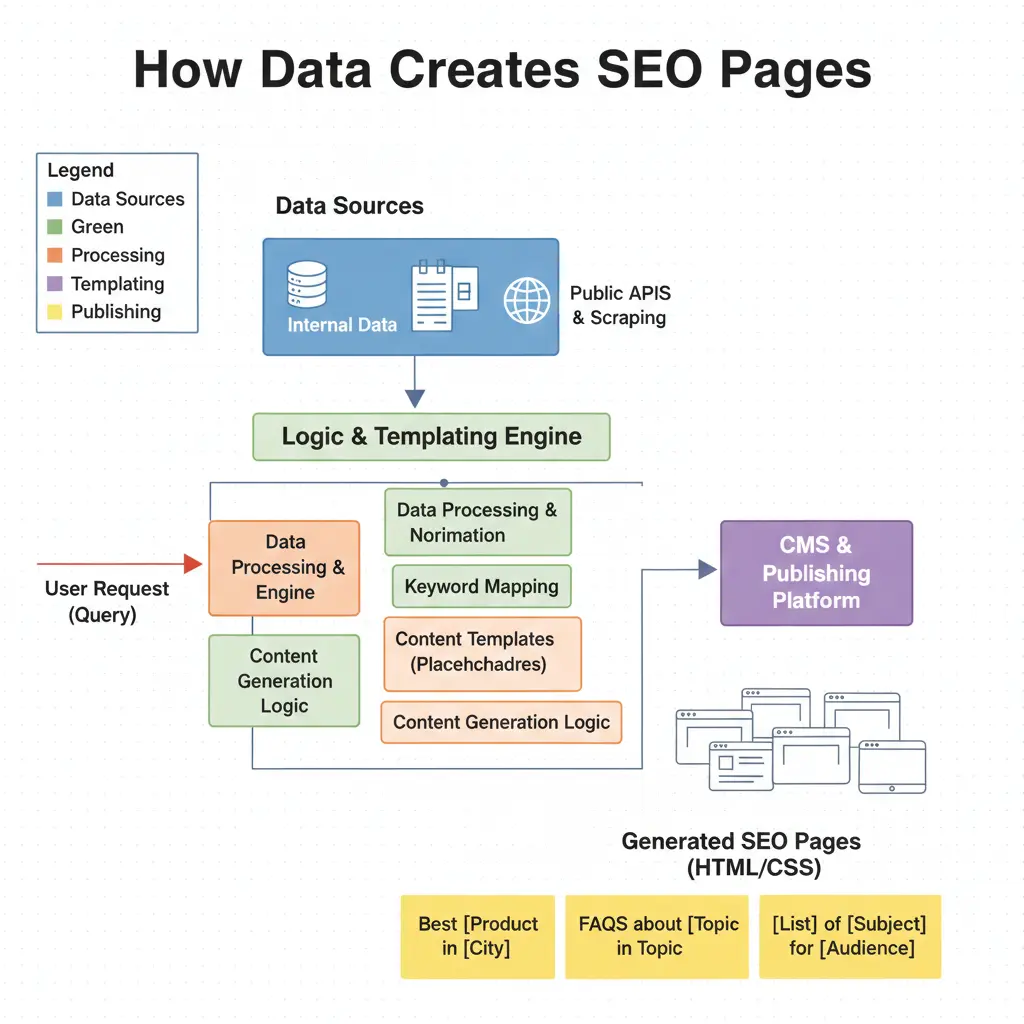
In any programmatic SEO initiative, data is the fuel. It is the single most critical component that determines the quality, authority, and ultimate success of your automated pages. While the template provides the structure and the script provides the speed, the data provides the substance. Without rich, accurate, and well-structured data, your dynamic SEO pages will be nothing more than thin, repetitive shells that fail to satisfy user intent and will likely be penalised by search engines.
The entire principle of data driven seo rests on having a reliable “source of truth.” This source dictates what content appears on each page, making the process of sourcing and cleaning data a non-negotiable prerequisite. The choice of data source depends on your business model, budget, and technical resources. Generally, they fall into four main categories.
1. Proprietary Internal Data
This is the gold standard for programmatic SEO. Proprietary data is information that your business owns and generates through its operations. It is unique, defensible, and highly valuable.
- Examples: A job board’s database of job listings, an e-commerce site’s product catalogue, a SaaS company’s user-generated templates, or a real estate platform’s property listings.
- Pros:
- Uniqueness: No competitor has access to this data, giving you a significant competitive advantage.
- Control: You have full control over the data’s accuracy, structure, and update frequency.
- Relevance: The data is directly tied to your core business, ensuring it aligns with user intent.
- Cons:
- Availability: Not all businesses have a large, pre-existing dataset suitable for programmatic use. Building one from scratch can be a long-term project.
Using your own data is the most powerful way to build a moat around your SEO strategy. Zapier, for instance, uses its internal data on app integrations to programmatically create pages for every possible combination (e.g., “Connect Gmail to Slack”).
2. Public and Private APIs
Application Programming Interfaces (APIs) allow different software systems to communicate and share data. Many organisations provide access to their data through APIs, which can be a treasure trove for programmatic content.
- Examples: Weather APIs (for travel sites), stock market data APIs (for finance sites), government statistics APIs (for research portals), or a partner’s product feed.
- Pros:
- Real-time Data: Many APIs provide live or frequently updated information, keeping your content fresh.
- Structured Format: API data is typically returned in a well-structured format (like JSON), making it easy to process.
- Cons:
- Cost: Many high-quality APIs come with subscription fees, which can become expensive at scale.
- Rate Limits: APIs often have limits on how many requests you can make in a given period, which can slow down SEO automation.
Dependency: Your content is dependent on a third-party service. If their API goes down or changes, your pages can break.
3. Public Datasets
The internet is filled with publicly available datasets that can be downloaded and used for content generation. These are often compiled by government agencies, academic institutions, or non-profit organisations.
- Examples: Census data, crime statistics, local business directories, geographical data, or public transport schedules.
- Pros:
- Free to Use: Most public datasets are free to access and use.
- Authoritative: Data from official sources can add a layer of credibility to your pages.
- Cons:
- Static: These datasets are often only updated periodically (e.g., annually), so the data can become stale.
Cleaning Required: The data is often provided in raw formats (like CSVs or XML files) and requires significant cleaning and structuring before it can be used.
4. Web Scraping
Web scraping involves using automated bots to extract data from other websites. While powerful, this method is technically complex and resides in a legal and ethical grey area. It should be approached with extreme caution.
- Examples: Scraping product prices from competitor sites, aggregating reviews from various platforms, or collecting business contact details from online directories.
- Pros:
- Vast Data Access: You can theoretically gather any data that is publicly visible on the web.
- Cons:
- Legal & Ethical Risks: Many websites explicitly prohibit scraping in their terms of service. Always consult with legal counsel before scraping.
- Technical Fragility: If the source website changes its layout, your scraper will break, requiring constant maintenance.
- Data Quality Issues: Scraped data is often messy and unstructured, requiring intensive cleaning.
Regardless of the source, the goal is the same: to compile a clean, structured database where each row represents a future page and each column represents a piece of unique value. Your ability to execute programmatic SEO effectively is not just about writing code; it is about becoming a master of data acquisition and management.
Templates, Variables & Page Generation
If data is the fuel for programmatic SEO, the template is the engine. It is the architectural blueprint that determines how that data is presented to both users and search engines. In this phase, template based seo takes center stage, transforming raw rows of a database into rich, engaging, and readable content.
Designing a master template is arguably the most creative part of the process. It requires a delicate balance: the structure must be rigid enough to maintain consistency across thousands of pages, yet flexible enough to accommodate unique data points without looking robotic.
The Anatomy of a High-Performance Template
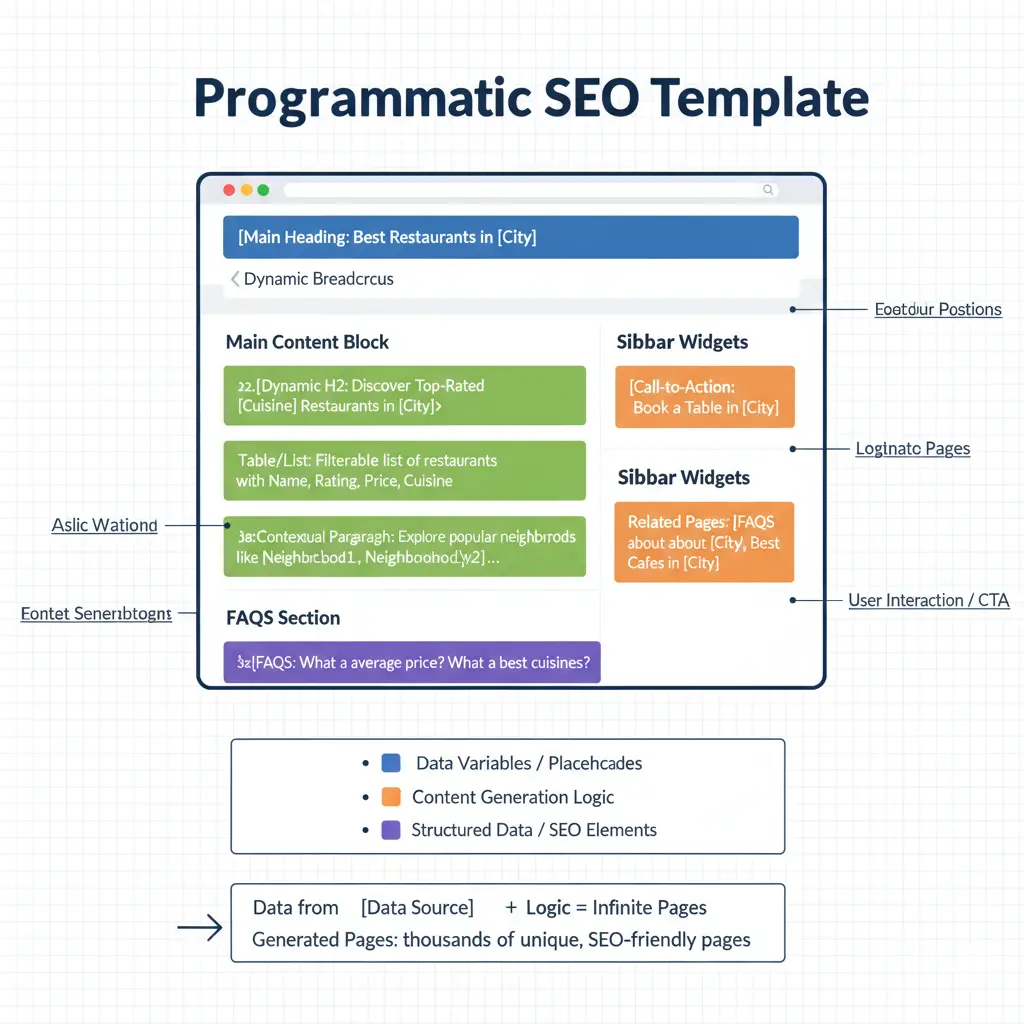
A programmatic template is composed of two distinct elements: static content and dynamic variables.
- Static Content: This is the text, layout, and code that remains constant on every page. It usually includes the header, footer, navigation, and general explanatory text that applies to the entire category of pages.
- Dynamic Variables: These are the placeholders that get swapped out for specific data from your database during seo automation.
To the uninitiated, this might look like a simple “Find and Replace” exercise, but sophisticated dynamic seo pages go much deeper. A basic implementation might look like this:
“Welcome to our {City} plumbing service. We offer the best plumbing in {City}.”
This is functional, but it is also low-quality and unlikely to rank well. It screams “generated content.” A high-authority template uses variables to construct narrative and value, looking more like this:
“Facing a leaky tap in {City}? Our team of {Number_of_Staff} certified plumbers can reach {Neighborhood} within {Avg_Response_Time} minutes. Rated {Review_Score} stars by locals, we specialize in {Specialty_Service}.”
By weaving multiple data points—staff numbers, specific neighborhoods, response times, and ratings—into the text, the content becomes unique and genuinely useful to the user.
Advanced Logic and Conditionals
The secret to making programmatic SEO indistinguishable from hand-written content lies in conditional logic. This involves using “If/Else” statements within your template to change the sentence structure based on the data.
For example, if you are generating pages for a travel site:
- If the {Weather} variable is “Rainy”, the template displays: “Don’t let the drizzle stop you—here are the best indoor museums in {City}.”
- If the {Weather} variable is “Sunny”, the template displays: “Enjoy the sunshine with these top-rated parks and outdoor walking tours in {City}.”
This level of detail ensures that the content “reads” naturally. It prevents the awkward phrasing often associated with automated content and significantly improves user engagement metrics, which are a key ranking factor for Google.
The Page Generation Process
Once the template is designed and the logic defined, the actual generation occurs. This is where the script (the “programmatic” part) runs through your database row by row.
- Fetch: The system grabs a row of data (e.g., Row 104: “Manchester”).
- Inject: It identifies every variable in the template (e.g., {City}, {Population}, {Attractions}) and injects the corresponding data from the Manchester row.
- Render: It processes any conditional logic to determine which text blocks to show or hide.
Publish: It generates a final HTML file and assigns it a unique URL structure, such as domain.com/locations/manchester.
Balancing Scale with User Experience (UX)
A common pitfall in large scale SEO is sacrificing user experience for volume. It is tempting to generate 10,000 pages because you can, but if those pages offer poor value, they will harm your site’s overall authority.
Google’s algorithms are adept at identifying “doorway pages”—pages created solely for search traffic with no distinct value. To avoid this, your template must provide a solid User Experience (UX).
- Visual Variation: Ensure images change based on the location or product. Do not use the same stock photo for 5,000 pages.
- Data Visualization: Use graphs, charts, or comparison tables generated from your data. A table comparing “Price of Coffee in {City} vs National Average” is unique, high-value content that users love.
- Internal Linking: Ensure the generated pages link back to parent category pages and other relevant generated pages (e.g., “Nearby Cities”), creating a natural crawl path for search bots.
By focusing on robust templates and rich variables, you ensure that your seo automation efforts result in a library of high-quality assets rather than a landfill of digital spam.
Programmatic SEO for AI & LLMs
The landscape of search is undergoing a seismic shift. For two decades, SEOs have optimised primarily for Google’s traditional “10 blue links.” Today, however, we must optimise for a new kind of user: the Large Language Model (LLM). As platforms like ChatGPT, Bing Chat, and Google’s Gemini become primary discovery engines, programmatic SEO is evolving into a critical tool for feeding these AI systems the structured information they crave.
This new frontier, often referred to as AI SEO or LLM SEO, requires a different approach to how we structure and deliver data at scale. It is no longer enough to just rank; you must be cited.
Feeding the AI: Why Structure Matters More Than Ever
LLMs are essentially prediction engines trained on vast amounts of text. When a user asks ChatGPT a question like “What are the best budget hotels in Manchester?”, the AI doesn’t “search” the web in the traditional sense; it constructs an answer based on the patterns and facts it has ingested.
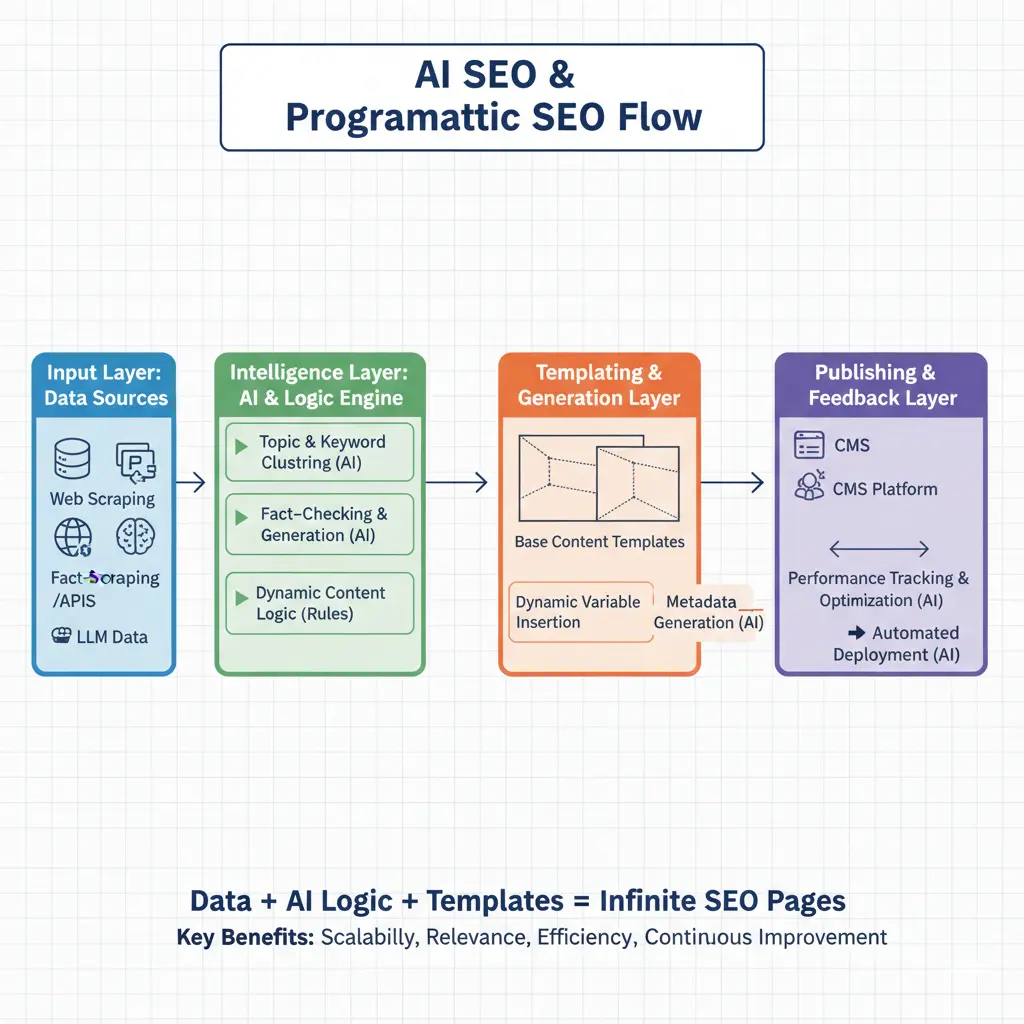
This is where programmatic SEO shines. Because programmatic pages are built on structured databases, they are inherently cleaner and easier for AI models to parse than unstructured blog posts.
To dominate ChatGPT SEO, your programmatic pages must serve as definitive “fact repositories.”
- Structured Data (Schema Markup): This is non-negotiable. Every programmatic page should be wrapped in robust Schema.org markup. If you are generating a page for a local business, use LocalBusiness schema. If it is a product, use Product schema. This code speaks directly to the AI, explicitly telling it: “This is the price,” “This is the rating,” “This is the location.”
- Semantic SEO: AI models understand concepts, not just keywords. Your templates should use entity-based language. Instead of just repeating “cheap hotel,” your template should naturally include related entities like “nightly rates,” “amenities,” “check-in times,” and “cancellation policies.” This context helps the LLM understand the relationship between the data points.
AI Content Generation vs. AI Hallucinations
One of the biggest risks in large scale SEO using AI is the phenomenon of “hallucination”—where an AI confidently invents false information.
In a data driven seo strategy, you solve this by separating the facts from the prose.
- The Facts (Hard Data): Use your proprietary database for the hard facts (prices, specs, addresses). Do not let an AI “guess” these. Hard-code them into the template variables.
- The Prose (AI Generation): Use AI content generation tools (via APIs like OpenAI’s GPT-4) to weave the connective tissue. You can pass your hard data to the AI prompt: “Write a description for a hotel with these exact amenities: {Pool}, {Gym}, {WiFi}.”
By constraining the AI to only write about the data you provide, you get the best of both worlds: the reliability of a database and the natural fluency of a language model. This hybrid approach ensures your thousands of pages are accurate, readable, and authoritative.
Optimizing for the "Zero-Click" Future
As search moves towards “zero-click” answers—where the user gets the answer directly on the search result page or chat interface—the goal of programmatic SEO shifts from driving traffic to driving brand visibility and authority.
If your programmatic pages are the most structured and accurate source of data on a topic, LLMs are more likely to reference your brand as the source of truth. For example, if you have the most comprehensive programmatic database of “SaaS pricing tiers,” an AI answering a question about software costs is statistically more likely to lean on your data patterns.
To succeed in this era of AI SEO, focus on:
- Data Uniqueness: Provide data that isn’t found elsewhere (proprietary stats, unique aggregations).
- Answer Directness: Ensure your programmatic templates answer specific questions immediately (e.g., “The average cost is £50”). Don’t bury the lead. AI models prioritise clear, concise answers.
By aligning your programmatic strategy with the needs of LLMs, you future-proof your site against the volatility of traditional search algorithms. You aren’t just building pages for users to visit; you are building the training data that the next generation of search engines will rely on.
Internal Linking at Scale
Creating thousands of dynamic SEO pages is only half the battle. If those pages exist in isolation, they are like islands in a vast ocean—difficult for both users and search engine crawlers to discover. An effective internal linking strategy is the connective tissue that transforms a collection of disparate URLs into a cohesive, authoritative website. For any programmatic SEO initiative, building an automated internal linking system is not just a best practice; it is a fundamental requirement for success.
Without a logical link structure, your newly generated pages risk becoming “orphan pages.” These pages have no inbound links from other parts of your site, making them nearly invisible to Googlebot. This severely hinders their ability to be indexed and ranked. In large scale SEO, manual internal linking is impossible, so you must bake the linking logic directly into your templates and SEO automation scripts.
Strategies for Programmatic Internal Linking
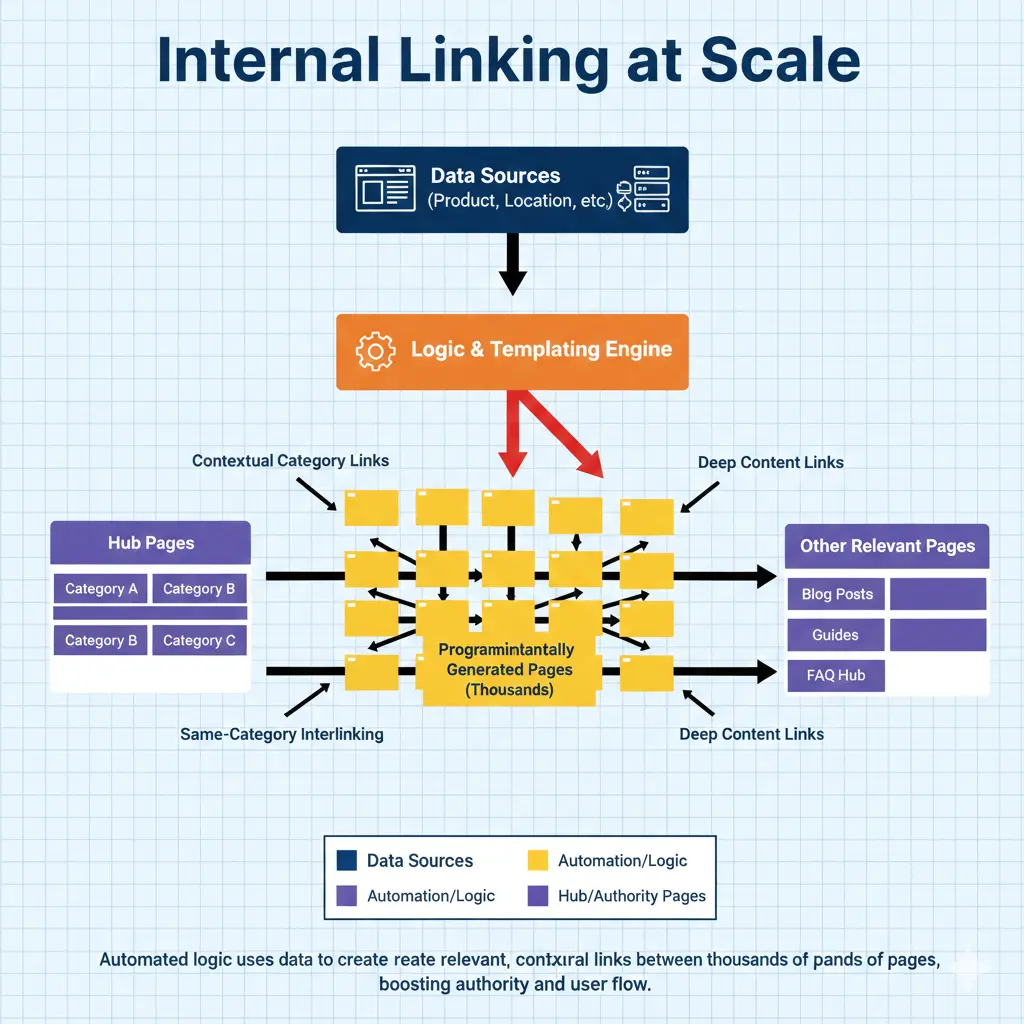
The goal is to create a logical hierarchy that guides crawlers and users through your site, distributing authority and providing contextual relevance. This is achieved by creating automated linking modules within your master page template.
1. Parent-Child Linking (Top-Down)
This is the most basic and essential form of internal linking. It establishes a clear site hierarchy.
- Parent to Child: Your main category page (the “parent,” e.g., yoursite.com/locations/) should link down to every individual programmatic page generated beneath it (the “children,” e.g., …/locations/london, …/locations/manchester). This is often achieved with a paginated index.
- Child to Parent: Every programmatic page should have a link pointing back up to its parent category page. This is commonly handled through breadcrumbs (e.g., Home > Locations > London).
This structure ensures that link equity flows from your established, authoritative pages down to your newly created long-tail pages, giving them an initial boost.
2. Sibling Linking (Side-to-Side)
Sibling linking involves connecting programmatic pages that are on the same hierarchical level. This is crucial for user experience and demonstrating topical breadth to search engines. For example, on the page for “Best Plumbers in London,” the template can automatically generate links to “Best Plumbers in Manchester” and “Best Plumbers in Birmingham” under a “Nearby Locations” or “Similar Searches” module.
This is accomplished by querying your database for entries with similar attributes. The logic might be:
- “Show links to 5 other cities in the same country.”
- “Show links to 3 other products in the same category.”
- “Show links to software with similar features.”
This creates a dense web of relevant connections, encouraging users to explore more of your site and allowing crawlers to easily hop from one page to the next.
3. Cross-Contextual Linking
This is a more advanced technique where you link between different sets of programmatic pages. Imagine you have two programmatic projects: one for /{service}/in/{city} and another for /{city}-statistics.
Your template for the plumbers/in/london page could include a module that automatically pulls in and links to the /london-statistics page. The link could be contextually woven into the content, such as: “According to our data, the population of London has grown by 5%…”
This creates powerful contextual bridges across your entire site, signaling to search engines that you have deep, interconnected expertise on a subject.
The Technical Implementation
Implementing this at scale requires adding logic to your page generation script. When the script builds a page for “London,” it doesn’t just pull London’s data. It also runs secondary queries on the database to find:
- The parent category URL.
- The URLs of 5 sibling pages.
- The URL of any relevant cross-contextual pages.
These URLs are then injected as variables into the template, just like any other piece of data. The result is that every page is automatically published with a rich set of internal links, perfectly tailored to its specific context. This automated approach ensures that as your site scales from 1,000 to 100,000 pages, your internal linking architecture remains robust, scalable, and optimised for both crawlers and users.
Tools for Programmatic SEO
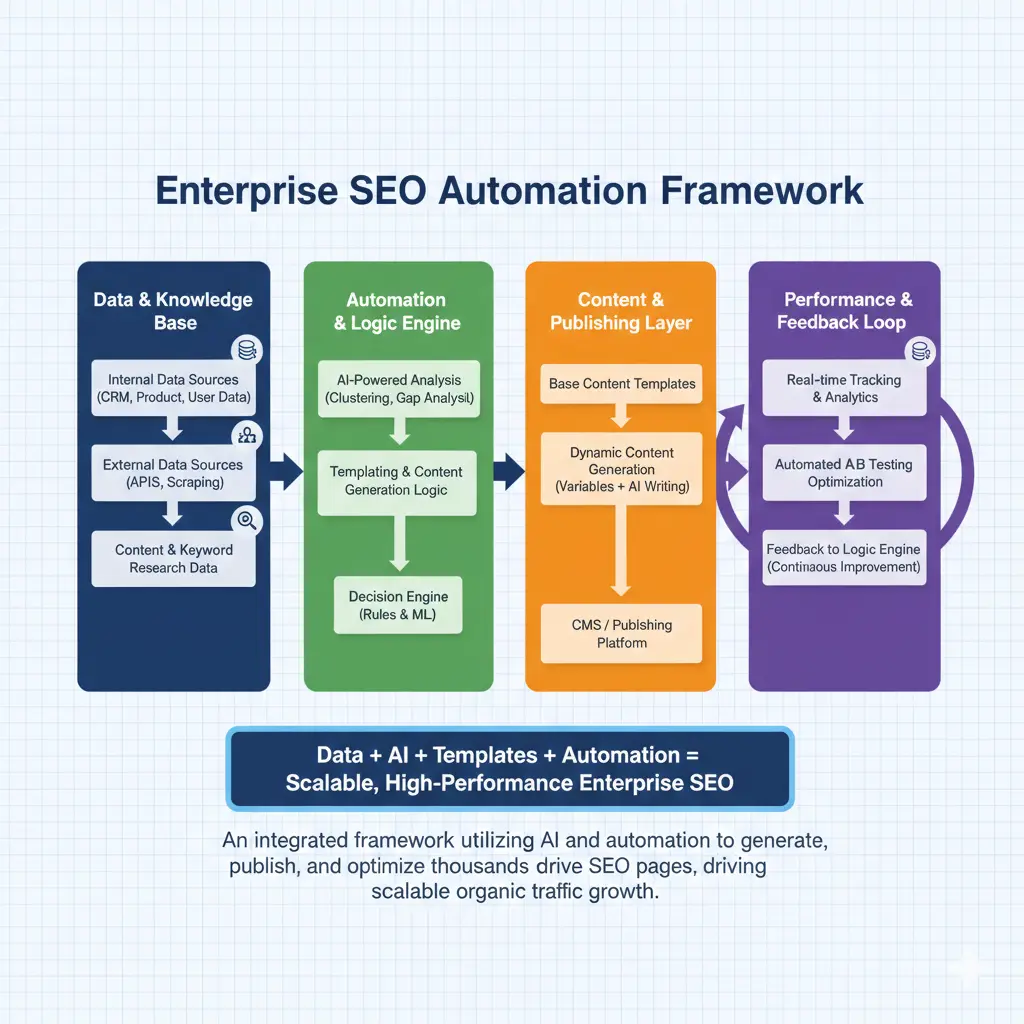
Building a programmatic SEO engine requires more than just a single piece of software; it demands a robust technology stack. Unlike traditional SEO, where a Content Management System (CMS) and a keyword tool might suffice, large scale SEO requires a pipeline that can handle data storage, processing, automation, and publishing.
There is no “one size fits all” solution, but a typical stack consists of four distinct layers: data management, automation, publishing, and quality control. Here are the essential tools that power the most successful data driven seo campaigns.
1. The Data Layer (Storage & Structure)
Before you can generate pages, you need a home for your data. This is your “source of truth.”
- Google Sheets: For smaller projects or MVPs (Minimum Viable Products), a simple spreadsheet is often sufficient. It is free, easy to collaborate on, and connects to almost every automation tool.
- Airtable: The industry standard for low-code programmatic SEO. Airtable functions like a hybrid between a spreadsheet and a database. Its relational features allow you to link different datasets (e.g., linking a “Cities” table to a “States” table), making it perfect for complex, multi-variable templates.
SQL Databases (PostgreSQL / MySQL): For enterprise SEO involving millions of rows, spreadsheets will crash. A proper SQL database is necessary to handle the volume and query speed required for massive sites.
2. The CMS & Publishing Layer
This is where your pages ultimately live. The choice of CMS dictates how flexible your templates can be.
- WordPress: The most popular choice due to its vast ecosystem. Plugins like WP All Import act as a bridge, allowing you to upload a CSV file and map columns to specific fields in a WordPress template. It handles the heavy lifting of creating thousands of posts from a single data file.
- Webflow: Excellent for designers who want visual control over their dynamic seo pages. Webflow’s “CMS Collections” feature is natively built for programmatic content. You can design one template page and populate it with up to 10,000 items from a collection.
Headless CMS & Custom Builds (Next.js / Gatsby): For maximum speed and customization, developers often build custom static sites using frameworks like Next.js. This approach offers the best performance (Core Web Vitals) but requires significant engineering resources.
3. The Automation & Logic Layer (The Connectors)
This layer connects your data to your CMS, handling the logic of when and how pages are created.
- Zapier / Make (formerly Integromat): These “no-code” automation platforms are the glue of the internet. You can set up workflows where adding a new row to Airtable automatically triggers the creation of a new page in Webflow or WordPress. Make is often preferred for seo automation due to its ability to handle complex logic loops and lower costs at scale.
- Python: For true power users, Python is the ultimate tool. Libraries like Pandas allow for advanced data cleaning and manipulation, while scripts can interact directly with APIs to generate content, creating a level of flexibility that no-code tools cannot match.
- Whalesync: A newer tool specifically designed to sync data bi-directionally between Airtable and Webflow/Notion. It updates your live site in real-time as you change data in your database.
4. Quality Assurance & Technical SEO Tools
When you publish 5,000 pages at once, a small error in your template becomes 5,000 errors on your site. Monitoring tools are critical for risk management.
- Screaming Frog SEO Spider: The Swiss Army knife of technical SEO. You must crawl your staging site with Screaming Frog before pushing live. It helps identify broken links, missing meta tags, and duplicate content issues across your generated pages.
- Ahrefs / Semrush: Essential for the initial research phase. Their APIs can also be used to programmatically fetch keyword metrics (search volume, difficulty) to enrich your database, ensuring you are prioritising high-value pages.
- IndexCheckr: Getting thousands of pages indexed by Google can be slow. Tools like IndexCheckr help monitor which of your programmatic pages are actually in the index, allowing you to troubleshoot crawling issues effectively.
By assembling the right combination of these tools, you move from manual tinkering to industrial-scale publishing. The goal is to build a system where the tools handle the repetition, leaving you free to focus on strategy and data quality.
Programmatic SEO Strategy
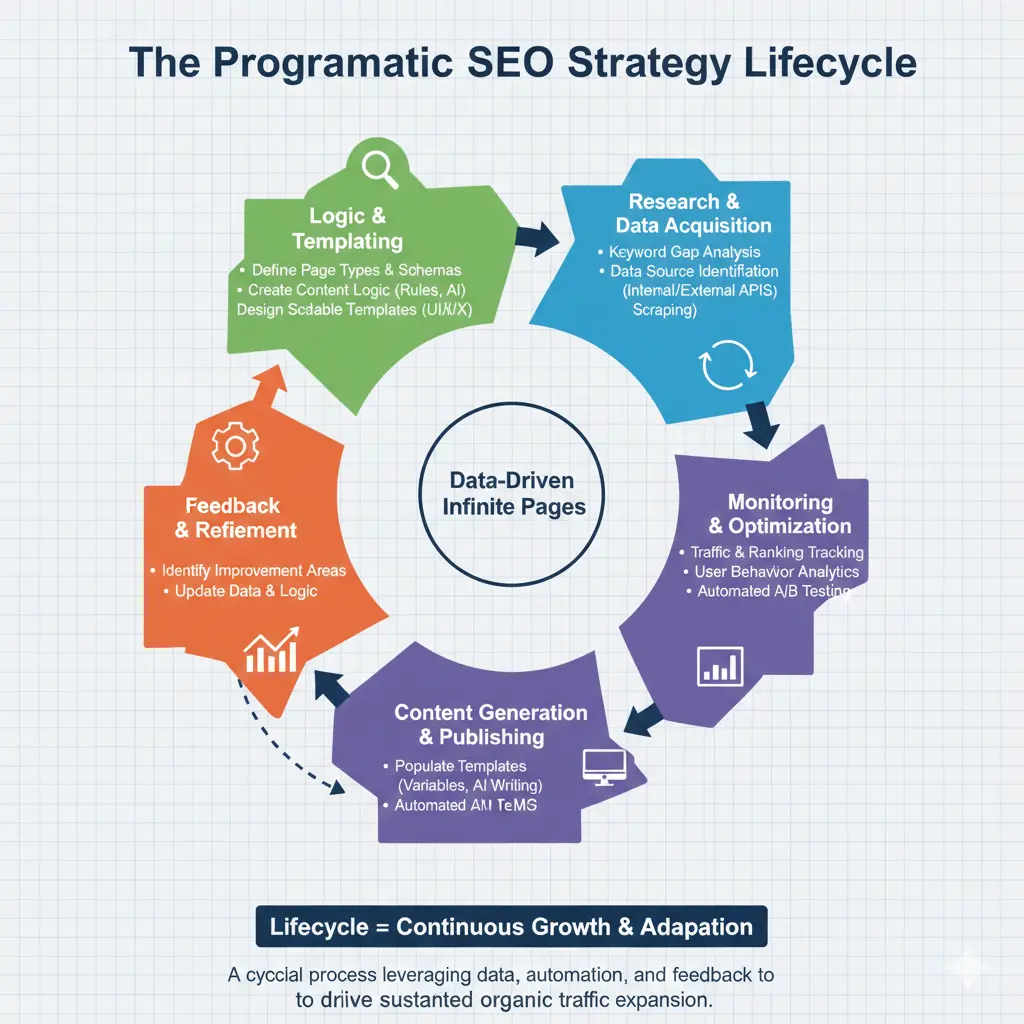
Executing a successful programmatic SEO campaign is not a one-off task; it is a strategic initiative that requires careful planning, meticulous execution, and continuous refinement. Simply generating thousands of pages without a coherent strategy will lead to poor-quality content that fails to rank and may even harm your site’s authority. A robust strategy ensures that every page you create serves a distinct purpose, meets user intent, and contributes to your overall business goals.
This is the blueprint for moving from concept to a high-performing, large scale SEO asset.
Step 1: Opportunity Identification & Keyword Research
Every programmatic project starts with identifying a scalable keyword pattern. This involves finding a “head term” and a “modifier” that users combine in their searches.
- Head Term: The core concept (e.g., “best restaurants,” “cost of living in,” “alternatives to”).
- Modifier: The variable element (e.g., {City}, {Service}, {Software Name}).
Use keyword research tools to validate that there is sufficient search volume across hundreds or thousands of these long-tail combinations. The goal is to find a user intent that is repeated across a large dataset. For example, if you are a real estate platform, you might target {Number} bedroom houses for sale in {Neighbourhood}.
Step 2: Data Sourcing & Structuring
This is the cornerstone of data driven seo. Your strategy lives or dies by the quality of your data.
- Sourcing: Determine your data source. Will you use proprietary internal data (e.g., your product inventory), purchase access to a third-party API, or aggregate public datasets?
- Structuring: Organise this data into a clean, machine-readable format like a spreadsheet (Airtable, Google Sheets) or a database. Each row should represent a page you intend to create, and each column should represent a unique data point (e.g., City, Population, Average_Rent, Top_Attraction).
- Enrichment: Go beyond the basics. Enrich your dataset with extra columns of valuable information. If you have a list of cities, add columns for crime rates, average temperature, and local landmarks. The more unique data points you have, the more valuable and distinct your generated pages will be.
Step 3: Template Design & User Experience (UX)
The template is the vessel for your data. A good template balances automation with a high-quality user experience.
- Define Page Structure: Wireframe the page layout. Decide where key elements like the title, main content, images, and data visualisations (tables, charts) will go.
- Write Static Content: Craft the universal text that will appear on every page, providing context and framing the dynamic data.
- Integrate Variables: Place your column headers as variables (e.g., {Population}) within the template. Use conditional logic (If/Then) to create more natural-sounding sentences and avoid awkward phrasing. For example, if {Number_of_reviews} is zero, the text should adapt.
- Plan Internal Linking: Design modules for parent-child and sibling linking. Decide the logic for which “similar” or “nearby” pages to link to from each template.
Step 4: Technical Build & Automation
This is where the seo automation happens.
- Choose Your Stack: Select your tools—a CMS like WordPress or Webflow, an automation tool like Make or a Python script, and your database.
- Develop the Script: Build the automation that connects your data source to your CMS. This script will loop through each row of your database, inject the data into the template, and publish a new page with a clean URL structure (e.g., /locations/{city-name}).
- Staging & Quality Assurance: NEVER publish directly to your live site. Generate the pages on a staging or development server first. Use a tool like Screaming Frog to crawl all the generated pages and check for errors, duplicate content, broken links, or missing meta titles.
Step 5: Phased Launch & Indexation
Do not publish 50,000 pages at once. This can overwhelm your server and send negative signals to Google.
- Launch in Batches: Publish an initial batch of 500-1,000 pages. This allows you to monitor initial performance and Google’s reaction without risking your entire site.
- Submit Sitemaps: Create an XML sitemap for your new programmatic URLs and submit it to Google Search Console to encourage crawling and indexing.
- Monitor Indexation: Use Google Search Console’s Coverage report to track how many of your new pages are being indexed. If pages are being excluded as “Crawled – currently not indexed,” it may indicate a quality issue with your template.
Step 6: Performance Monitoring & Iteration
Programmatic SEO is not a “set it and forget it” strategy.
- Track Rankings: Monitor the performance of your head terms and a sample of long-tail variations.
- Analyse Traffic & Engagement: Watch your analytics to see which pages are driving traffic and how users are behaving on them. High bounce rates might indicate a mismatch between user intent and your content.
- Iterate: Use the performance data to improve your system. You might need to add more unique data to your database, refine the copy in your template, or improve the internal linking logic. Because your site is a system, a single change to the template can improve thousands of pages at once.
By following this structured approach, you ensure your large scale SEO efforts are built on a solid foundation, maximizing your chances of ranking and driving sustainable organic growth.
Future of Large-Scale SEO
We are standing at the precipice of a new era in search. The days of small-scale, manual optimization are rapidly fading for enterprise businesses. As we look toward the horizon, it is clear that programmatic SEO will not just be a tactic for growth hackers; it will become the standard operating procedure for any serious digital organization.
The future of large scale SEO is inextricably linked to the rapid advancement of Artificial Intelligence. We are moving from a world of “search engines” to “answer engines,” and this shift fundamentally alters how we must approach automation.
The Rise of Hyper-Personalized Search
Currently, programmatic SEO focuses on creating pages for broad cohorts (e.g., “Best hotels in London”). However, as AI search engines like Google’s Gemini and ChatGPT become more sophisticated, we will see a shift toward hyper-personalization.
Future SEO automation systems won’t just generate pages based on static location data; they will generate dynamic experiences based on real-time user signals. Imagine a programmatic system that doesn’t just rank for “Best CRM software” but instantly reconfigures the page content based on the user’s specific industry, company size, and previous search history. This is the next frontier of data driven seo: content that adapts in real-time.
The "Quality over Quantity" Correction
For years, the criticism of programmatic strategies was that they flooded the web with low-quality “spam.” Search engines are getting smarter at detecting thin content. The future belongs to those who use automation to enhance quality, not just quantity.
We will see a move away from simple “Mad Libs” style templates toward sophisticated AI SEO frameworks where Large Language Models (LLMs) act as editors. These systems will review generated pages against Google’s E-E-A-T (Experience, Expertise, Authoritativeness, and Trustworthiness) guidelines before they ever go live, ensuring that every automated page meets human quality standards.
Integration with Multi-Modal Search
Search is no longer just text. It is visual, auditory, and interactive. The next generation of programmatic SEO will need to automate the creation of multi-modal assets.
- Automated Video Generation: Scripts will pull data from your database to generate short-form video summaries for every landing page.
- Dynamic Imagery: AI image generators will create unique, context-aware visuals for thousands of pages, replacing generic stock photos.
- Voice Search Optimization: Structured data will be optimized specifically for voice assistants, ensuring your programmatic data is the direct answer spoken back to the user.
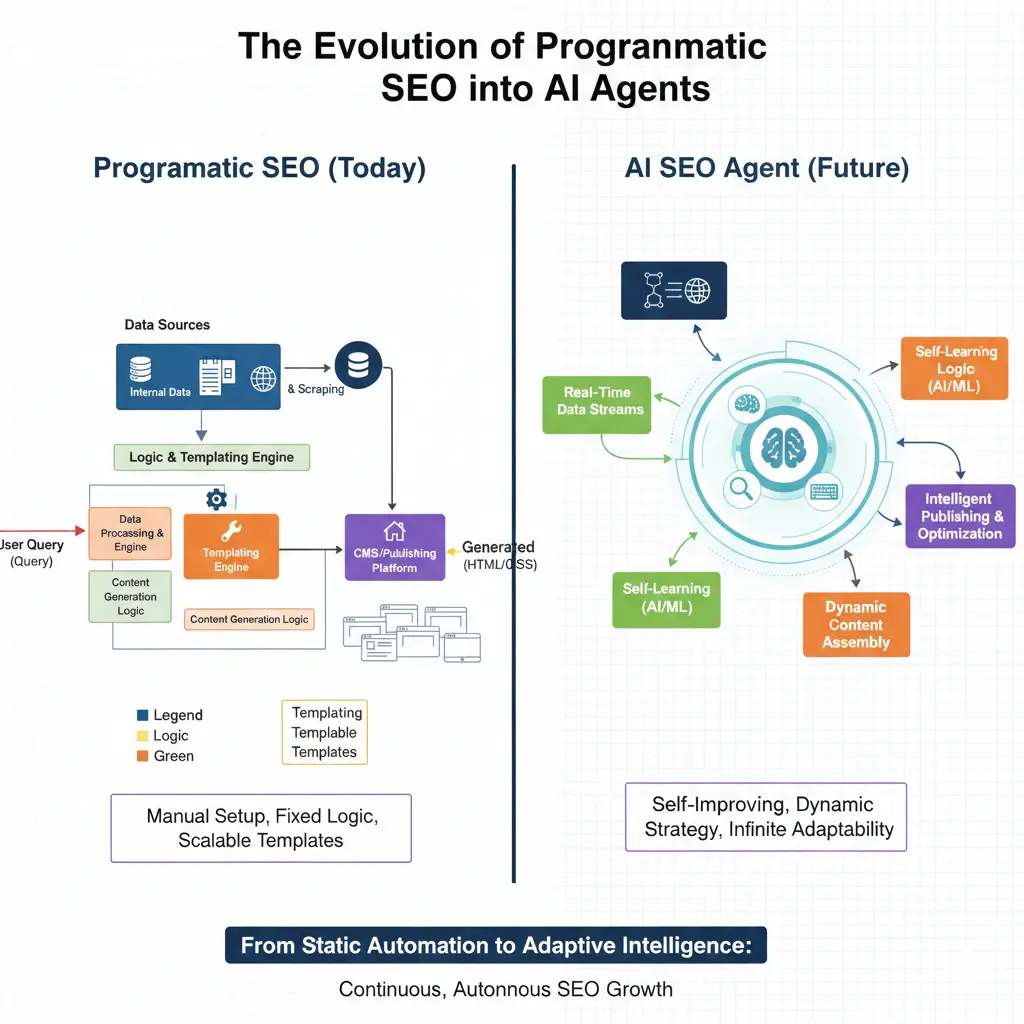
Final Thoughts: Adapt or Obsolete
The mechanism of search is changing, but the core principle remains: users want answers, and they want them fast. Programmatic SEO is the only methodology capable of meeting this demand at the scale of the modern web.
By mastering the intersection of data, automation, and user intent today, you are not just building a website; you are building a digital infrastructure capable of weathering the AI revolution. The future of SEO is automated, it is data-driven, and it is waiting for you to build it.
Scaling Your Way to Search Dominance
Programmatic SEO represents a fundamental evolution in how we approach organic growth. We have moved past the era where every page required a human author to craft every sentence. As we have explored throughout this guide, the combination of seo automation, structured data, and intelligent templates allows you to serve user intent at a magnitude that was previously impossible.
By adopting this strategy, you are not cutting corners; you are building a more efficient infrastructure. You are transforming your website from a static brochure into a dynamic engine that answers thousands of specific queries simultaneously. Whether you are using internal proprietary data or enriching your content with public APIs, the principle remains the same: leverage data to create value at scale.
The divide between businesses that rely solely on manual content and those that embrace large scale seo will only widen. As AI and LLMs continue to reshape the search landscape, having a structured, data-rich website will be your strongest asset. It ensures you are speaking the language of the algorithms while still providing the specific, accurate answers your human users are searching for.
Now is the time to audit your data, identify your repeatable keyword patterns, and start building. The tools are available, the strategy is proven, and the opportunity for massive organic growth is waiting. Do not just write your next page—engineer it.
Programmatic SEO: Frequently Asked Questions
Programmatic SEO is an SEO strategy that involves using automation and data to create and manage web pages at a large scale. Instead of manually writing each page, you create a template and use a database to automatically generate hundreds or thousands of unique pages, each targeting a specific long-tail keyword.
Traditional SEO focuses on manually crafting individual pages for high-competition keywords, which is time-intensive. Programmatic SEO focuses on building a system (template + data) to automatically generate pages at scale, targeting thousands of low-competition, high-intent long-tail keywords. It prioritises efficiency and scalability.
No, not when done correctly. High-quality programmatic SEO focuses on creating genuinely useful pages by using rich, unique, and structured data. It aims to satisfy user intent for very specific searches, whereas spam typically involves creating thin, valueless content solely to manipulate search rankings.
The primary benefits are massive scalability, extreme efficiency, and the ability to dominate long-tail search. It allows you to create thousands of pages in the time it would take to manually write a few, update content across the entire site instantly, and capture a huge amount of cumulative traffic from highly specific user queries.
It is ideal for businesses whose products or services can be described by a matrix of variables. This includes real estate platforms (e.g., properties in cities), e-commerce sites (e.g., products by category/brand), travel aggregators (e.g., flights from city A to B), job boards, and SaaS directories.
The best source is your own proprietary data (product catalogues, user data). Other common sources include third-party APIs (weather, stocks), public datasets (government statistics, census data), and, with caution, web scraping. The key is that the data must be clean, structured, and reliable.
A typical stack includes a data management tool (like Airtable or Google Sheets), a CMS with programmatic capabilities (like Webflow or WordPress with plugins), and an automation or scripting tool (like Make, Zapier, or a custom Python script) to connect them.
SEO automation is the process of using a script or no-code tool to loop through each row in your database. For each row, the script injects the data into your master template and automatically publishes a new, fully optimised page on your website.
This refers to the core practice of designing a single master page layout that serves as the blueprint for all your generated pages. This template contains static content that stays the same and dynamic placeholders (variables) that are filled with data from your database.
Yes. Low-code and no-code tools like Airtable, Webflow, and Make (formerly Integromat) have made programmatic SEO accessible without writing code. These platforms allow you to manage data, design templates, and create automation workflows through visual interfaces.
By using a rich and varied dataset. The more unique data points (columns) you have in your database, the more unique each generated page will be. Using conditional logic in your template to change sentence structure based on data also helps create variation and avoids repetition.
It is critical. Without an automated internal linking strategy, your thousands of new pages will be "orphans" that are difficult for Google to find. Your template should automatically generate links to parent categories, sibling pages (e.g., "nearby cities"), and other contextually relevant pages.
Programmatic pages, being built on structured data, are perfect for training and feeding information to AI models. This is a key part of AI SEO or LLM SEO. You can also use AI to write the "prose" within your templates, constrained by your hard data, to make content sound more natural.
Focussing on quantity over quality. Generating 10,000 pages with thin, unhelpful data will hurt your site. A successful strategy requires investing time in sourcing rich, unique data that provides real value to the user.
Success is measured by tracking the indexation rate of your new pages in Google Search Console, monitoring the organic traffic growth to the programmatic page set, and tracking rankings for a sample of the long-tail keywords you are targeting.
It varies. The technical setup can take weeks or months. Once launched, it can take Google several months to crawl, index, and begin ranking thousands of new pages. Programmatic SEO is a long-term strategy, but the growth can be exponential once it gains traction.
Absolutely. A common strategy is to add a new section to an existing site, such as a /locations/ or /integrations/ directory, to house the programmatic content. This leverages your existing domain authority.
The "head term" is the core search query (e.g., "things to do in"). The "modifier" is the variable that changes (e.g., {City}). Identifying a pattern where users combine a head term with thousands of different modifiers is the first step in finding a programmatic opportunity.
This is a major strength of programmatic SEO. You do not update the pages individually. Instead, you update the master template or the source database. The changes are then automatically propagated across all relevant pages, making maintenance incredibly efficient.
The future involves greater integration with AI for content enhancement, hyper-personalisation of pages based on user data, and the automated creation of multi-modal content like videos and dynamic images. The core principle of using structured data to answer user intent at scale will only become more important.