Digital Marketing for Beginners
Digital Marketing for Beginners: A Step-by-Step Guide
Imagine having a shop that is open 24 hours a day, 7 days a week, and accessible to anyone in the world. That is the power of the internet. But having the shop is not enough. You need customers to walk in. You need people to see your products. You need them to trust you enough to buy.
This is where digital marketing comes in.
If you are new to this world, it can feel overwhelming. There are so many acronyms like SEO, PPC, and CTR. There are so many platforms like Google, Facebook, and Instagram. Where do you even start?
This guide is written specifically for you. We will strip away the jargon and explain digital marketing for beginners in plain English. Think of this as your first textbook on how to succeed online. By the end of this guide, you will understand exactly how businesses grow online and how you can start learning these valuable skills yourself.
Let’s begin your journey.
Table of Contents
What is Digital Marketing?
Before we dive into the complex tools and strategies, we must first answer the most basic question: What is digital marketing?
Definition of Digital Marketing
At its simplest level, digital marketing is the act of promoting products or services using the internet and electronic devices. If you see an ad on Facebook, that is digital marketing. If you search for “best pizza near me” on Google and find a restaurant, that is digital marketing at work.
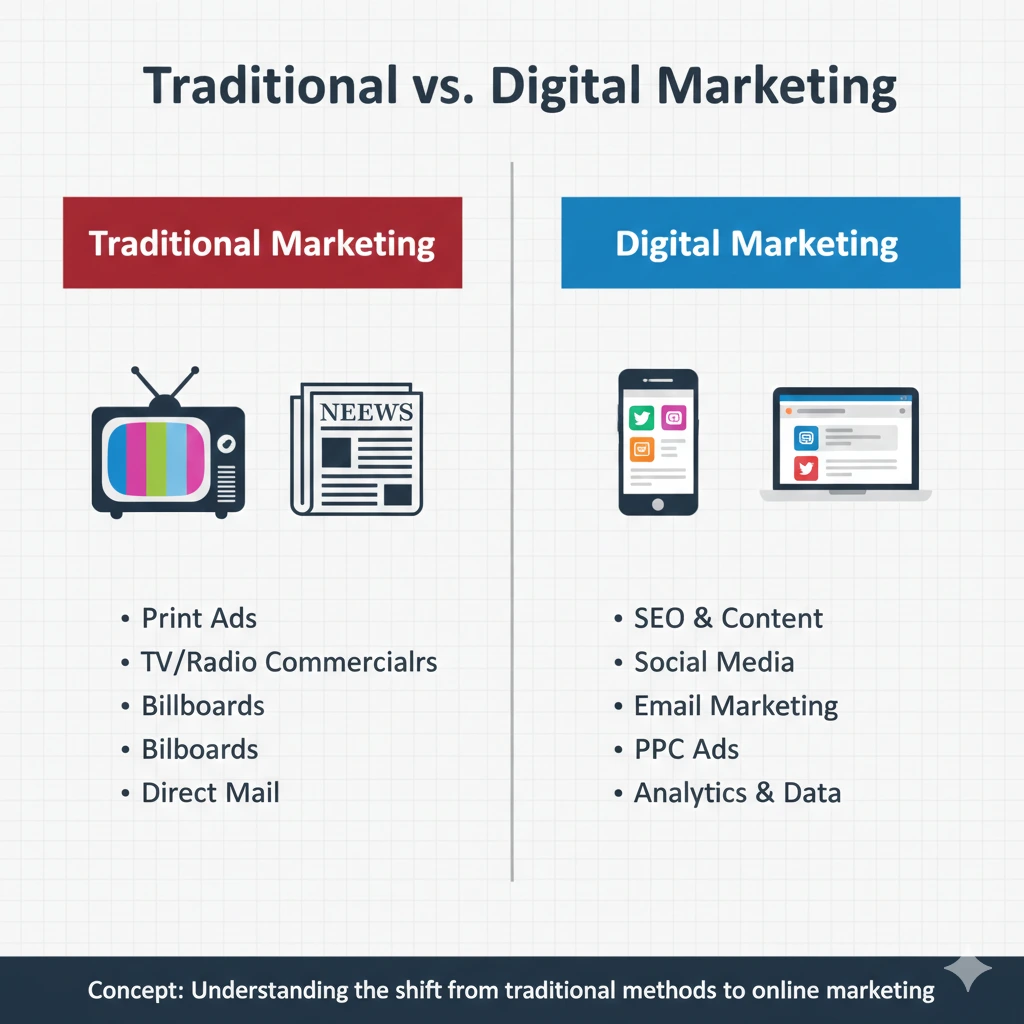
Unlike traditional marketing, which relies on billboards, newspapers, or TV commercials, digital marketing happens online. It allows businesses to connect with prospective customers where they spend much of their time: on their phones and laptops.
Why is Digital Marketing Important?
You might wonder why everyone is talking about online marketing for beginners and experts alike. The answer lies in consumer behaviour.
Years ago, if you wanted to buy a car, you went to a dealership. If you wanted to buy a TV, you went to an electronics store. Today, the process starts online. People research, compare prices, read reviews, and often make the purchase without ever speaking to a salesperson.
Digital marketing is important because:
- It is cost-effective: You can reach thousands of people for a fraction of the cost of a TV ad.
- It is measurable: You can see exactly how many people clicked your link or watched your video.
- It is targeted: You can show your message only to people interested in what you offer.
- It levels the playing field: Small businesses can compete with big brands.
Examples of Digital Marketing in Action
To help you learn digital marketing, let’s look at some real-life scenarios you probably encounter every day.
Example 1: The Email Offer
You sign up for a newsletter from a clothing brand. A week later, they send you an email with a 20% discount code for your birthday. This is Email Marketing.
Example 2: The Google Search
You type “how to fix a leaky tap” into Google. You click on a blog post that gives you step-by-step instructions. At the bottom of the post, there is a link to buy a wrench. This is Content Marketing and SEO.
Example 3: The Instagram Ad
You are scrolling through Instagram and see a video of a new type of coffee machine. You click the “Shop Now” button. This is Social Media Marketing.
Digital Marketing Basics
To master digital marketing basics, you need to understand the different pillars that hold it up. Think of digital marketing as a house. The house needs a roof, walls, windows, and a door. If one part is missing, the house isn’t complete.
Here are the key components you need to know.
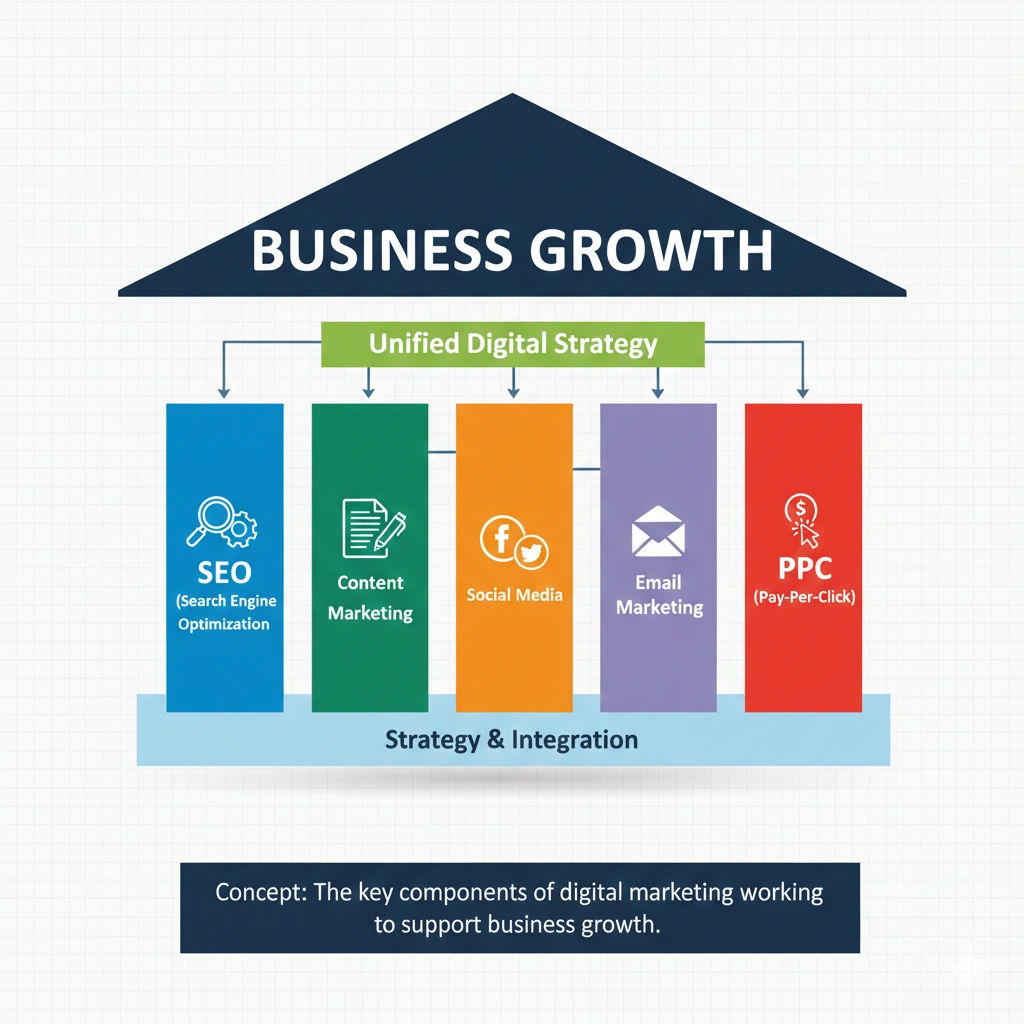
Key Components of Digital Marketing
SEO for Beginners
SEO stands for Search Engine Optimisation. It sounds technical, but the concept is simple. SEO is the process of improving your website so that it appears higher in search results on Google or Bing.
When you search for something, you usually click on the first or second result. You rarely go to page two. SEO is the art of getting your website to that top spot.
How it works:
- You find out what words people are typing into Google (Keywords).
- You create high-quality content that answers their questions.
- You make sure your website is fast and easy to use.
Content Marketing Basics
Content marketing basics revolve around creating valuable information. Instead of just saying “Buy my product,” you provide help, entertainment, or education.
Content includes:
- Blog posts (like this one)
- Videos (YouTube tutorials)
- Infographics (Visual charts)
- Podcasts (Audio shows)
The goal is to build trust. If a company teaches you how to solve a problem for free, you are more likely to trust them when you are ready to buy something.
Social Media Marketing Basics
This is the practice of using platforms like Facebook, Instagram, LinkedIn, TikTok, and Twitter (X) to promote a brand. Social Media Marketing basics involve more than just posting pictures.
It involves:
- engaging with followers in the comments.
- creating content that people want to share.
- building a community around your brand.
For a beginner, the key is to not try to be everywhere at once. It is better to be really good on one platform than average on five.
Google Ads for Beginners
While SEO is about getting traffic for free (organic), Google Ads is about paying for traffic (paid). This is often called PPC (Pay-Per-Click).
Google Ads for beginners works like an auction. You bid money on specific keywords. For example, a plumber might bid on the keyword “emergency plumber London.” If they win the bid, their ad appears at the very top of the search results. They only pay Google when someone actually clicks on the ad.
Email Marketing Basics
Many people think email is dead, but it is actually one of the most powerful tools in digital marketing. Email marketing basics involve collecting email addresses from interested people and sending them messages.
Unlike social media, where an algorithm decides who sees your post, email lands directly in a user’s inbox. It is personal and direct. It is used to nurture relationships with potential customers over time.
Traditional Marketing vs. Digital Marketing
To fully grasp what is digital marketing, it helps to compare it to the old way of doing things.
Feature | Traditional Marketing | Digital Marketing |
Medium | TV, Radio, Print, Billboards | Social Media, Email, Websites, Search Engines |
Cost | High (Expensive to run a TV ad) | Low/Flexible (Can start with £5) |
Reach | Broad (Reaches everyone, interested or not) | Targeted (Reaches specific ages, interests, locations) |
Interaction | One-way (Customer watches/reads) | Two-way (Customer can comment, reply, share) |
Measurement | Difficult to track exact results | Easy to track every click and view |
How to Start Digital Marketing
Now that you understand the definitions, the next question is typically: how to start digital marketing? Whether you want to promote your own business or start a new career, the steps are similar.
Digital Marketing Step by Step
Step 1: Understand Your Audience
You cannot sell to everyone. If you try to speak to everyone, you end up speaking to no one. You need to define your “Target Audience.”
Ask yourself:
- Who are they? (Age, gender, location)
- What are their problems?
- Where do they hang out online? (Instagram? LinkedIn? Google?)
Step 2: Set Clear Goals
What do you want to achieve? “Success” is too vague. You need SMART goals (Specific, Measurable, Achievable, Relevant, Time-bound).
- Bad Goal: “I want more visitors.”
- Good Goal: “I want to reach 1,000 website visitors per month within 6 months using SEO.”
Step 3: Learn the Tools of the Trade
You don’t need to buy expensive software yet. Start with free tools to understand the data.
- Google Analytics: Shows you who visits your website.
- Google Search Console: Shows you how your site performs in search results.
- Canva: Helps you design simple graphics for social media.
- Mailchimp (Free Plan): Helps you send basic emails.
Step 4: Create a Digital Marketing Roadmap
A digital marketing roadmap is your plan of action. It outlines what channels you will use and when.
For example:
- Month 1: Build a website and write 4 blog posts (SEO/Content).
- Month 2: Set up an Instagram account and post 3 times a week (Social Media).
- Month 3: Start collecting emails and send a monthly newsletter (Email Marketing).
Step 5: Start Small and Scale Gradually
One of the biggest mistakes in digital marketing for beginners is trying to do everything at once. Pick one channel. Master it. Then move to the next.
If you enjoy writing, start with a blog (Content Marketing). If you enjoy visuals, start with Instagram. Don’t spend money on ads until you understand how to get traffic for free first.
Common Mistakes Beginners Should Avoid
- Ignoring Mobile Users: Most people browse on phones. Ensure your content looks good on a small screen.
- Being Inconsistent: Posting five times in one week and then disappearing for a month will kill your progress. Consistency is key.
- Expecting Overnight Results: SEO can take 6 months to show results. Building a social following takes time. Patience is required.
- Buying Followers: Never do this. It looks bad, and these “fake” people will never buy from you.
Digital Marketing Roadmap
Let’s look deeper into how you can structure your learning or your campaign. A roadmap keeps you from getting lost.
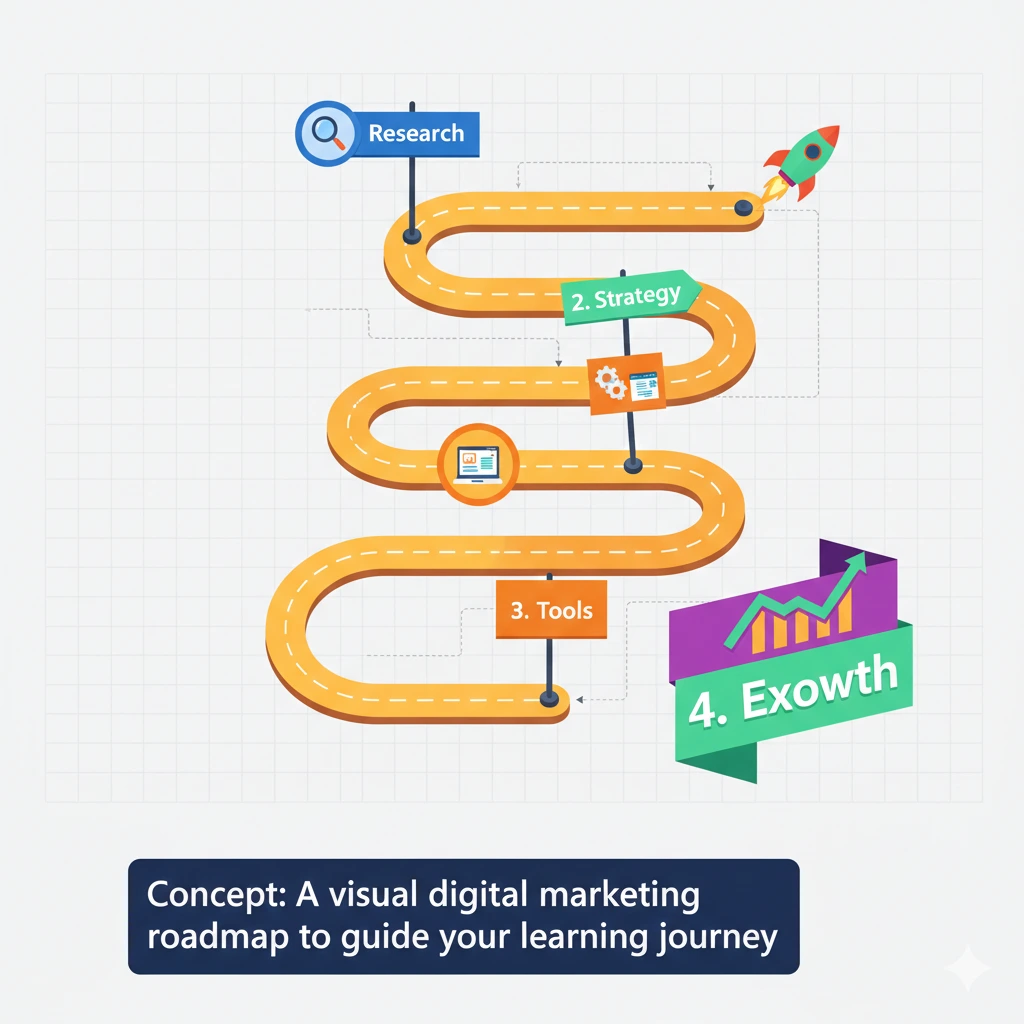
A Beginner’s Guide to Building a Strategy
Research and Planning
Before you write a single word or post a single image, research is vital.
- Competitor Analysis: Look at what your competitors are doing. What keywords do they use? What kind of posts get likes?
- Keyword Research: Use tools like Google Keyword Planner (free) to see what people are searching for.
Execution and Monitoring
This is where you do the work. You write the blog posts, you create the videos, you send the emails. But you must also monitor them.
- Check your analytics weekly.
- See which posts did well and which did poorly.
- Ask yourself “why?”
Optimization and Growth
Digital marketing is never “finished.” You are always testing and improving.
- If a headline didn’t get clicks, rewrite it.
- If a page loads slowly, fix the images.
- If an email didn’t get opened, try a different subject line.
Tools to Help You Learn Digital Marketing
To effectively learn digital marketing, familiarise yourself with these industry standards. Many offer free academies or certifications.
- HubSpot Academy: Excellent free courses on Inbound Marketing and Social Media.
- Google Digital Garage: Google’s own free training on the fundamentals of digital marketing.
- Moz Beginner’s Guide to SEO: The gold standard for reading about SEO basics.
Digital Marketing Career: Is It Right for You?
Perhaps you aren’t starting a business. Perhaps you are looking for a job. A digital marketing career is a fantastic choice in the modern economy. Demand is high, and you can often work remotely.
Skills Needed for a Digital Marketing Career
You do not need a university degree in marketing to succeed. However, you do need a specific set of skills:
- Data Analysis: You must be comfortable looking at numbers and charts to see what is working.
- Writing: Good copywriting is the heart of almost all digital marketing.
- Creativity: You need to come up with fresh ideas to grab attention.
- Adaptability: The internet changes every day. You must be willing to learn constantly.
Job Roles in Digital Marketing
The field is broad. You can generalise or specialise.
- Digital Marketing Manager: Oversees the whole strategy.
- SEO Specialist: Focuses purely on ranking in Google.
- Content Writer: Writes blogs, articles, and website copy.
- Social Media Manager: Handles the brand’s social accounts.
- PPC Specialist: Manages paid ad campaigns (Google Ads, Facebook Ads).
How to Build a Portfolio as a Beginner
Employers want to see proof that you can do the job. But how do you get proof without a job?
- Start your own blog: Pick a hobby you love (e.g., gaming, cooking, hiking) and build a site. Try to rank it on Google.
- Volunteer: Offer to run the social media page for a local charity or a friend’s small business.
- Get Certified: Complete the free Google and HubSpot certifications and add them to your LinkedIn profile.
FAQs About Digital Marketing for Beginners
The easiest way is to start doing it. You can watch videos all day, but you will learn more by building a simple website or starting an Instagram page for a specific topic. Hands-on experience is the best teacher. Start with free resources like Google Digital Garage to get the terminology down, then apply it immediately.
To understand the digital marketing basics, it can take 1 to 3 months of dedicated study. However, becoming an expert takes years. Because platforms like Google and Facebook change their rules (algorithms) constantly, learning never truly stops. You are always a student in this industry.
Yes, absolutely. Everyone starts with zero experience. The barrier to entry is low because you don't need expensive equipment. All you need is a computer, an internet connection, and the willingness to learn. Many top marketing directors today started by just tinkering with their own blogs or social media pages.
Start with the free versions of powerful tools:
- Canva for design.
- Google Analytics for data.
- Buffer or Hootsuite for scheduling social media posts.
- WordPress for building a website.
- Mailchimp for email newsletters.
Yes. It is one of the fastest-growing industries globally. Every business, from the local coffee shop to massive international corporations, needs digital marketing to survive. This means job security is generally high, and there are many opportunities for freelance work if you prefer to be your own boss.