Topical Authority SEO
Topical Authority SEO – How to Dominate Google Using Topic Clusters
Ranking on Google is no longer about winning a single keyword. It’s about winning an entire topic. For years, SEOs focused on optimizing individual pages for specific keywords. That era is over. Today, search engines priorities websites that demonstrate comprehensive expertise and authority on a subject. This is the core of topical authority.
By building deep, interconnected content networks, you signal to Google and other search engines that you are a definitive source of information. This guide will take you through the principles of topical authority SEO, from understanding the theory to implementing a practical strategy. You will learn how to build topic clusters, create topical maps, and structure your site to dominate search results not just for a handful of keywords, but for an entire domain of knowledge. This is a fundamental part of any modern advanced SEO strategy.
Table of Contents
1. What is Topical Authority?
Topical authority is the perceived expertise and depth of knowledge a website has on a specific subject. Instead of viewing a site as a collection of individual pages, search engines like Google assess its overall coverage of a topic. When a site thoroughly covers a subject, answering every conceivable question and connecting related concepts, it builds topical authority.
Think of it like this: if you wanted to learn about classical music, would you trust a single article on Mozart from a general interest blog, or would you trust a website with hundreds of interconnected articles on composers, eras, instruments, and music theory? The latter is the one with topical authority.
In the context of SEO, achieving this authority means your website becomes the go-to resource for a particular niche. This isn’t about keyword density or backlinks to a single page. It’s about creating a comprehensive ecosystem of content that collectively proves your expertise. This depth of content signals to search algorithms that you are a reliable and trustworthy source, making it more likely that your pages will rank for a wide array of queries related to your topic.
Building topical authority is a long-term strategy. It requires a shift from a keyword-centric mindset to a topic-centric one. The goal is to own the conversation around your area of expertise, creating a moat of content that competitors will find difficult to replicate.
2. How Google Measures Topical Authority
Google’s algorithms have evolved far beyond simple keyword matching. The search engine’s primary goal is to provide users with the most relevant, accurate, and comprehensive answers to their queries. To do this, it needs to understand which sources are truly experts. Google uses several sophisticated methods to measure and validate topical authority.
First, Google analyses the breadth and depth of your content on a subject. It looks for a structured collection of content, often organized into topic clusters, that covers a subject from multiple angles. A site with one article on “digital marketing” has far less authority than a site with a central pillar page on the topic, supported by detailed articles on SEO, content marketing, PPC, email marketing, and social media.
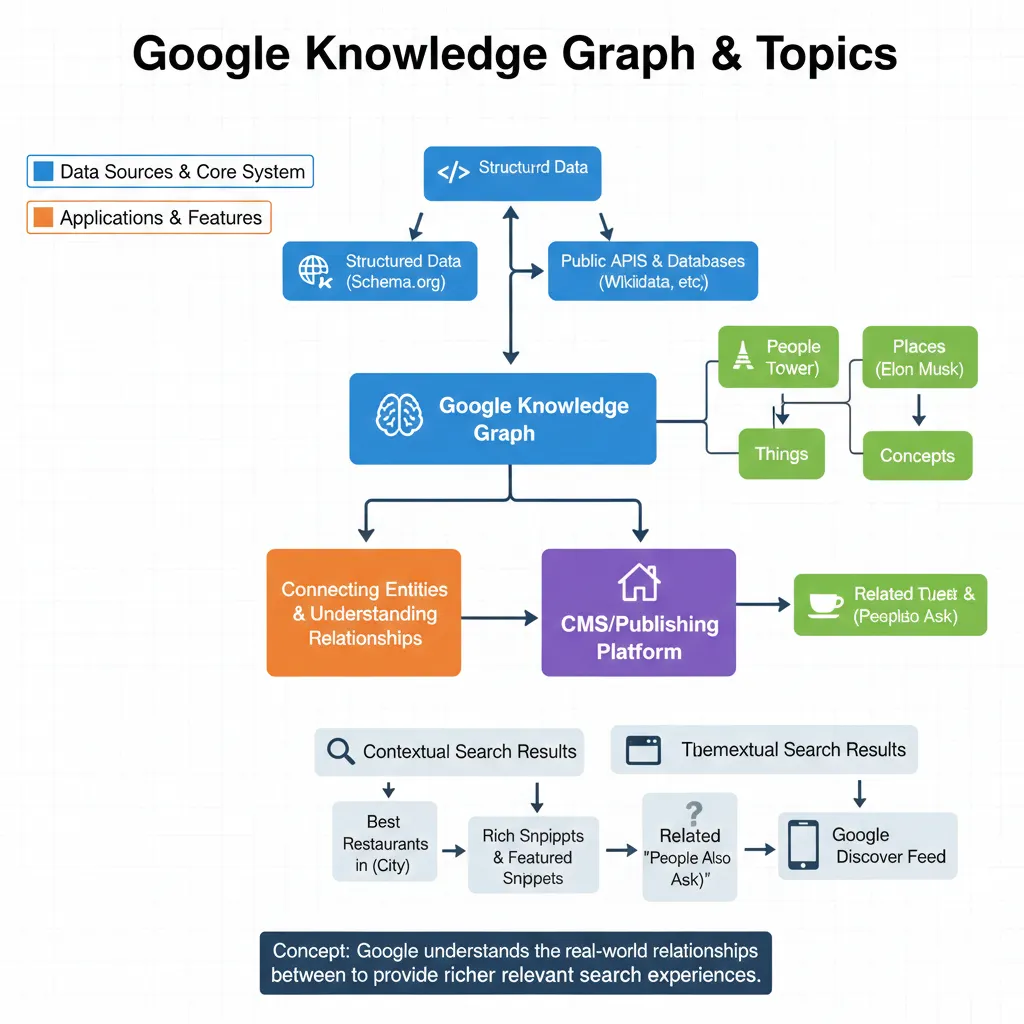
Second, Google assesses semantic SEO relationships between your content. It doesn’t just see words; it understands entities (people, places, things, concepts) and the relationships between them. When you create content that logically connects different entities within your topic, you help Google build its own understanding. For example, an article about “email marketing” that also discusses “open rates,” “click-through rates,” “segmentation,” and “automation” demonstrates a deeper understanding than one that just repeats the primary keyword. This is closely linked to entity SEO.
Third, internal linking plays a critical role. The way you link your pages together creates a roadmap for search crawlers, showing them which pages are most important and how different concepts are related. Strong internal linking from supporting articles to a central pillar page, and vice versa, reinforces the structure of your topic cluster and funnels authority to your most important content. This structured approach, sometimes referred to as SEO silos, is a powerful signal.
Finally, user engagement signals and external validation (backlinks) still matter, but in the context of your overall topic. When users spend more time on your site, clicking through to related articles, it tells Google your content is valuable. Similarly, backlinks from other authoritative sites within your niche validate your expertise. However, a backlink to a page within a strong topic cluster carries more weight than a link to a standalone, orphaned page.
3. Topical Maps & Knowledge Graph
To understand how to build topical authority, you must first understand how Google sees the world: through the lens of its Knowledge Graph. The Knowledge Graph is a massive database of entities and the relationships between them. It’s what allows Google to understand that “Leonardo da Vinci” was a person, the painter of the “Mona Lisa,” and an inventor from the Renaissance.
A topical map is essentially your website’s version of the Knowledge Graph for your specific niche. It is a strategic blueprint that outlines all the subtopics, questions, and related concepts you need to cover to establish comprehensive authority on a subject. It’s not just a list of keywords; it’s a structured hierarchy of interconnected ideas.
Creating a topical map involves identifying a broad “pillar” topic and then breaking it down into smaller, more specific “cluster” topics. These clusters, in turn, can be broken down even further.
For example, a topical map for “Home Gardening” might look like this:
- Pillar Topic: The Ultimate Guide to Home Gardening
- Cluster Topic: Vegetable Gardening
- Sub-cluster: Growing Tomatoes
- Sub-cluster: Growing Lettuce
- Sub-cluster: Pest Control for Vegetables
- Cluster Topic: Flower Gardening
- Sub-cluster: Planting Roses
- Sub-cluster: Perennials vs. Annuals
- Cluster Topic: Tools & Equipment
- Sub-cluster: Choosing the Right Shovel
- Sub-cluster: Soil Testing Kits
- Cluster Topic: Vegetable Gardening
This map visually represents your content strategy. It ensures you cover every facet of your core topic, leaving no gaps in your expertise. By building out content based on this map, you are creating a website structure that mirrors how Google understands information. This makes it incredibly easy for the search engine to recognize your site’s topical relevance and reward it with higher rankings. Your topical map is the architectural plan for your content fortress.
4. Topic Clusters vs Keyword Pages
The traditional SEO approach focused on creating individual pages, each optimized for a single, high-volume keyword. This resulted in websites with a scattered collection of articles that often competed with each other and failed to provide a cohesive user experience. The topic clusters model is a strategic evolution that addresses these flaws.
A keyword page is a single page designed to rank for a specific search term, like “best running shoes.” Its focus is narrow and isolated.
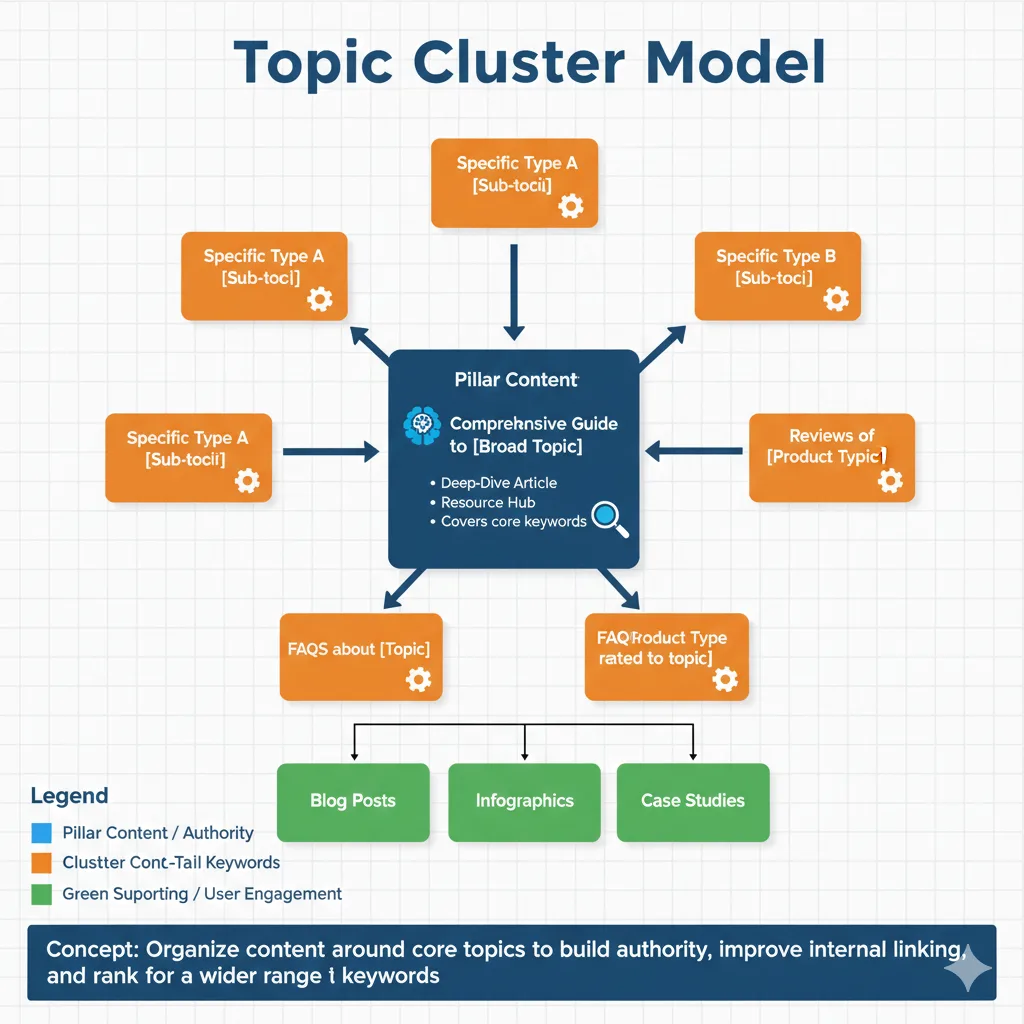
A topic cluster, on the other hand, is a collection of interlinked pages built around a central, broad topic. It consists of two main components:
- Pillar Page: This is a long-form, comprehensive piece of content that provides a broad overview of the main topic. For example, “A Complete Guide to Running Shoes.” This page targets a broad, high-volume keyword but aims to be the definitive resource on the subject.
- Cluster Content (or Sub-pages): These are more specific articles that delve into subtopics related to the pillar. Each cluster page targets a more specific, long-tail keyword. Examples for the “Running Shoes” pillar could include “Best Running Shoes for Flat Feet,” “How to Choose Trail Running Shoes,” and “Nike vs. Adidas Running Shoes.”
Here’s why the topic cluster model is superior to the old keyword page strategy:
- Organized Architecture: Topic clusters create a logical, clean site architecture. This improves user experience by making it easy for visitors to find related information, increasing dwell time and engagement.
- Demonstrates Expertise: Creating a comprehensive cluster of content proves to Google that you have deep knowledge on a subject, building topical authority. A single page can’t achieve this.
- Internal Linking Power: The model is built on a foundation of strategic internal linking. All cluster pages link up to the central pillar page, and the pillar page links out to the clusters. This creates a powerful flow of PageRank and relevance signals throughout the topic hub, boosting the ranking potential of every page within the cluster.
- Broader Keyword Reach: A topic cluster allows you to rank for hundreds or even thousands of related keywords, not just one. The pillar page targets the broad terms, while the cluster content captures the long-tail queries. Over time, the authority of the entire cluster lifts all boats, improving rankings across the board.
Shifting from a keyword-focused to a topic-focused strategy is essential for modern topical authority SEO. It aligns your content strategy with how both users and search engines explore and understand information.
5. How to Build a Topical Map
Building a topical map is the most critical strategic step in establishing topical authority. It is the blueprint that will guide your entire content creation process. This process requires research, analysis, and strategic thinking. Follow these steps to build a robust topical map for your niche.
Step 1: Identify Your Core Pillar Topic
Start by defining the broad subject you want to be known for. This should be central to your business or website’s purpose. It should be a topic with significant search volume and broad enough to be broken down into numerous subtopics. For an accounting firm, a core pillar might be “Small Business Accounting.” For a fitness brand, it could be “Strength Training.”
Step 2: Brainstorm Cluster Topics
Once you have your pillar, start brainstorming all the related subtopics. Think about the different facets of your main topic. What are the key components? What questions do people ask about it?
For the “Small Business Accounting” pillar, cluster topics could include:
- Bookkeeping Basics
- Tax Planning for Small Businesses
- Payroll Management
- Financial Reporting
- Choosing Accounting Software
- Managing Cash Flow
Don’t filter your ideas at this stage. Use tools like Google’s “People Also Ask” section, AnswerThePublic, and forums like Reddit or Quora to find what your audience is curious about.
Step 3: Conduct Keyword and SERP Research
Now, take your brainstormed list and validate it with data. For each potential cluster topic, perform keyword research to understand search volume, difficulty, and user intent. Look at the search engine results pages (SERPs) for these terms. What kind of content is ranking? Are they blog posts, guides, or product pages? Pay close attention to the sub-topics covered by the top-ranking pages. These are clues from Google about what it considers relevant to that topic.
This research helps you refine your cluster topics and identify even deeper sub-clusters. For “Tax Planning for Small Businesses,” you might discover sub-clusters like “Quarterly Estimated Taxes,” “Business Expense Deductions,” and “S Corp vs. LLC Taxes.”
Step 4: Structure and Visualize Your Map
Organize your findings into a hierarchical structure. You can use a spreadsheet, a mind mapping tool like MindMeister or XMind, or even just a whiteboard.
Your structure should look something like this:
- Level 1 (Pillar): The main topic.
- Level 2 (Clusters): The primary subtopics that support the pillar.
- Level 3 (Sub-clusters): More specific articles that support each cluster.
[Image: Topical Map Diagram]
This visual representation is your topical map. It clearly shows the relationship between different pieces of content and ensures you are creating a cohesive content ecosystem, not just a random collection of articles. This is the foundation of building effective content clusters.
Step 5: Priorities and Plan Content Creation
You likely won’t be able to create all the content on your map at once. Priorities based on business goals, search volume, and competitive landscape. You might start with the clusters that are most important to your audience or where you have the best chance of ranking quickly.
Some SEOs even use programmatic SEO techniques to rapidly build out content for highly structured sub-clusters, such as creating pages for “Best Accounting Software for [Industry].” This can accelerate the process of building topical relevance. However, the core of your map should be built with high-quality, expert-written content.
6. Internal Linking for Authority
A well-planned topical map is useless without the glue that holds it together: internal linking. The way you link pages within your site is one of the most powerful signals you can send to Google about your site’s structure, the relative importance of your pages, and your topical authority. A strategic internal linking plan turns your collection of articles into a cohesive, authority-building machine.
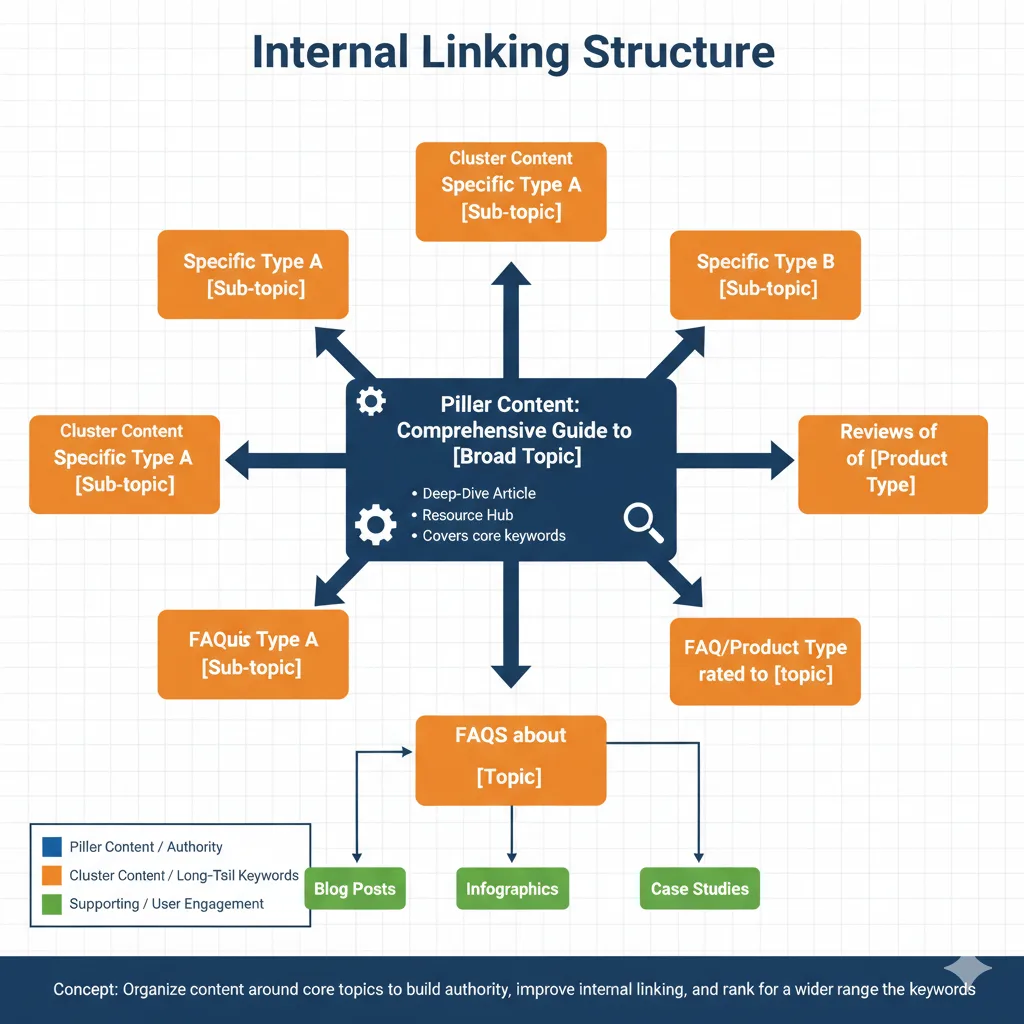
The primary model for internal linking within a topic cluster is the “Pillar and Cluster” model. The rules are simple but effective:
- Link Clusters to the Pillar: Every cluster page (the specific, sub-topic articles) should link up to the main pillar page. This link should be contextual, meaning it is placed within the body of the text where it makes sense. For example, in an article about “Quarterly Estimated Taxes,” you might have a sentence like, “This is a key part of your overall small business accounting strategy,” with the anchor text linking to your pillar page. This funnels authority from your specific articles up to your main hub page.
- Link the Pillar to Clusters: Your pillar page should link out to all of its supporting cluster pages. Since the pillar page provides a broad overview, it’s natural to link to more detailed articles for readers who want to dive deeper. For instance, in the “Small Business Accounting” pillar, you would have sections for “Tax Planning,” “Bookkeeping,” etc., with links to your specific cluster articles on those topics.
This reciprocal linking structure creates a tightly-knit hub of content. It signals to Google that these pages are all related and that the pillar page is the most important page in the group. This is the essence of creating SEO silos—grouping related content together to concentrate its ranking power.
Beyond the basic pillar-and-cluster model, consider these advanced internal linking strategies:
- Link Between Related Cluster Pages: It’s also beneficial to link between different cluster pages where relevant. An article on “Business Expense Deductions” could logically link to an article on “Choosing Accounting Software” to track those deductions. This creates a “web” of content that further reinforces the topical relationships and improves user experience by guiding them to relevant information.
- Anchor Text Optimization: Use descriptive, keyword-rich anchor text for your internal links. Instead of “click here,” use “learn more about our tax planning services.” This gives both users and search engines context about the linked page. Vary your anchor text to keep it looking natural.
- Priorities Important Pages: Pages with more internal links pointing to them are seen as more important by Google. Ensure your most critical pages (like your pillar pages and money pages) receive the most internal links from other relevant pages on your site. This requires a solid grasp of your site’s overall architecture, often managed through good technical SEO.
A deliberate internal linking strategy is not an afterthought; it is a core component of topical authority SEO. It is the mechanism that activates your topical map and channels authority where it’s needed most.
7. Topical Authority for AI & LLMs
The rise of AI-powered search, including Google’s AI Overviews and conversational models like ChatGPT and Gemini, has made topical authority more important than ever. These Large Language Models (LLMs) don’t just crawl and index content; they consume, synthesize, and understand it to generate novel answers. For your content to be used as a source for these AI-generated results, it must be authoritative, comprehensive, and clearly structured.
This is where AI SEO and LLM SEO come into play. It’s about optimizing your content not just for traditional crawlers, but for AI models that are looking for definitive, well-explained information. Here’s why topical authority is critical in this new landscape:
- AI Needs Trusted Sources: LLMs are trained to identify and priorities information from sources that demonstrate deep expertise. A website with a comprehensive topical map and well-structured content clusters is a much more reliable source for an AI than a site with a few scattered articles. When an AI needs to generate an answer about a complex topic, it will favor the site that has covered it from every angle.
- Structure Aids Synthesis: AI models thrive on structured data. A clear hierarchy of pillar pages and cluster content, connected by logical internal linking, makes it easier for an AI to understand the relationships between concepts on your site. This structured approach helps the LLM synthesize the information accurately and attribute it back to you.
- Entity-Based Understanding: AI search is heavily reliant on entity based SEO. LLMs understand the world as a network of entities and relationships. By building out a topical map, you are essentially creating a detailed entity map for your niche. Your content defines what the key entities are (e.g., “S Corp,” “quarterly taxes”) and explains their attributes and how they relate to one another. This makes your content highly valuable to AI systems.
To optimize for AI and LLMs, you must double down on the principles of topical authority:
- Answer Questions Explicitly: Structure your content to directly answer common questions. Use clear headings (e.g., “What is a Business Expense Deduction?”) and provide concise, accurate answers. This makes your content easy for an LLM to parse and use in a generated answer.
- Cover Topics Comprehensively: Leave no stone unturned. Your topical map should guide you to cover not just the “what” but the “why,” “how,” “when,” and “who” of your subject. The goal is to be the most complete resource available.
- Priorities Factual Accuracy and Clarity: AI models are getting better at detecting misinformation. Ensure your content is well-researched, factually accurate, and clearly written. Simple, direct language is easier for both humans and machines to understand.
In the age of AI search, being a generalist is a losing strategy. The future belongs to specialists who have proven their deep expertise through comprehensive, well-structured content. Topical authority SEO is the key to becoming a trusted source for the next generation of search.
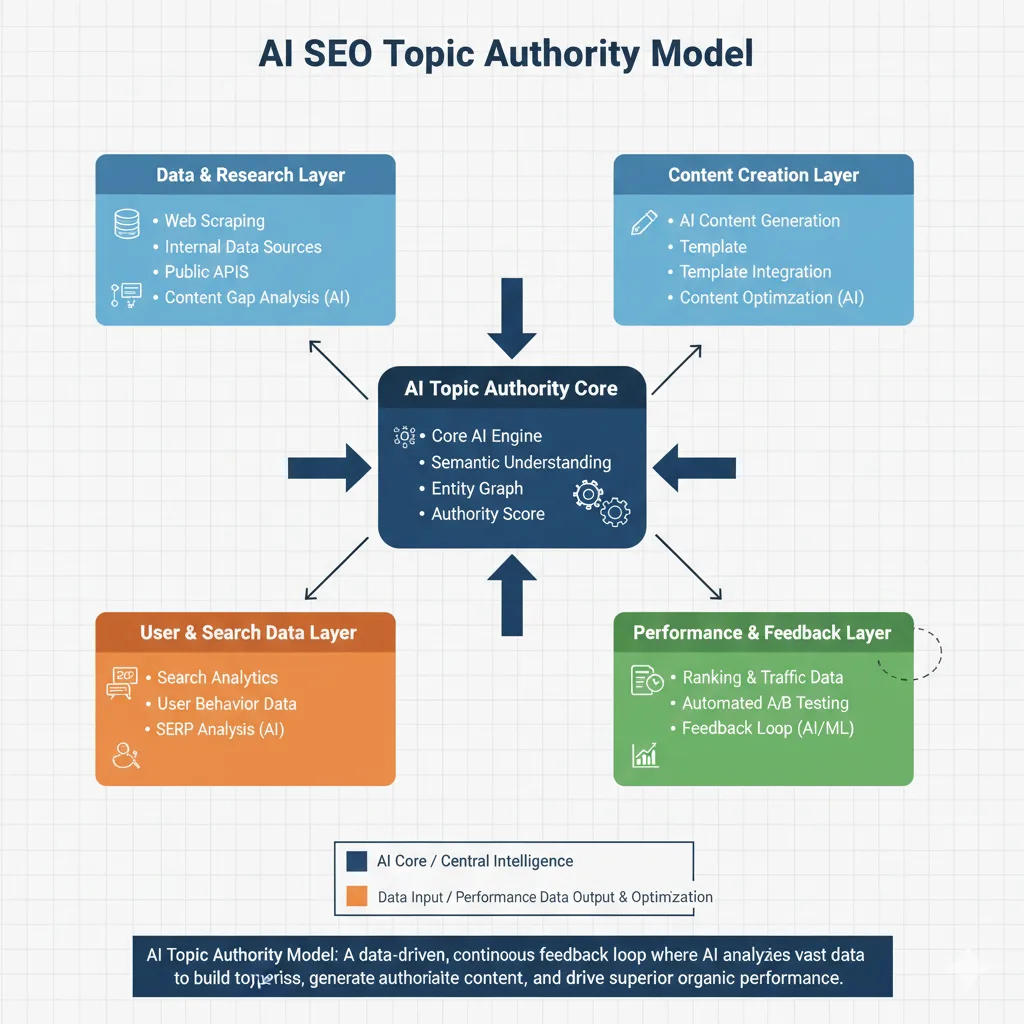
8. Tools to Build Topical Maps
Creating a comprehensive topical map manually is a monumental task. Fortunately, a variety of tools can streamline the research and organization process, helping you identify topics, analyze competitors, and structure your content strategy more efficiently. Here are some of the best tools for building topical maps and executing a topical authority SEO strategy.
- Mind Mapping Tools (XMind, MindMeister)
Before you get into heavy SEO tools, you need a way to visualize your map. Mind mapping software is perfect for this. You can start with your pillar topic in the center and branch out with your clusters and sub-clusters. This visual approach helps you see the relationships between topics and identify gaps in your plan. - SEO Suites (Ahrefs, Semrush)
These all-in-one SEO platforms are indispensable.
- Keyword Explorer: Use them to validate your topic ideas, find search volume, and discover thousands of related keywords and questions. Ahrefs’ “Questions” report and Semrush’s “Keyword Magic Tool” are excellent for finding cluster topic ideas.
- Content Gap Analysis: Enter your domain and a few of your top competitors. These tools will show you the keywords your competitors rank for that you don’t. This is a goldmine for finding cluster topics you’ve missed.
- Top Pages Analysis: Look at the top-performing pages of authoritative sites in your niche. This shows you what topics are driving traffic for them and provides a model for the kind of content that succeeds.
- Specialized Topical Authority Tools (Topic, SurferSEO, MarketMuse)
These tools are specifically designed for content optimization and topical modeling.
- MarketMuse: This is a premium platform that uses AI to analyze your entire site and provide a personalized topical map. It scores your content on topic depth and identifies specific subtopics you need to cover to build authority.
- Topic & SurferSEO: These tools analyze the top-ranking SERPs for your target keyword and provide a detailed brief of what to include in your content. They list related topics, questions to answer, and recommended word counts, helping you create more comprehensive content than your competitors. They are essential for optimizing individual cluster pages for topical relevance.
- Question & Forum Research Tools (AnswerThePublic, AlsoAsked)
These tools visualize search data from Google’s “People Also Ask” and autocomplete features.
- AnswerThePublic: Enter a keyword, and it will generate a visualization of questions (what, where, why, how) and comparisons (vs, or, and) related to your topic. It’s a fantastic brainstorming tool for finding cluster and sub-cluster ideas directly from user queries.
- AlsoAsked: This tool provides a branching tree of “People Also Ask” questions, showing you the journey a user takes as they explore a topic in more depth. This helps you structure your content clusters logically.
- Google’s Own Tools (Search, Trends, Keyword Planner)
Don’t forget the free tools at your disposal.
- Google Search: The “People Also Ask” boxes, “Related searches,” and autocomplete suggestions are direct insights into how Google connects topics.
- Google Trends: Use this to compare the popularity of different topics over time and identify emerging trends you can build content around.
By combining these tools, you can move from a vague idea to a data-driven, highly detailed topical map that sets the foundation for your content strategy.
9. Topical Authority SEO Strategy
Having a topical map and understanding the concepts is one thing; executing a successful topical authority SEO strategy is another. This requires a long-term commitment and a methodical approach to content creation, optimization, and maintenance. Here is a step-by-step strategy to build and leverage topical authority.
Step 1: Foundational Audit and Planning
Start with what you already have. Conduct a content audit to see how your existing articles fit into your new topical map.
- Identify existing assets: Do you already have pages that could serve as pillars or clusters?
- Find content to consolidate or prune: You may have multiple weak articles on the same topic that could be combined into one stronger piece. You may also have outdated, low-quality content that should be removed or redirected.
- Priorities your map: Using your topical map, create a content calendar. Priorities topics based on business value, audience need, and competitive opportunity.
Step 2: Create High-Quality Pillar Content
Your pillar pages are the cornerstones of your authority. Do not cut corners here. A pillar page should be one of the best resources on the internet for that topic.
- Be comprehensive: Aim for 3,000-10,000+ words, covering every major aspect of the topic.
- Be well-structured: Use clear headings (H2s, H3s), a table of contents, and rich media (images, videos, diagrams).
- Be a hub: Design it to link out to all your supporting cluster content.
Step 3: Build Out Your Topic Clusters
With the pillar in place, begin creating your cluster content. Each piece should be a deep dive into a specific sub-topic.
- Focus on user intent: Each cluster article should thoroughly answer the specific question or solve the specific problem behind the long-tail keyword it targets.
- Optimize for comprehensiveness: Use tools like SurferSEO to ensure you’re covering the sub-topic in more depth than the current top-ranking pages.
- Implement internal linking immediately: As you publish each cluster article, link it up to the pillar page and to any other relevant cluster pages.
Step 4: Promote and Build Authority
Content creation is only half the battle. Once your cluster is live, you need to promote it.
- Link building: While internal authority is key, external backlinks from other authoritative sites in your niche are still a powerful trust signal. Promote your pillar page as a definitive resource worthy of links.
- Social promotion: Share your content across relevant social channels to drive initial traffic and engagement.
- Repurposing: Turn your pillar content into videos, infographics, or webinar presentations to reach a wider audience.
Step 5: Measure, Refresh, and Expand
Topical authority is not a “set it and forget it” strategy.
- Track your rankings: Monitor your rankings not just for your primary keywords, but for the hundreds of long-tail variations your cluster should be capturing. Use a rank tracker to monitor your topic’s “share of voice.”
- Refresh content: Topics evolve. Periodically review and update your pillar and cluster content to ensure it remains accurate and comprehensive. Add new information, update statistics, and fix broken links.
- Expand your map: Once you have established authority in one topic, you can begin building out an adjacent topic cluster, linking the new pillar to your existing one. This expands your website’s overall authority over time.
This strategic cycle of planning, creating, promoting, and refining is how you systematically build and maintain a dominant position in the SERPs through semantic SEO and topical authority.
10. Future of Semantic SEO
The discipline of SEO is in a constant state of flux, but the shift towards semantic SEO and topical authority is not a fleeting trend—it is the foundational future of search. As search engines become more intelligent and AI-driven, their ability to understand meaning, context, and expertise will only grow stronger.
The future of semantic SEO is a future where strings of keywords matter less and networks of concepts matter more. Websites will not be judged on the optimization of a single page, but on the intellectual integrity of their entire content ecosystem.
Here are the key trends that will define the future of topical authority SEO:
- Hyper-Niche Specialization: As the web becomes more crowded, the only way to stand out will be to go deeper. Generalist sites covering dozens of unrelated topics will struggle. The winners will be those who achieve unparalleled depth in a specific niche, becoming the undeniable experts in that one area.
- AI as Both Competitor and Collaborator: AI Overviews and other generative AI experiences will increasingly provide direct answers, competing with traditional organic listings. The only way to appear as a source for these answers is to have the most authoritative, well-structured content. At the same time, AI tools will become indispensable for creating and analyzing the complex topical maps needed to compete.
- Multi-Modal Content Clusters: Topical authority will not be limited to text. A truly authoritative topic cluster will include articles, videos, podcasts, tools, and interactive diagrams. Search engines will favors brands that provide information in the format that best serves the user’s needs for that specific query.
- Dynamic Content Ecosystems: Websites will need to become living resources. Content will need to be constantly updated and interconnected in near real-time to reflect the changing world. Strategies like programmatic SEO will be used to keep large-scale content hubs fresh, while expert human oversight will ensure quality and accuracy.
Ultimately, the future of SEO is about getting back to fundamentals: creating genuinely valuable, expert-driven content for your audience. The difference is that now, you must do it at scale and within a strategic framework that both users and increasingly sophisticated algorithms can understand.
The path forward is clear. Stop chasing individual keywords. Start building your topical empire. Define your area of expertise, map it out, and create the most comprehensive resource on that topic the web has ever seen. That is how you will win not just in the search results of today, but in the AI-powered information landscape of tomorrow.
FAQ
Topical authority SEO is a strategy where a website aims to become the "go-to" resource for a specific subject area. Instead of focusing on ranking for individual keywords, the goal is to cover a broad topic in depth. This involves creating a comprehensive network of content that answers every possible user question related to that subject. When search engines like Google see that a site has extensive, high-quality coverage of a topic, they view it as an authority, which generally leads to higher rankings across all related search queries.
Topic clusters improve SEO by organizing your content in a way that search engines can easily understand. By linking a main "pillar" page to several related sub-pages (cluster content), you create a semantic relationship between them. This structure signals to search engines that your site has breadth and depth on the subject. Additionally, the internal linking structure passes authority (PageRank) from high-performing pages to newer or deeper pages within the cluster, helping the entire group rank better.
A topical map is a strategic blueprint or visual hierarchy of all the content needed to cover a specific niche fully. It outlines the main pillar topics, the supporting cluster topics, and the specific sub-articles required to achieve topical authority. Think of it as an architectural plan for your website's content. Building a topical map ensures you don't miss any crucial sub-topics and helps you avoid creating content gaps that competitors might exploit.
Internal linking acts as the glue that holds your topic clusters together. It helps search engine crawlers discover new pages and understand the relationship between different pieces of content. By linking cluster pages back to a central pillar page (and vice versa), you concentrate authority and relevance signals. This tells Google which pages are most important and reinforces the idea that your site offers a complete, interconnected library of information on the topic.
Semantic SEO focuses on the meaning behind words and the relationships between entities (people, places, concepts), rather than just matching keywords. This is crucial for AI search (like Google's AI Overviews or ChatGPT) because these models use semantic understanding to generate answers. If your content clearly defines entities and explains how they relate to one another, AI models can more easily "read" and trust your content as a source for their answers.
A keyword page is a standalone article optimized for a single specific search term (e.g., "cheap red running shoes"). It often lacks context or connection to the rest of the site. A topic cluster is a group of interlinked pages that collectively cover a broad subject (e.g., a guide to running gear, reviews of shoe brands, and tips for different foot types). While keyword pages target one phrase, topic clusters target an entire area of knowledge, which is a more sustainable long-term strategy.
There are several tools available to help build topical maps:
- Mind Mapping Tools: XMind or MindMeister are great for visually brainstorming content hierarchies.
- SEO Research Tools: Ahrefs and Semrush provide keyword data and competitive analysis to find content gaps.
- Topic Modelling Tools: MarketMuse, SurferSEO, and Topic use AI to analyse top-ranking content and suggest related sub-topics to cover.
Search Data Tools: AnswerThePublic and AlsoAsked visualise "People Also Ask" data to help you understand user questions.
Building topical authority is a long-term investment, not a quick fix. It typically takes months or even a year or more, depending on the competitiveness of your niche and the volume of content you can produce. It requires consistently publishing high-quality, interconnected content. However, once established, topical authority creates a strong "moat" that makes it difficult for competitors to displace you, leading to more stable and sustainable traffic over time.
AI can be a powerful assistant in the process, helping with research, outlining, and drafting content. However, simply publishing raw AI output is rarely enough to build true authority. Search engines and users value unique insights, expert opinions, and factual accuracy. The best approach is often a hybrid one: use AI to help scale your content production and structure your topical maps, but rely on human experts to review, refine, and inject real-world experience into the final articles.