What is AI SEO
What is AI SEO & Why It Exists
What is AI SEO?
AI SEO is the process of optimizing a website so artificial intelligence systems like ChatGPT, Google Gemini, Perplexity, and AI-powered search engines can read, understand, trust, and use that website as a source to answer user questions.
Instead of only helping pages rank on Google, AI SEO helps your website become the actual answer shown inside AI-generated results.
AI SEO focuses on how machines understand content. AI does not see design or layout like humans. It reads structure, meaning, clarity, internal connections, and trust signals. When someone asks a question to ChatGPT or Gemini, the AI scans millions of web pages and selects the most reliable, well-structured, and helpful information. AI SEO ensures that your website becomes one of those trusted sources.
Table of Contents
Why was AI SEO created?
AI SEO was created because the way people search for information has changed from clicking links to asking AI for direct answers.
Users no longer want to browse 10 websites. They want one clear answer, and AI systems are designed to provide exactly that.
Earlier, SEO was only about ranking in Google search results. Now, tools like ChatGPT, Gemini, Bing Copilot, and Perplexity read content from many websites and generate one final answer. If your website is not optimized for AI, it will not be used inside these answers, even if it ranks on Google. AI SEO was created to make websites visible inside AI-generated responses.
Who needs AI SEO?
Anyone who wants visibility, traffic, leads, or brand recognition in the age of artificial intelligence needs AI SEO.
This includes bloggers, SEO agencies, ecommerce stores, SaaS companies, coaches, course creators, local businesses, and global brands.
When people ask AI questions like “Which SEO agency is best?” or “Which digital marketing course should I take?”, only websites that AI understands and trusts will be mentioned. If your website is not optimized for AI, it becomes invisible to this fast-growing audience.
When does AI SEO matter?
AI SEO matters right now because AI-powered search is already replacing traditional search behavior.
Google AI Overviews, ChatGPT, and Gemini are already giving direct answers instead of showing long lists of websites.
Millions of people now search using AI tools every day. This means AI SEO is no longer optional. If your website is not prepared for AI-based search, your organic traffic will slowly decrease even if your traditional SEO is still strong.
Where does AI SEO work?
AI SEO works inside every platform that uses artificial intelligence to answer questions or show search results.
This includes ChatGPT, Google Gemini, Bing Copilot, Perplexity, voice assistants, and AI features inside browsers, smartphones, and apps.
Your website is no longer competing only on Google. It is now competing inside AI systems that decide which brands and websites are trusted enough to be used in their answers.
How is AI SEO different from traditional SEO?
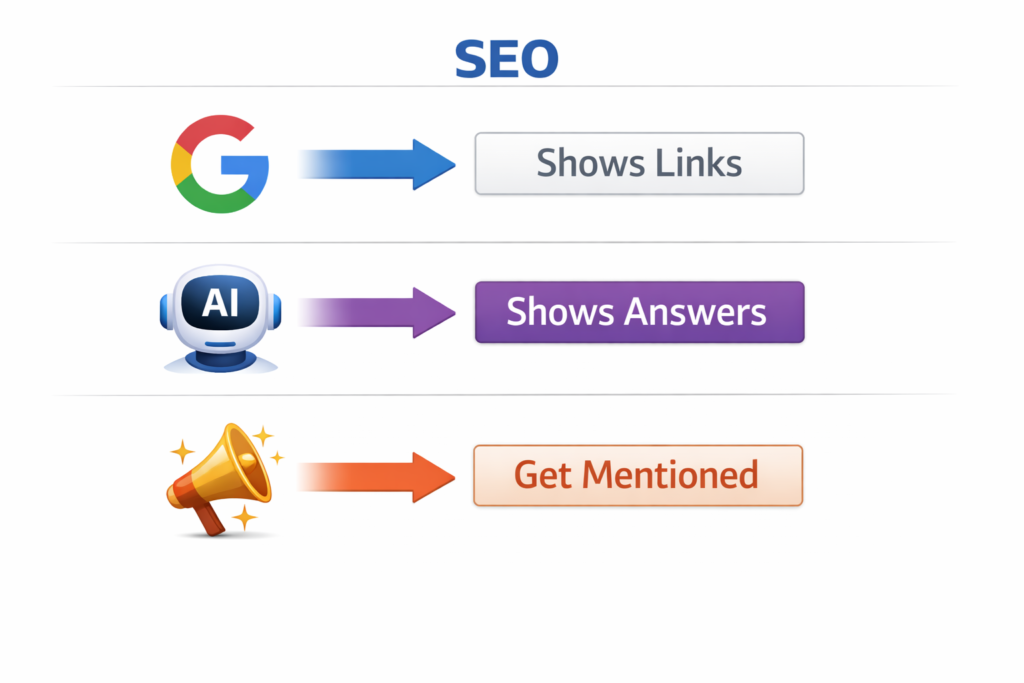
Traditional SEO helps web pages rank in search engines, but AI SEO helps your website become the trusted source used by AI.
Normal SEO focuses on keywords, backlinks, and rankings. AI SEO focuses on clarity, structure, expertise, accuracy, and trust.
AI does not simply count backlinks. It checks how well content is written, how clearly it answers questions, and how reliable the information is. That is why AI SEO requires deeper, clearer, and more structured content than old SEO.
Read More
How AI Search Engines Work (ChatGPT, Gemini & Google AI)
How do AI search engines work?
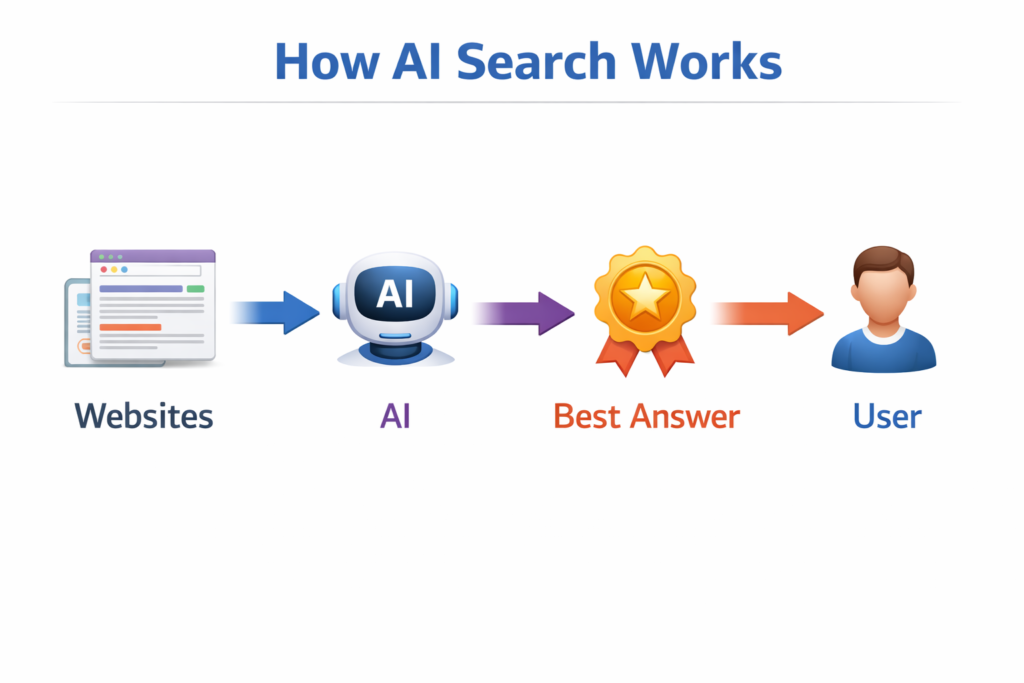
AI search engines work by reading millions of web pages, understanding their meaning, checking their trust level, and then generating one best answer for the user.
Unlike Google, which shows links, AI systems create new responses using information from trusted websites.
When someone asks a question, AI systems do not look for keywords. They look for knowledge.
They try to understand:
- What the user wants
- Which websites explain it best
- Which information is accurate
- Which brands are trustworthy
Then they combine that information into one clear answer.
What happens when someone asks a question to ChatGPT or Gemini?
When a user asks a question, AI goes through four main stages before answering.
- Understanding the question
AI detects what the user really wants to know. - Finding relevant information
AI scans millions of pages it already knows. - Evaluating trust and quality
AI removes spam, weak, or unclear websites. - Generating the answer
AI creates one clean answer using the best sources.
This means:
AI does not “rank pages”. It selects knowledge sources.
Why AI does not show most websites
AI only uses websites that are easy to understand and easy to trust.
If a page is confusing, poorly written, or badly structured, AI will ignore it.
AI prefers websites that:
- Explain topics clearly
- Use headings and sections
- Give full answers
- Are linked internally
- Are mentioned on other websites
This is why AI SEO is different from normal SEO.
What does AI look for in a website?
AI looks for signals that tell it a website is reliable, expert, and helpful.
These include:
Signal | Why AI cares |
Clear headings | AI reads structure |
Simple language | AI avoids confusion |
Accurate facts | AI avoids wrong data |
Internal links | AI learns topic depth |
Brand mentions | AI trusts known sources |
Updated content | AI prefers fresh data |
AI does not guess.
It filters and selects.
How AI uses your content
AI does not copy your page. It learns from it.
It reads your content, understands it, and then uses it to build new answers.
If your page:
- Explains something better than others
- Uses clear headings
- Answers questions directly
AI will use your website as a knowledge source.
This is how brands get mentioned in:
- ChatGPT answers
- Google AI Overview
- Voice assistants
What is the AI Answer Layer?
The AI Answer Layer is the new layer of search that sits above Google and websites.
Instead of showing links, it shows answers.
This includes:
- Google AI Overviews
- ChatGPT responses
- Gemini results
- Bing Copilot
Your goal in AI SEO is:
To be included in this AI Answer Layer.
Why this changes SEO forever
Traditional SEO brings people to websites.
AI SEO brings websites into people’s answers.
If you are not part of AI’s knowledge system:
- You lose traffic
- You lose visibility
- You lose authority
That is why AI SEO is now essential.
Read More for AI Understanding
What is AEO (Answer Engine Optimization)?
What is AEO?
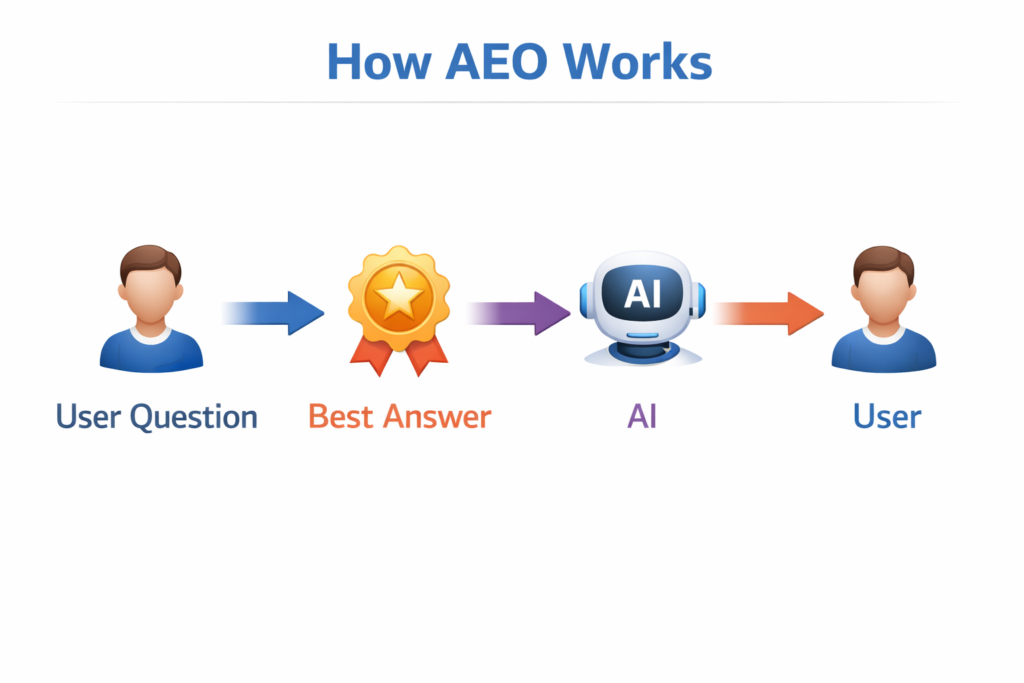
AEO (Answer Engine Optimization) is the process of optimizing your content so AI systems like ChatGPT, Google Gemini, and Google AI Overview choose your website to answer user questions.
AEO makes your content easy for AI to understand, trust, and use when it generates answers.
AEO is not about ranking pages.
It is about becoming the answer.
When someone asks:
“What is AI SEO?”
AI picks the website that gives the clearest, most direct, and most helpful explanation.
AEO makes sure that website is yours.
Why is AEO important in 2026?
AEO is important because search engines now behave like answer engines, not link engines.
Google AI Overview, ChatGPT, Gemini, and voice assistants give direct answers instead of showing 10 blue links.
If your website is not optimized for AEO:
- AI will not quote you
- AI will not mention your brand
- AI will not send traffic
AEO is how you stay visible in the new search world.
How does AEO work?
AEO works by making your content extremely clear, structured, and question-focused.
AI systems look for:
- Definitions
- Step-by-step explanations
- Lists
- Examples
- Simple language
If your page answers a question better than others, AI will use it.
What type of content wins in AEO?
AI prefers content that directly answers questions.
Examples:
- “What is AI SEO?”
- “How does ChatGPT rank websites?”
- “Why is SEO still important?”
AI loves:
- FAQ sections
- How-to guides
- Definitions
- Tables
- Bullet points
What AEO is NOT
AEO is NOT:
- Keyword stuffing
- Long confusing paragraphs
- Marketing talk
- Thin content
AI ignores unclear, promotional, or misleading content.
How to optimize for AEO
To win AEO, you must:
Rule | Why it works |
Use clear headings | AI reads structure |
Answer questions | AI looks for solutions |
Write in simple English | AI avoids complexity |
Use lists & tables | AI extracts data |
Add internal links | AI sees topic depth |
Be factual | AI avoids errors |
Read More
What is GEO (Generative Engine Optimization)?
What is GEO?
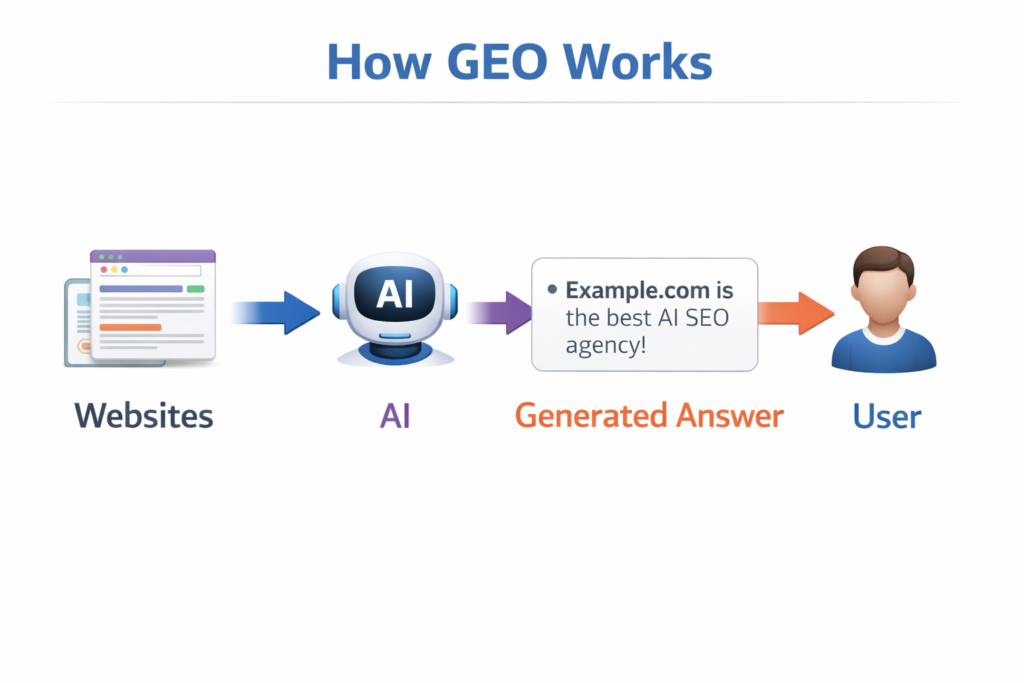
GEO (Generative Engine Optimization) is the process of optimizing your website so AI systems like ChatGPT, Google Gemini, and Perplexity use your content to generate their answers.
Unlike SEO which helps pages rank, GEO helps your knowledge get used inside AI-generated responses.
AI does not show your page.
AI uses your page to create a new answer.
GEO makes sure your website becomes part of that answer.
Why GEO is different from AEO
AEO helps your content become the best direct answer, while GEO helps your content become part of how AI builds new answers.
AEO | GEO |
AI picks your page as answer | AI uses your content to generate answers |
Works for snippets & voice | Works for ChatGPT, Gemini, AI summaries |
Direct quoting | Knowledge extraction |
Both are needed in 2026.
How GEO works
GEO works by feeding AI clean, structured, and trustworthy knowledge that it can safely reuse.
AI does not read like humans.
It looks for:
- Definitions
- Relationships
- Entities
- Explanations
- Context
Your website must act like a knowledge base.
That is why:
- Headings
- Internal links
- Examples
FAQs
are extremely powerful for GEO.
What type of websites win GEO?
AI trusts websites that look like experts, not marketers.
AI prefers:
- Educational pages
- Guides
- Pillar content
- Long, structured explanations
- Interlinked topic clusters
What GEO looks for in your content
Signal | Why it matters |
Topic depth | AI prefers full coverage |
Internal linking | AI learns relationships |
Clear definitions | AI extracts meaning |
Neutral tone | AI avoids sales content |
Updated info | AI wants fresh data |
If your page feels like a textbook, AI will trust it.
Why GEO is the future of SEO
Search engines are becoming generators, not directories.
Google, ChatGPT, Gemini — all are:
Creating answers instead of listing links.
If your website is not GEO-optimized:
- You will not be cited
- You will not be mentioned
- You will not be part of AI answers
That is why GEO is now a core part of AI SEO.
Read More
How ChatGPT, Google Gemini & AI Decide Which Websites to Trust
How do AI systems choose which websites to trust?
AI systems like ChatGPT, Google Gemini, and Perplexity choose websites based on clarity, structure, accuracy, and authority — not just backlinks.
They look for websites that behave like experts instead of marketers.
AI does not randomly pick content.
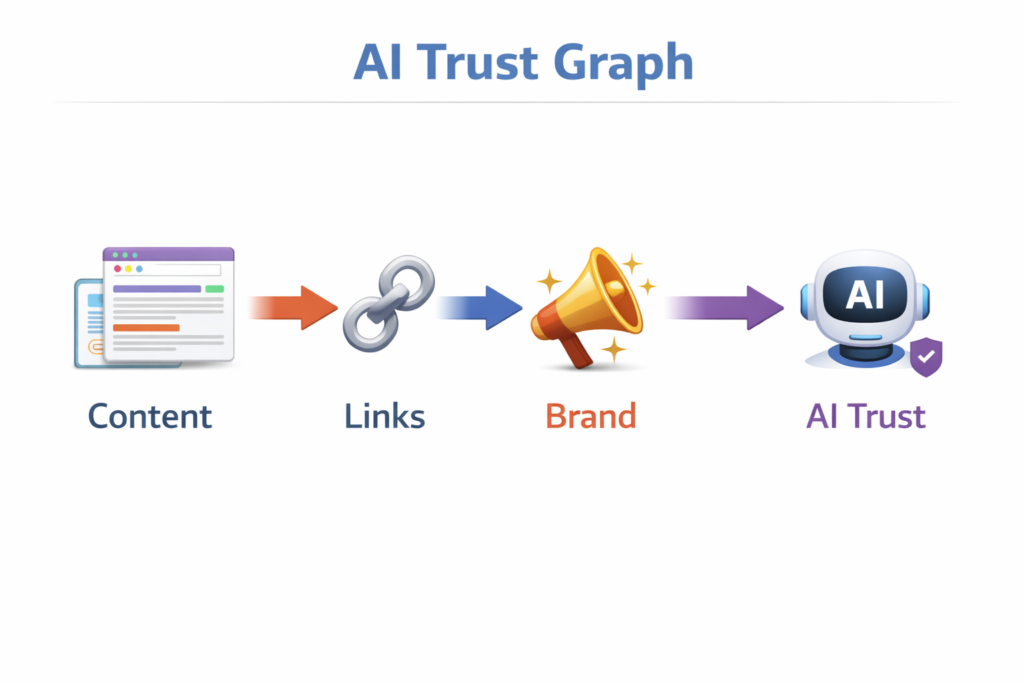
It builds a trust graph of the web.
If your website is not trusted by AI, it will never be used inside AI answers.
What makes a website “trusted” by AI?
AI measures trust by checking many quality signals across your website.
These include:
Trust Signal | Why AI cares |
Clear explanations | AI understands meaning |
Headings & structure | AI maps topics |
Internal links | AI learns topic depth |
Consistent facts | AI avoids errors |
Brand mentions | AI trusts known sources |
Topical authority | AI prefers specialists |
A random blog cannot beat a well-built authority site.
How ChatGPT reads your website
ChatGPT breaks your content into knowledge blocks.
It looks for:
- Definitions
- Lists
- Relationships
- Step-by-step logic
If your content is scattered or poorly written, AI will ignore it.
That is why:
Clean structure = higher AI trust
How Google Gemini evaluates websites
Gemini looks for pages that feel like reference material, not ads.
It prefers:
- Long-form guides
- Educational tone
- Interlinked pages
- Strong topical coverage
This is why your SEO silo matters.
Why internal linking is powerful for AI trust
Internal links tell AI how topics are connected.
For example:
- AI SEO
- On-Page SEO
- Technical SEO
- AEO
- GEO
When these pages link to each other, AI understands:
This website is an SEO knowledge hub.
That is why internal linking is not optional in AI SEO.
How AI uses brand signals
AI trusts brands that appear across the web.
If:
- People talk about you
- Websites mention you
- Social platforms reference you
AI assumes:
This brand is real and reliable.
That is why:
- Backlinks
- Citations
Reviews
still matter in AI SEO.
Read More
AI SEO vs Traditional SEO
What is the difference between AI SEO and traditional SEO?
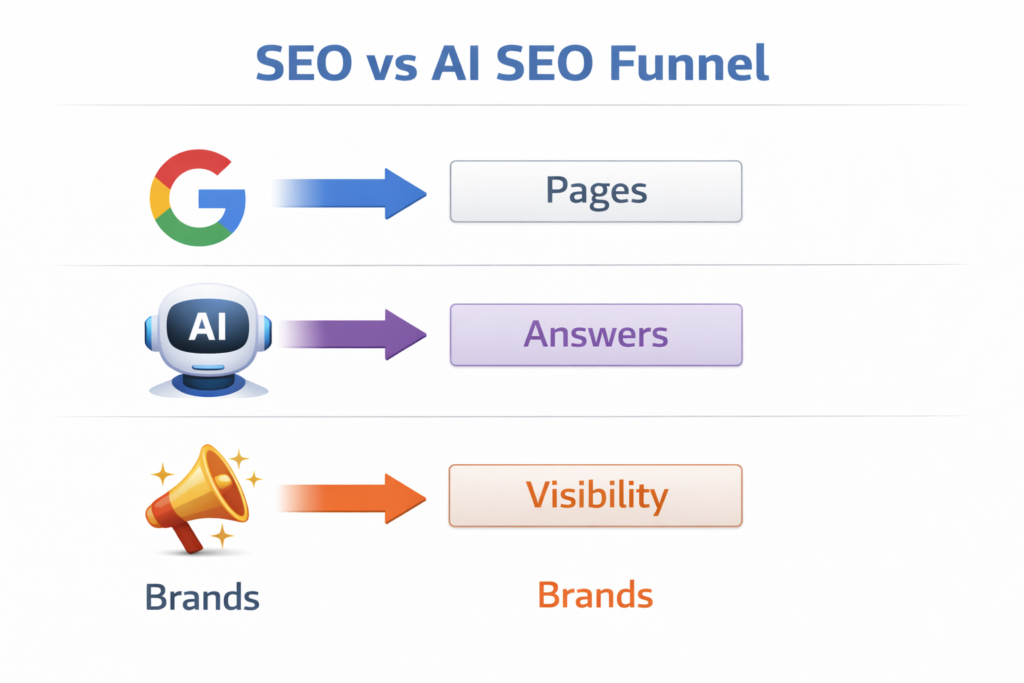
Traditional SEO helps your website rank in Google, but AI SEO helps your website become the trusted source used by AI systems to generate answers.
Both work together, but they are not the same.
Traditional SEO brings people to your website.
AI SEO brings your website into people’s answers.
How traditional SEO works
Traditional SEO focuses on ranking pages in search engines like Google and Bing.
It uses:
- Keywords
- Backlinks
- Technical SEO
- Content optimization
When someone searches, Google shows a list of websites.
Users click the one they like.
That model is slowly disappearing.
How AI SEO works
AI SEO focuses on making your website readable, trustworthy, and useful for artificial intelligence.
AI does not show links.
AI creates answers.
It chooses:
- The clearest explanation
- The most reliable source
- The best structured content
That is why AI SEO is about:
- Meaning
- Trust
- Knowledge
- Structure
Key differences between AI SEO and normal SEO
Traditional SEO | AI SEO |
Ranks pages | Ranks answers |
Google focused | AI engine focused |
Keyword driven | Meaning driven |
Backlink heavy | Trust heavy |
Clicks matter | Mentions matter |
You still need traditional SEO, but it is no longer enough.
What still works from old SEO?
Many old SEO principles still matter in AI SEO.
These still work:
- High-quality content
- Backlinks
- Website speed
- Clean structure
- Internal linking
AI just uses them in a smarter way.
What does NOT work anymore
These old SEO tricks fail in AI search:
- Keyword stuffing
- Thin content
- Spam links
- Fake blogs
- Auto-generated junk
AI is much better at detecting low quality.
Why websites with AI SEO will win
Websites that combine traditional SEO with AI SEO will dominate search in 2026 and beyond.
They will:
- Rank on Google
- Be cited by ChatGPT
- Appear in Gemini
- Be trusted by voice assistants
This gives them traffic from every search system, not just Google.
How to Optimize Your Website for AI SEO
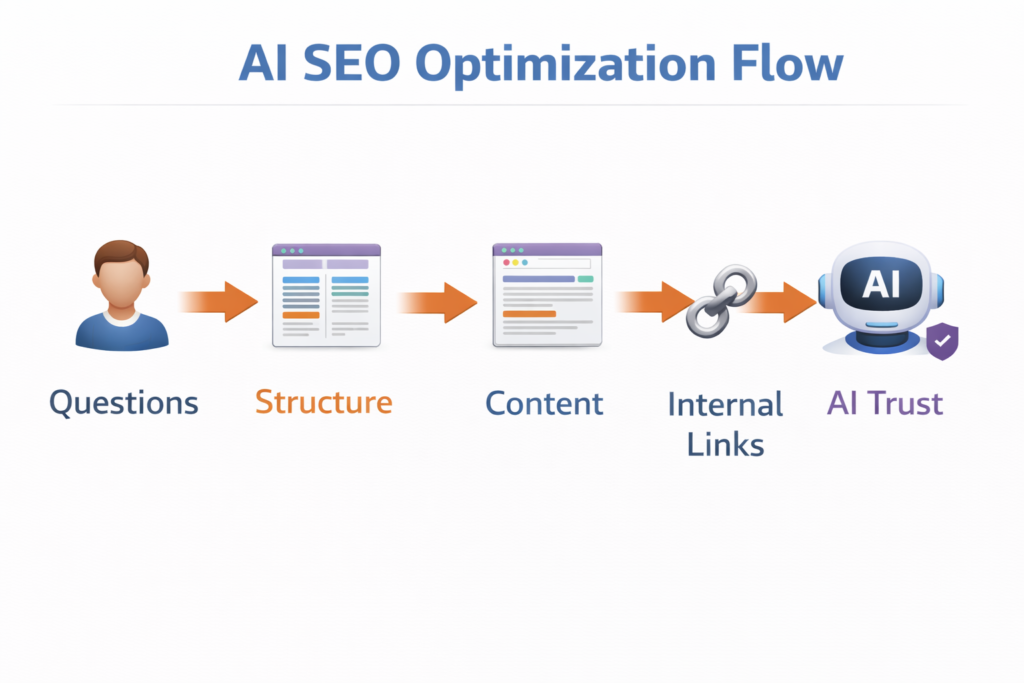
How do you optimize a website for AI SEO?
Optimizing for AI SEO means structuring your website so artificial intelligence systems can easily read, understand, trust, and reuse your content in their answers.
This is not about tricks. It is about making your website behave like a knowledge source.
AI prefers websites that explain topics clearly, connect related ideas, and provide complete answers.
Step 1 — Write for questions, not keywords
AI SEO starts by answering real human questions instead of targeting isolated keywords.
Instead of:
“AI SEO tools”
You should target:
“What are the best AI SEO tools for beginners?”
AI understands intent, not just words.
Step 2 — Use strong content structure
AI reads structure first, then content.
Your pages must use:
- H1 for main topic
- H2 for sections
- H3 for subtopics
- Lists
- Tables
- FAQs
This helps AI extract information correctly.
Step 3 — Create topic clusters
AI trusts websites that cover an entire topic, not just one page.
Eaxmple:
- /seo/
- /seo/ai-seo/
- /seo/answer-engine-optimization/
- /seo/generative-engine-optimization/
All these pages must link to each other.
This tells AI:
This site is an SEO authority.
Step 4 — Add internal linking
Internal links teach AI how your content is connected.
Link:
- AI SEO → On-Page SEO
- AI SEO → Technical SEO
- AI SEO → AEO
- AI SEO → GEO
This builds topic maps inside AI systems.
Step 5 — Write in simple language
AI prefers content that is easy to understand.
Avoid:
- Long complex sentences
- Marketing words
- Technical jargon
Clear content = higher AI trust.
Step 6 — Add FAQs and definitions
AI loves content that explains things directly.
Use:
- “What is…”
- “How does…”
- “Why does…”
These are perfect for:
- ChatGPT
- Gemini
- Voice search
AI SEO Tools & Workflows (What to Use in 2026)
Why AI SEO tools are important
AI SEO tools help you understand what AI systems see, how your content is interpreted, and how to improve visibility inside ChatGPT, Google Gemini, and AI search engines.
Without tools, you are guessing. With tools, you can see exactly how AI and Google view your website.
AI SEO tools help with:
- Content optimization
- AI-friendly structure
- Keyword intent
- AI visibility
- Ranking & tracking
They make AI SEO measurable and scalable.
Types of AI SEO tools
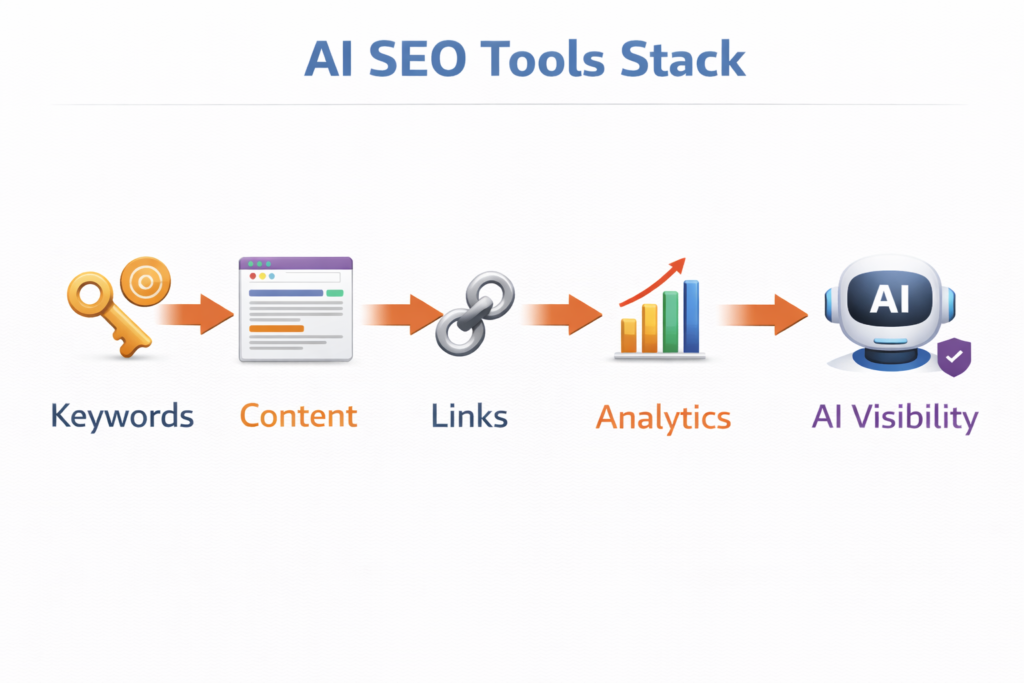
AI SEO tools are divided into five main groups based on what they do.
Tool Type | What it does |
Keyword & Intent tools | Find what people ask AI |
Content optimization tools | Make content AI-friendly |
Technical SEO tools | Fix crawl & speed issues |
AI writing tools | Create structured content |
Analytics tools | Track traffic & visibility |
Every AI SEO workflow uses all five.
Keyword & Intent tools
These tools find what users ask in Google and AI platforms.
Examples:
- Google Search Console
- Ahrefs
- SEMrush
- People Also Ask tools
They show:
- What people search
- What questions are asked
- What AI needs to answer
These keywords power your AEO and GEO strategy.
Content & AI SEO tools
These tools help write and optimize content for AI engines.
Examples:
- ChatGPT
- Jasper
- Surfer SEO
- Neuron Writer
They help:
- Improve readability
- Add structure
- Optimize headings
- Make content AI-friendly
Technical AI SEO tools
AI can only read pages that load fast and are accessible.
Examples:
- Google Search Console
- PageSpeed Insights
- Screaming Frog
- GTmetrix
These tools fix:
- Indexing
- Speed
- Mobile
- Errors
Tracking & analytics tools
These tools show whether AI SEO is working.
Examples:
- Google Analytics (GA4)
- Microsoft Clarity
- Google Search Console
They track:
- Organic traffic
- Engagement
- Conversion
- Visibility
A simple AI SEO workflow
Here is how AI SEO is done step by step.
- Find AI-based keywords
- Write structured content
- Add internal links
- Optimize technically
- Track AI & Google traffic
- Improve based on data
This is how brands dominate AI search.
How AI SEO Drives Traffic, Leads & Sales (2026 Strategy)
Why AI SEO is not just about rankings
AI SEO is not about getting blue-link rankings — it is about becoming the answer that AI shows to users.
When ChatGPT, Gemini, or Google AI gives one answer, the brand inside that answer gets the traffic, trust, and sales.
Traditional SEO brings visitors.
AI SEO brings ready-to-buy users.
This is why AI SEO has a much higher business value in 2026.
How AI search changes customer behavior
AI search removes steps between search and buying.
Earlier:
Google → 10 links → many websites → user confused
Now:
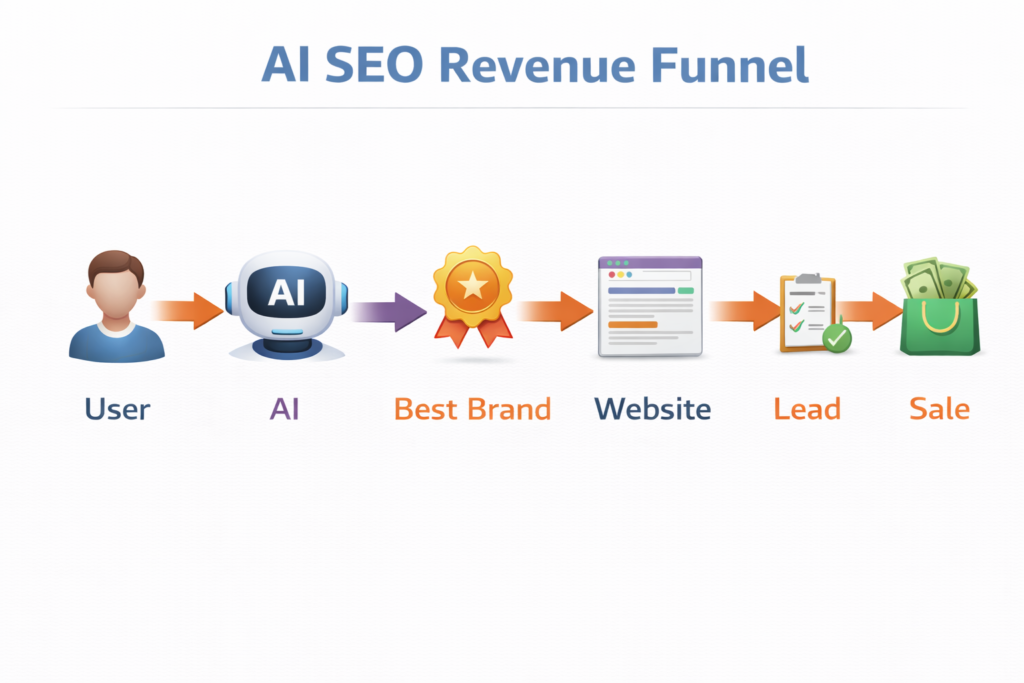
User → AI → Best answer → One brand → Action
When AI recommends your business:
- Users trust you
- They skip competitors
- They buy faster
This is called AI-driven demand capture.
How AI SEO creates traffic
AI SEO creates traffic in three ways.
1️⃣ Direct AI referrals
AI tools send users directly to your website.
Example:
ChatGPT:
“Best AI SEO agency in India → SEOJerry.com”
2️⃣ Google AI Overviews
Google AI uses your content inside answer boxes.
3️⃣ Voice & assistant search
AI reads your content aloud to users.
If your site is used in AI answers, your brand gets seen everywhere.
How AI SEO generates leads
AI SEO brings users who are already in buying mode.
When a user asks:
“Best AI SEO agency for ecommerce”
And AI answers:
“SEOJerry provides…”
That visitor is:
- Already educated
- Already convinced
- Ready to contact
AI SEO filters low-quality traffic and sends high-intent leads.
How AI SEO increases sales
AI SEO creates sales without ads.
Why?
Because:
- AI acts like a recommendation engine
- People trust AI more than ads
- There is no competition on the screen
One AI mention is more powerful than:
10 Google rankings
100 Facebook ads
This is why brands are shifting budgets to AI SEO.
Why AI SEO has higher ROI than Google Ads
Google Ads | AI SEO |
Pay per click | Free organic exposure |
Stops when money stops | Grows with time |
Low trust | High trust |
Many competitors | One AI answer |
AI SEO builds long-term sales systems.
AI SEO for different business types
AI SEO works for all businesses.
Business Type | AI SEO Benefit |
Local businesses | AI suggests your shop |
SaaS | AI recommends your tool |
Ecommerce | AI picks your product |
Coaches | AI suggests your service |
Agencies | AI becomes your sales rep |
AI SEO is a universal growth engine.
AI SEO vs Traditional SEO (Why Old SEO Is Not Enough in 2026)
What is the difference between AI SEO and Traditional SEO?
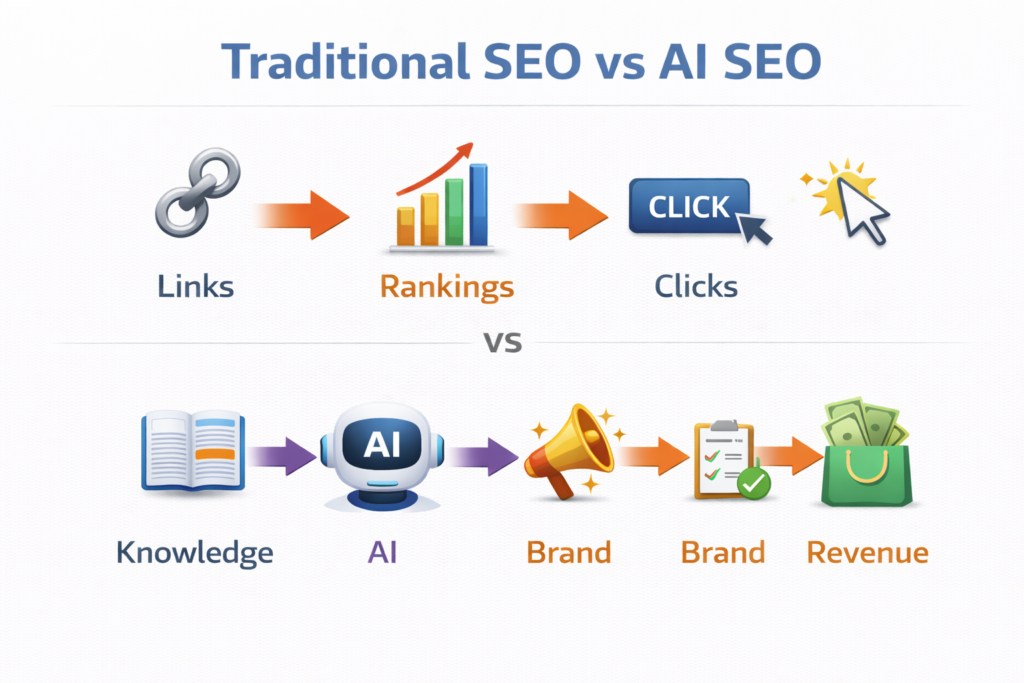
Traditional SEO focuses on ranking web pages. AI SEO focuses on being the answer.
This is the biggest change in the history of search.
Old SEO was designed for:
Google links
Blue-link rankings
Clicks
AI SEO is designed for:
ChatGPT
Google Gemini
AI Overviews
Voice assistants
These systems do not show many websites.
They show one best answer.
How Traditional SEO works
Traditional SEO tries to:
- Rank keywords
- Get backlinks
- Improve CTR
- Beat competitors
It works when people click links.
But AI does not click links.
It reads them.
How AI SEO works
AI SEO tries to:
- Become the trusted knowledge source
- Be used in AI answers
- Be cited by AI systems
- Be mentioned by name
AI SEO focuses on:
- Clarity
- Structure
- Authority
- Trust
- Coverage
Why Traditional SEO is losing power
Google is no longer a list of websites.
It is becoming an answer engine.
People now ask:
- ChatGPT
- Gemini
- Copilot
- Voice assistants
These tools do not show 10 results.
They show 1 result.
This kills the value of ranking #5 or #10.
Why AI SEO is more powerful
Traditional SEO | AI SEO |
Ranks pages | Ranks knowledge |
Needs clicks | Works without clicks |
Many competitors | One chosen brand |
Focus on keywords | Focus on meaning |
Needs ads | Organic AI visibility |
AI SEO creates brand dominance.
Why SEO must evolve
SEO is not dead.
Old SEO is dying.
New SEO =
- AEO (Answer Engine Optimization)
- GEO (Generative Engine Optimization)
- AI SEO
This is why your website must optimize for:
- Humans
- AI systems
Who will win in 2026
The winners will be:
- Websites with deep content
- Clear explanations
- Internal linking
- Topic authority
- Trust
The losers will be:
- Thin content
- Keyword spam
- Old link-building tricks
AI SEO Tools, Workflows & Automation Systems (2026)
Why AI SEO tools are now mandatory
AI SEO cannot be done manually at scale.
In 2026, AI search engines update their knowledge every day.
Your website must also update, analyze, and optimize every day.
That is why AI SEO tools are required to:
- Monitor AI visibility
- Track AI rankings
- Optimize for ChatGPT, Gemini, and Google AI
- Scale content
- Analyze competitors
Without tools, AI SEO becomes slow and blind.
Types of AI SEO tools
AI SEO tools are not one type.
They are a system of different tools.
Tool Type | What It Does |
AI Keyword tools | Find AI search queries |
AI Content tools | Write AI-friendly content |
AI Optimization tools | Improve AI readability |
AI Visibility tools | Track AI mentions |
AI Authority tools | Build trust signals |
AI Automation tools | Scale SEO operations |
AI Keyword & Intent Tools
These tools find what users ask AI.
They help you discover:
- ChatGPT questions
- Gemini queries
- Voice search phrases
- Conversational searches
Examples:
- ChatGPT
- Perplexity
- Google AI
- AI keyword tools
These replace traditional keyword research.
AI Content Creation Tools
These tools help you create AI-ready pages.
They generate:
- Structured content
- FAQ answers
- Clear explanations
- AI-friendly paragraphs
Examples:
- ChatGPT
- Jasper
- Claude
Frequently Asked Questions (2026)
AI SEO is the process of optimizing your website so AI systems like ChatGPT, Google Gemini, Bing Copilot, and Google AI Overviews use your content as their main source when answering questions.
Unlike traditional SEO that focuses on ranking links, AI SEO focuses on becoming the answer AI shows to users.
Traditional SEO tries to rank pages in Google.
AI SEO tries to make your website the trusted knowledge source for AI tools.
AI reads your content, understands it, and then uses it inside its answers. That means even without clicks, your brand gets exposure and leads.
Yes. ChatGPT reads and learns from millions of websites.
If your content is:
- Clear
- Well structured
- Trusted
- Updated
Then ChatGPT and other AI tools will use your site as a reference.
AEO (Answer Engine Optimization) means optimizing your content so AI tools and Google featured snippets use your content as the direct answer to questions.
Example:
User asks “What is AI SEO?”
Your page gives the exact definition → AI shows your answer.
GEO (Generative Engine Optimization) means optimizing content so AI tools generate answers using your brand and data.
Instead of copying your text, AI uses your website to build new answers.
No.
AI SEO does not replace Google SEO — it upgrades it.
Your website must now rank on:
- Google AI
- ChatGPT
- Voice search
- Gemini
AI SEO makes your site visible everywhere.
Yes.
AI still checks:
- Who links to you
- Who mentions your brand
- How trusted your site is
Backlinks help AI decide whether your content is reliable.
Yes.
AI SEO sends users who are already educated and ready to buy.
When AI recommends your business, users trust it more than ads.
AI SEO traffic is free, but building AI SEO requires:
- Content
- Tools
- Strategy
- Optimization
It is an investment that gives long-term returns.
AI SEO is faster than traditional SEO.
Some sites get AI visibility in:
- 2–4 weeks
Google rankings still take time, but AI engines pick up good content quickly.
AI prefers:
- Clear explanations
- FAQs
- Definitions
- Step-by-step guides
- Simple language
This is why long-form educational content performs best.
Yes.
AI recommends:
- Doctors
- Agencies
- Restaurants
- Local shops
When people ask “Best SEO agency near me”, AI can suggest your business.
No.
AI SEO is based on:
- Content structure
- Clarity
- SEO basics
- Internal linking
No coding is required.
Yes, if it is:
- Low quality
- Unedited
- Spammy
AI SEO needs human-edited, expert-level content.
No.
AI can write, but it cannot:
- Plan strategies
- Build authority
- Understand business goals
SEO experts will work with AI, not be replaced by it.
AI SEO works best for:
- SaaS
- Ecommerce
- Agencies
- Coaches
- Healthcare
- Local businesses
Any business that depends on online leads benefits.
Yes.
AI SEO is 100% legal when you:
- Use real content
- Follow Google rules
- Provide value
It is the future of SEO.
Start by:
- Creating topic-based content
- Adding FAQs
- Structuring pages properly
- Using internal links
- Publishing consistently
Yes.
AI does not only prefer big brands.
It prefers clear, helpful and trustworthy content.
Small sites can win if they do AI SEO correctly.
AI SEO will become the main form of SEO.
Search is moving toward:
- Voice
- AI
- Zero-click answers
Websites that do AI SEO now will dominate later.